



Recruiting senior employees directly in Ho Chi Minh City often takes considerable time, yet candidates may still withdraw or leave soon after joining. This consumes leadership time and puts pressure on recruitment budgets. This 2026 update on headhunter fees in Ho Chi Minh City helps employers assess their options and choose a cost-effective approach to hiring.
How are headhunter fees calculated in Ho Chi Minh City?
Headhunter fees pay for a recruitment service. They represent an investment based on the value of the role and the scarcity of relevant expertise in the labour market.
In a major economic centre such as Ho Chi Minh City, recruitment firms base their fees on 3 core factors: the compensation budget for the role, its seniority—specialist, middle management or C-level—and the engagement model agreed with the employer.
Fees as a percentage of first-year compensation
This established pricing model accounts for more than 85% of recruitment contracts in the Ho Chi Minh City market today.
The fee is a percentage of the successfully placed candidate’s total first-year compensation. Rates typically range from 15% to 25% and can reach 30% for roles where suitable candidates are exceptionally scarce.
For CFOs and HR managers preparing recruitment budgets, the calculation is:
[Total first-year compensation] = [Fixed gross monthly salary x 12 or 13 months] + [Fixed allowances, if applicable].
Note: Variable performance bonuses, including KPI bonuses, car allowances and employee stock awards (ESOP) are generally excluded unless a specific agreement applies to a senior appointment.
Consider this practical example from Ho Chi Minh City’s 2026 market: an employer seeks a marketing manager in District 1 with a guaranteed gross salary of VND 50,000,000 per month and a contractual 13th-month salary. The agreed recruitment fee is 20%.
- The candidate’s total first-year compensation: 50,000,000 x 13 = VND 650,000,000.
- The employer’s recruitment fee: 650,000,000 x 20% = VND 130,000,000.
The percentage increases with the difficulty of the assignment. Fees for general office administration roles typically range from 15% to 18%; IT, digital and fintech roles range from 20% to 22%; and executive search assignments for directors and C-level leaders consistently fall within the 25%–30% range.
Contingency fees and retainer fees: understanding the difference
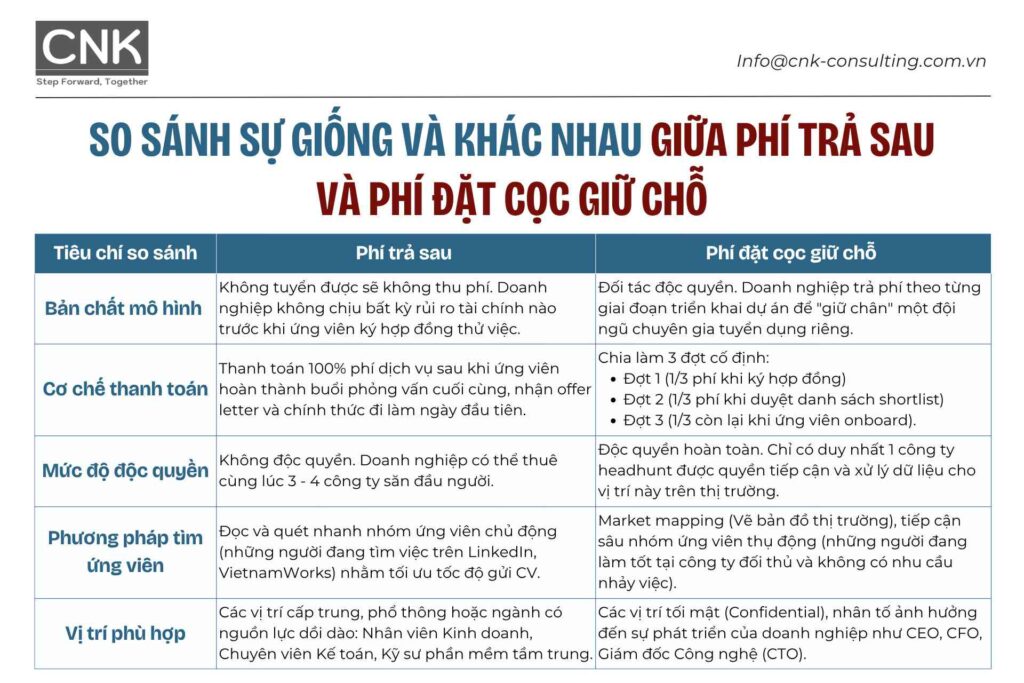
To choose a service model suited to the role, employers need to understand 2 main payment arrangements: contingency fees and retainer fees.
The distinction extends beyond payment timing. It also reflects the recruitment firm’s level of commitment and approach to finding candidates.
The shift towards fixed fees for SMEs in 2026
Ho Chi Minh City’s economy entered 2026 with strong growth in small and medium-sized enterprises (SMEs) and startups.
For these employers, paying VND 100–200 million upfront for a single placement under the traditional salary-percentage model can create a substantial financial burden and disrupt short-term cash flow.
This pressure has driven a new pricing trend in Ho Chi Minh City’s 2026 recruitment market: fixed fees.
Under a fixed-fee model, the recruitment firm and employer agree on a single all-inclusive fee for each assignment at the outset. The fee remains unchanged regardless of the candidate’s eventual negotiated gross salary.
Fixed fees are gaining significant traction in Ho Chi Minh City in 2026 because:
- SMEs need greater control over recruitment budgets. Knowing the fee in advance supports financial planning without tying costs to the candidate’s salary.
- Demand for volume recruitment is growing. Retail, FMCG, logistics and e-commerce employers often recruit for several roles simultaneously, making fixed fees a more cost-effective option.
- Increasing competition among recruitment firms is prompting many providers to offer more flexible service packages to attract clients.
Fixed-fee recruitment is expected to continue growing strongly among SMEs in 2026, while retained search is expected to remain the dominant model for senior appointments and strategic roles.
Average headhunter fees in Ho Chi Minh City in 2026
Headhunter fees depend on seniority, expected salary, candidate scarcity, sector, the time required to complete the assignment and the replacement guarantee.
As a result, fees for the same role can vary considerably between providers.

Fee ranges for general and office roles
General and back-office roles consistently attract strong recruitment demand in Ho Chi Minh City, but employee turnover is also high.
Fees in this segment remain stable at 15%–18% of total first-year compensation. Alternatively, employers can choose a fixed fee equivalent to 1.5–2 months of base salary.
Typical roles include sales executives, HR officers, general accountants and digital marketing specialists.
Because candidates in this segment are relatively plentiful on platforms such as LinkedIn, recruitment firms generally use contingency fees. The employer pays only after the candidate passes the interviews and formally starts work.
Recruitment fees for mentors, C-level leaders and senior specialists
Executive search for chief executive officers (CEOs), chief financial officers (CFOs), chief operating officers (COOs) and strategic advisers remains a demanding undertaking for employers across Ho Chi Minh City.
Fees in this segment consistently sit at the upper end of the market, ranging from 25% to 30% of total annual compensation. This reflects the confidentiality of the assignment and the role’s influence on the organisation.
Strong C-level candidates in Ho Chi Minh City are generally not actively looking for work. These passive candidates are already contributing to competing corporations.
To reach them, executive search consultants conduct extensive talent mapping, approach candidates discreetly through private professional networks and hold 3–5 screening interviews to assess core competencies before presenting them to the employer.
Given the workload and opportunity cost, executive search firms generally require a retained search or exclusive engagement. The employer pays part of the fee—approximately 30%—upon signing to secure the firm’s strongest resources and full attention for the assignment.
Specialist recruitment pricing: IT, finance & green energy in Ho Chi Minh City
In 2026, the 3 sectors with the fastest-growing headhunter fees in Ho Chi Minh City are information technology (IT), finance and investment, and renewable and green energy.
The main driver is a shortage of highly qualified professionals alongside continually rising hiring demand.
- IT & high technology: Employers in the high-tech park in Thu Duc City and Quang Trung Software City face persistent difficulty finding AI engineers, data scientists and solutions architects. Recruitment fees for these roles typically approach 25%. Contracts often include an off-limits clause committing the recruitment firm not to solicit the employer’s own employees for 1–2 years.
- Finance & banking: International investment funds relocating to District 1 are driving demand for risk analysts, portfolio managers and CFOs. Fees of 22%–24% are considered the benchmark for candidates with clean professional records, international credentials such as CFA or CPA, and valuable client networks.
- Green energy & smart cities: This is a new feature of Ho Chi Minh City’s 2026 market. FDI enterprises investing in green infrastructure, rooftop solar or carbon credit advisory services need engineers with exceptionally scarce technical expertise. Fees are not based solely on gross salary: many recruitment firms also charge a supplement according to the length of the candidate search.
Less visible factors that affect recruitment fees
When reviewing headhunter quotations, many employers focus on the headline figure: 15%, 20% or 25% of total first-year compensation, or a fixed fee for each role.
In practice, the candidate’s salary is only part of the calculation. Several less visible aspects of the recruitment process also influence the fee.
These factors may not be clearly stated in the initial quotation, yet they directly affect pricing, hiring timelines, the number of candidates presented and the assignment’s success rate.
Employers should understand these factors before signing an agreement, particularly in Ho Chi Minh City’s competitive labour market.
Candidate scarcity in Ho Chi Minh City’s labour market
Candidate scarcity is among the most significant influences on recruitment fees. A management role with a plentiful candidate pool may attract an average market fee.
Fees are usually substantially higher when the role requires specialist skills, rare experience or the ability to influence revenue directly.
In Ho Chi Minh City, this scarcity takes 2 main forms:
- Scarcity of emerging skills: Rapid growth in AI, Big Data and semiconductor projects at the high-tech park has sharply increased demand for AI engineers, cloud solutions specialists and data experts. Very few professionals have the required practical digital capabilities, forcing recruitment firms to invest substantial resources in finding them.
- Scarcity of combined skills: A standard chief accountant search in Ho Chi Minh City attracts a fee of approximately 18%. If an FDI enterprise also requires fluent business Chinese (HSK 5–6) or Japanese (N2 or above) to work directly with its parent company, the fee immediately rises to 22%–25%, as the candidate pool shrinks by as much as 90%.
Greater scarcity means higher fees because the recruitment firm must invest more time, data and consulting resources.
Consultant reputation and proprietary candidate databases
Another less visible influence on fees is the consultant’s personal reputation and the quality of the recruitment firm’s proprietary candidate database.
Candidate data means more than a collection of CVs. A valuable database includes candidates’ capabilities, career histories, compensation expectations, reasons for considering a move, cultural fit, industry relationships and willingness to discuss new opportunities.
Recruitment firms and consultants with extensive experience in a particular sector often have strong networks of passive candidates. This helps explain why 2 firms may quote different fees for the same role.
Personal credibility is especially influential in searches for managers, specialists and C-level leaders. Senior candidates are willing to engage only when they believe the consultant understands their sector, can maintain confidentiality and can provide sound career advice.
The employer is therefore paying for the consultant’s trusted relationships, reputation and professional network as well as the recruitment service.
Urgent start dates and confidential search requirements
The final factors behind these less visible costs are time pressure and the level of confidentiality required.
- Urgent start dates: An executive search assignment typically takes 45–60 days to complete. If an employer needs a replacement or must fill a vacancy within 15–20 days to keep a new project on schedule, the recruitment firm must accelerate the search. This requires pausing other assignments and directing the entire team towards calls, outreach and talent mapping around the clock. The surcharge for this time pressure typically ranges from 3% to 5% of the total contract value.
- Strict project confidentiality: Some assignments are sensitive: an employer may be replacing an underperforming senior employee or quietly preparing to expand a product line to compete with a rival. All candidate approaches must remain anonymous, with the employer’s identity withheld until the final interview. Consultants must strictly observe confidentiality agreements. Managing this information discreetly requires experienced executive search professionals, which keeps fees high.
Replacement guarantees and refunds: assessing value for money
Employers comparing recruitment firms should look beyond the initial fee.
A low quotation may offer little saving without a clear replacement guarantee. A higher fee may be justified if the firm commits to finding a replacement, helping manage risks and providing a transparent refund mechanism when a placement fails.
Before signing, employers should examine 3 important groups of terms: replacement guarantees, proportionate refunds and contractual responsibilities if a candidate ghosts.
Free replacement within 60–90 days
A free replacement clause is among the most important commitments in a recruitment services agreement. It allows the employer to request a replacement search if a placed candidate leaves during the guarantee period.
Standard guarantee periods generally start at 60 days for specialist roles and range from 90 to 180 days for middle and senior management roles.
If the candidate resigns during this period, or the employer must terminate their employment because they lack the required professional capabilities—as demonstrated by a clear probationary KPI assessment—the recruitment firm is responsible for:
- Immediately restarting the search for the same role.
- Finding, screening and presenting a replacement candidate at no additional charge.
- Ensuring the replacement meets or exceeds the original agreed selection criteria.
Our recruitment specialists advise employers to review guarantee exclusions carefully. Recruitment firms will decline a free replacement if the candidate leaves because of restructuring, redundancies, changes to the original job description or delayed salary payments that affect the employee’s interests.
Proportionate refunds when a candidate leaves early
Alongside replacement guarantees, some employers seek a refund mechanism for early departures. This is a sensitive contractual issue: not every recruitment firm agrees to refunds, particularly after investing substantial resources in a search.
Modern recruitment contracts in Ho Chi Minh City in 2026 use a refund calculation based on the candidate’s actual days of service, rather than retaining 100% of the employer’s payment. The refund percentage decreases as the candidate’s service length increases:
- The candidate leaves within the first 30 days: A refund of 70%–80% of the total service fee paid.
- The candidate leaves between day 31 and day 60: A refund of 40%–50% of the service fee.
- The candidate leaves between day 61 and day 90, for senior appointments: A refund of 20%–30% of the service fee.
For a refund mechanism to work in practice, the agreement must clarify 4 points:

- Whether the refund is a cash repayment or a credit towards the next assignment.
- Whether the guarantee period starts when the offer is signed, when the candidate starts work or when the employment contract is signed.
- The circumstances in which the employer loses its entitlement to a refund.
- The deadline for processing the refund once the candidate’s departure is confirmed.
Employers should go beyond asking “Is a refund available?” and establish when it applies, what percentage is refundable, how it will be paid and how long payment will take.
Candidate ghosting and contractual protections in 2026
Ghosting occurs when a candidate suddenly stops communicating: they do not reply to messages, attend interviews, confirm an offer or, even after accepting an offer, arrive on their agreed start date.
There are 2 common forms of ghosting that directly harm employers:
- A candidate accepts an offer letter and commits to a start date, then switches off their phone and cuts off contact when that date arrives.
- A candidate works for only 3–5 days, finds the environment falls short of expectations and leaves without notice.
To protect employers against this risk, recruitment services agreements in 2026 need clear service-level commitments and specific contractual penalties:
- Link payment deadlines to actual service: The agreement should state that the final instalment—or the full fee for a contingency assignment—is payable only after the candidate has completed at least 10–15 working days, rather than on their first day.
- Penalties for missed deadlines: If a candidate ghosts immediately before their start date, the recruitment firm must provide a replacement shortlist within 7–14 working days. If it fails to present suitable candidates within that period, the employer should have the right to terminate the agreement unilaterally, with the firm required to refund 100% of the upfront retainer, where applicable, and pay a contractual penalty equivalent to 5%–10% of the service package value.
- Exclusivity and professional conduct: The agreement should prohibit the recruitment firm from approaching, soliciting or recruiting away a candidate it has successfully placed with the employer throughout that candidate’s employment, or for at least 24 months from their start date.
Should employers recruit internally or engage a recruitment firm?
Deciding whether to recruit internally or engage a recruitment firm is a difficult decision for managers in Ho Chi Minh City. Many business owners see fees of 15%–25% and assume internal recruitment will cost less.
The answer becomes less straightforward when all financial and time costs are considered.
The hidden costs of running an internal HR function
Employers recruiting internally often count only visible expenses, such as HR salaries. The total cost of ownership (TCO) for an internal senior recruitment process is usually much higher because of the following hidden costs:
- Subscriptions and job advertising tools: Accounts with platforms such as LinkedIn Recruiter, VietnamWorks, TopCV and Anphabe cost tens of millions of VND annually.
- Operating costs and leadership time: Screening hundreds of unsuitable CVs and interviewing the wrong candidates consumes dozens of working hours for department heads and CEOs.
- Opportunity costs: Leaving a sales manager or project director position vacant for 3–6 months means lost opportunities to gain market share and revenue declines running into billions of VND.
- The risk of an unsuccessful hire: If an internally recruited employee fails to complete the 2-month probationary period successfully, the employer loses all the operating expenditure above and must restart the process.
Managing the budget: when to recruit internally and when to outsource
To optimise recruitment budgets in 2026, employers in Ho Chi Minh City should allocate resources flexibly:
Use an internal recruiter when:
- The employer needs volume recruitment for general labour, internships or entry-level and junior positions.
- Candidates are readily available and the interview process is straightforward.
- The employer is developing its employer brand over the long term.
Outsource the full assignment to a recruitment firm when:
- A confidential search is needed to replace an employee or expand into a new project without alerting competitors.
- The employer seeks C-level leaders, experts or specialist technical professionals in AI, semiconductors or fintech who are passive candidates and never submit CVs themselves.
- An SME needs to fill a vacancy within 15–30 days to meet business deadlines, while its internal HR team is already overstretched.
Conclusion
Headhunter fees in Ho Chi Minh City in 2026 can vary considerably by role, candidate scarcity and service quality. Choosing the right recruitment firm saves time and reduces the risk of an unsuccessful hire, helping employers manage workforce costs over the long term.
CNK Consulting Vietnam
Comprehensive executive search and specialist recruitment advisory and delivery in Vietnam
Hotline: +84 369 882 579
Email: info@cnk-consulting.com.vn
Address: 12BT6 Thanh Bình Garden, No. 3 Nguyễn Cảnh Dị, Định Công Ward, Hanoi, Vietnam
References:
- DevsData – How Much Does it Cost to Hire a Headhunter: True Costs (The actual costs of engaging a talent search professional).
- Investopedia: What Is a Headhunter? What They Do and How They’re Paid (The role of a headhunter, their work and how they are paid).
- Hunter Recruiting: How Much Do Executive Search Firms Charge? (Fees charged by executive search firms).