

Confidential search is a strategic recruitment solution that enables businesses to hire key talent while protecting sensitive business information. It is commonly delivered through professional headhunter services to ensure both hiring accuracy and the highest level of confidentiality. This article explores how confidential search works, its key benefits, and why it is essential for executive and strategic hiring.
Confidential search recruitment context and challenges
Finding senior executives or highly specialized professionals has always been a major challenge for businesses.
For sensitive or strategic positions in particular, the hiring process becomes even more complex, requiring the highest level of discretion and professionalism through a confidential search approach.
What is confidential search recruitment and why is it important?
Confidential search recruitment is the process of identifying and recruiting talent without publicly disclosing information about the position, the hiring company, or the reason behind the recruitment.
Definition of confidential search recruitment
During periods of business growth or organizational restructuring, there are positions that companies cannot publicly advertise in the job market. In such cases, confidential search serves as the optimal recruitment solution.
This recruitment approach is conducted discreetly, with limited information shared to ensure confidentiality and protect the interests of both the hiring company and candidates.
This approach is commonly used for the following positions:
- Strategic positions: Roles that have a significant impact on the company’s direction and future (e.g., a Chief Technology Officer (CTO) for a new product launch).
- Sensitive positions: When replacing an existing employee or creating a new role where disclosure could disrupt internal operations, making confidential search essential.
- Executive positions: Leadership and C-suite roles that require the highest level of confidentiality and the most rigorous selection process.
Confidential search is more than simply keeping recruitment information private. It is a strategic hiring approach that enables businesses to protect their reputation, maintain organizational stability, and secure the right talent at the most critical moments.
Risks of recruiting executive positions in-house
In-house recruitment can be a cost-effective solution. However, for executive or strategic positions, managing the hiring process internally carries significant risks. A single information leak can trigger a chain reaction, affecting the company’s reputation, employee morale, and overall business strategy.
Some of the most common risks include:
- Causing internal disruption: When news of a leadership replacement spreads, existing employees may become uncertain, lose motivation, or lose confidence in the company’s leadership.
- Exposing business strategies: Competitors may gain insight into expansion plans, new product initiatives, or business direction, allowing them to gain a competitive advantage. This is one of the key reasons companies choose confidential search for strategic hiring.
- Creating unnecessary pressure: Publicly advertising executive-level vacancies may discourage qualified candidates from applying, especially those currently holding similar positions at other organizations.
For these reasons, confidential search is a specialized recruitment solution that enables businesses to secure the right talent while protecting their strategic interests and maintaining internal stability.
Common challenges of in-house recruitment
Even highly capable HR teams can face significant challenges when managing a confidential search recruitment process.
Limited resources and executive talent network
- Limited reach: In-house HR teams are often restricted to traditional recruitment channels. They typically lack the extensive, exclusive professional networks that experienced executive headhunters have, making confidential search more challenging.
- Limited proactive outreach: Executive-level professionals are often passive candidates who are successful in their current roles and are not actively seeking new opportunities. As a result, in-house HR teams may find it difficult to identify, engage, and persuade them.
Challenges in maintaining recruitment confidentiality
Any in-house recruitment activity is more susceptible to information leaks through the company’s communication channels, employees, or even candidate profiles posted on public platforms. This directly undermines the core objective of a confidential search process.
Opportunity costs and extended hiring timelines
Executive recruitment can take three to six months. When handled internally, the process may take even longer due to limited experience and the lack of a specialized executive talent network. As a result, businesses may miss critical market opportunities and delay key strategic initiatives.
When does your business need a headhunter?
Not every role requires the support of a headhunter. However, at critical turning points, hiring the right person at the right time becomes essential to a company’s growth.
When internal resources are limited, hiring timelines are tight, confidentiality is critical, or the position is strategic and directly impacts the company’s future direction, a headhunter becomes a trusted strategic partner.
Through a confidential search approach, businesses can identify and secure top talent more efficiently, discreetly, and with greater confidence.
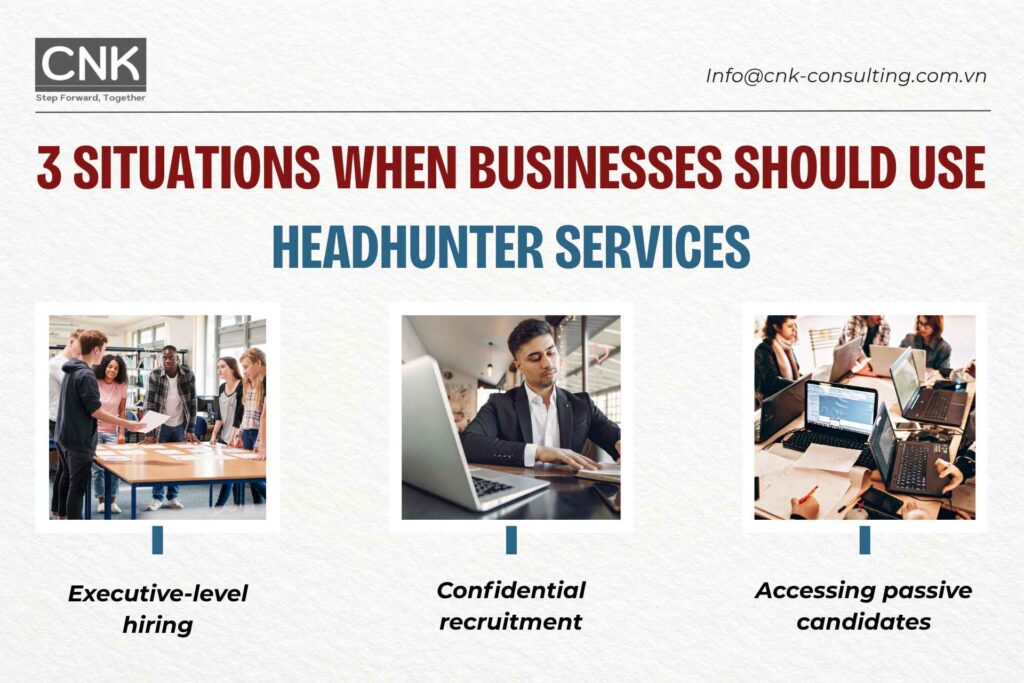
Executive hiring needs
When speed and hiring quality become top priorities, partnering with a professional headhunter delivers clear advantages.
Whether a business needs to fill an executive position urgently or is searching for highly specialized talent in a competitive market, a headhunter acts as an extension of the internal recruitment team – reducing time-to-hire, optimizing resources, and ensuring complete confidentiality through a confidential search process.
Hiring key leadership positions
Roles such as CEO, CFO, COO, CMO, and Business Unit Directors require strategic leadership, long-term vision, and deep industry expertise. Managing these searches internally often results in longer hiring cycles, overlooked talent, or insufficient assessment capabilities.
Executive headhunters are specifically equipped to solve these challenges. They not only reduce successful hiring time by 30–50% but also ensure:
- Hiring the right talent: Candidates are thoroughly assessed for their experience, leadership capabilities, and alignment with the company’s culture.
- Hiring at the right time: Headhunters can reach passive candidates – high-caliber professionals who are not actively seeking new opportunities but are the right fit for the role through a targeted confidential search approach.
Hiring highly specialized and hard-to-find talent
- One of the biggest challenges businesses face today is finding talent in niche industries where the supply of qualified professionals is extremely limited. Examples include artificial intelligence (AI) specialists, chip design engineers, and market development directors for highly specialized sectors.
- In these situations, partnering with a specialized headhunter is often essential. Through a targeted confidential search process, they leverage high-quality talent databases, deep industry expertise, and exclusive relationships with qualified candidates whom businesses are unlikely to reach through traditional recruitment channels.
Absolute confidentiality requirements
This is one of the primary reasons businesses turn to confidential search services. When recruitment involves strategic or sensitive positions that could significantly impact the organization, maintaining confidentiality is not just a preference – it is a critical requirement.
In these situations, headhunters serve as trusted partners, ensuring complete discretion throughout the entire talent identification and selection process.
Replacing existing key personnel
One of the most common scenarios requiring a confidential search is the replacement of an existing key employee. If this information is disclosed prematurely, it may lead to data loss, workflow disruption, employee poaching, or negative effects on team morale.
With a carefully designed recruitment process, headhunters represent the hiring company when approaching potential candidates while keeping the employer’s identity strictly confidential until the final stages of the interview process. This enables businesses to protect internal operations and ensure a smooth leadership transition.
Entering new markets or launching undisclosed strategic projects
When a business is preparing to expand into a new market or launch a strategic project that has not yet been announced, every aspect of the recruitment process must be handled with the highest level of confidentiality.
For example, an international company may need to hire a Country Manager for the Vietnamese market before its official market entry, or a business may be developing “Project X” and require a project lead before the public launch.
In these situations, headhunters act as a layer of protection through a confidential search process, representing the business while withholding its identity, strategic plans, and commercial objectives from candidates until the appropriate stage.
This allows companies to attract the right talent while safeguarding critical business strategies before they are publicly announced.
Need to reach passive candidates
Many highly qualified professionals are well established in their current roles and are not actively seeking new career opportunities.
When businesses need to engage these passive candidates, a headhunter provides the expertise to connect with them discreetly, build trust, and encourage them to consider the right opportunity through a targeted confidential search process.
- Headhunters’ network – a gateway to passive candidates: Approximately 70% of senior executives and highly skilled professionals are securely employed and are not actively looking for new opportunities. Through advanced sourcing and headhunting techniques, headhunters can engage these passive candidates in a discreet and effective manner. They present new career opportunities by highlighting career growth, leadership prospects, and the company’s long-term vision, encouraging candidates to explore new opportunities while maintaining the highest level of professionalism and confidentiality through a confidential search process.
- Company culture analysis and in-depth talent assessment: Headhunters do more than identify qualified candidates – they also ensure a strong cultural fit between the candidate and the organization. They conduct comprehensive competency assessments, perform thorough screening, and evaluate each candidate’s ability to adapt to the client’s working environment. This approach helps businesses reduce the risk of mis-hires while improving long-term talent retention.
Benefits of headhunter services and how to choose the right partner
Partnering with a headhunter not only addresses immediate executive hiring needs but also forms part of a long-term talent acquisition strategy. It enables businesses to access scarce, high-caliber talent, reduce time-to-hire, and improve the quality of hiring decisions.
Through a professional, confidential search process, companies can secure the right candidates while minimizing recruitment risks and protecting sensitive business information.
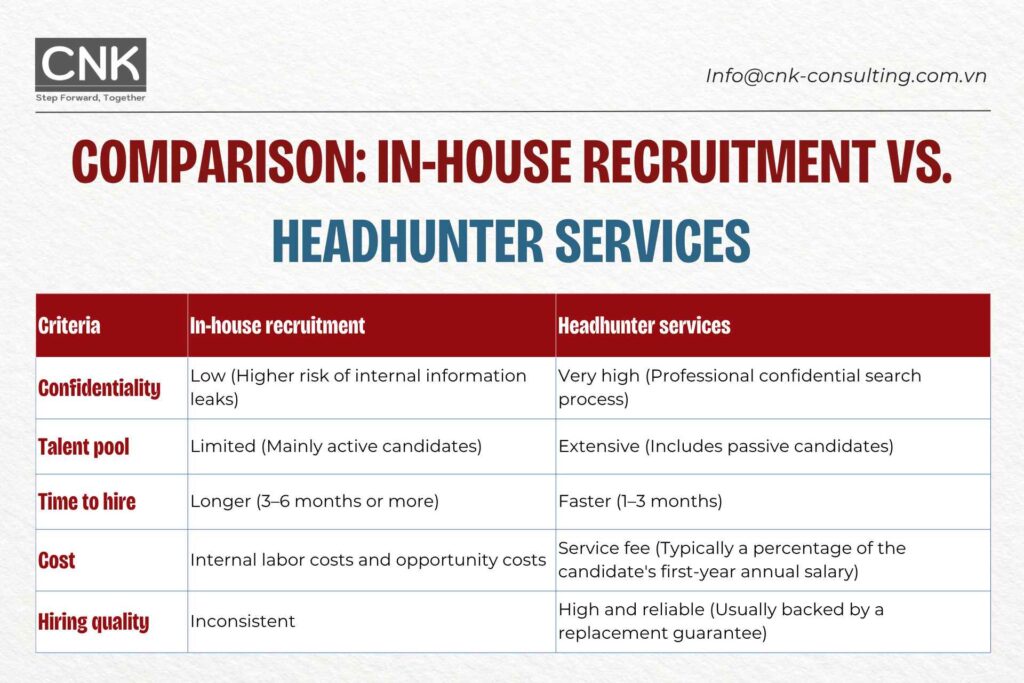
Comparison: In-house recruitment vs. headhunter services
The table below compares in-house recruitment and headhunter services across key factors, including hiring timelines, costs, access to talent, and the level of confidentiality provided throughout the recruitment process.
Criteria for choosing a specialized executive headhunter
To ensure the success of a confidential search, businesses should carefully select a headhunting partner that meets the following criteria:
- Proven expertise in your industry and executive recruitment: Prioritize headhunting firms with dedicated consultants specializing in your industry – such as banking, IT, manufacturing, or healthcare – as they possess extensive talent networks and a deep understanding of executive hiring requirements.
- A robust confidential search process: Ensure the headhunter signs a non-disclosure agreement (NDA) before any information is shared. Ask about their confidential search methodology, including how they manage sensitive information and approach candidates without revealing your company’s identity.
- Service guarantees and replacement policy: Reputable headhunting firms typically provide a three- to six-month replacement guarantee. If a placed candidate leaves during the guarantee period, they will source a replacement at no additional cost. This reflects the firm’s confidence in the quality of its candidate selection and recruitment process.
Key considerations when partnering with a headhunter
Partnering with a headhunter is a critical component of an effective executive hiring and confidential search strategy.
To maximize success, businesses should follow a structured process that ensures faster hiring, high-quality candidate selection, and strict confidentiality throughout every stage of the engagement.
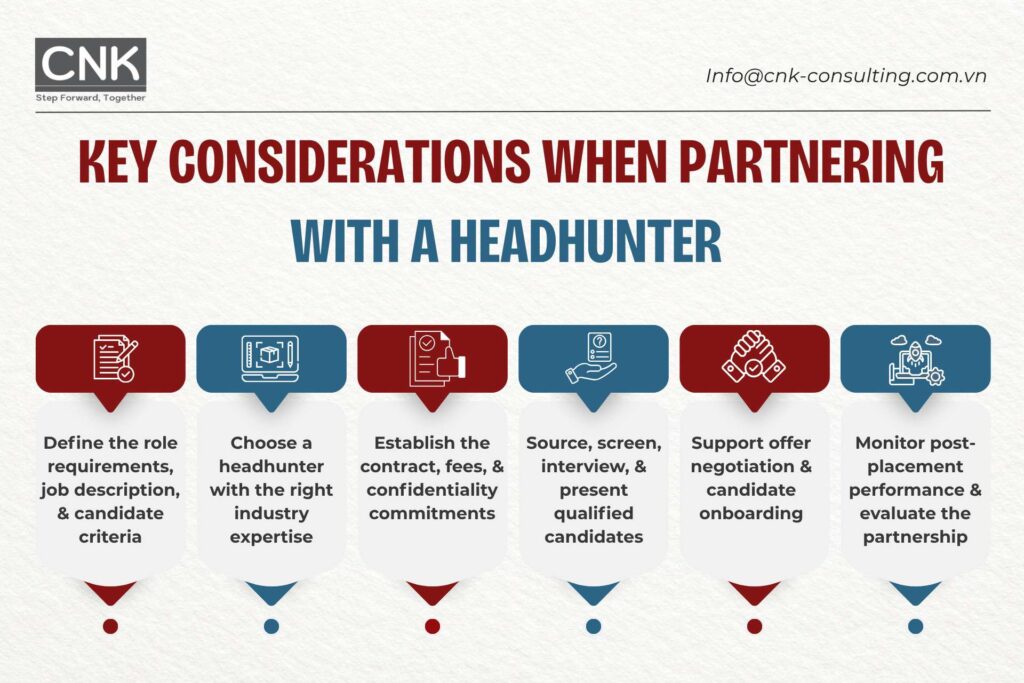
Define the role requirements, job description, and candidate criteria
The first step is to clearly define the role requirements, develop a detailed job description, and establish candidate selection criteria. This should include key responsibilities, technical expertise, required experience, and cultural fit. A well-defined brief enables the headhunter to fully understand the hiring needs, shortening the screening process and increasing the success rate of the confidential search.
Choose a headhunter with the right industry expertise
Not every headhunter is the right fit for every industry. Businesses should evaluate a firm’s industry expertise, executive recruitment experience, and talent network. Choosing the right partner significantly improves access to high-caliber candidates, particularly for niche specialties and C-level positions.
Establish the contract, fees, and confidentiality commitments
Once a headhunting partner has been selected, the next step is to finalize a detailed agreement covering service fees, project timeline, scope of work, and confidentiality obligations. A clearly defined contract protects the interests of both parties while providing a solid legal framework for a professional confidential search engagement.
Source, screen, interview, and present qualified candidates
The headhunter identifies and approaches potential candidates before screening them against the agreed criteria. They then conduct preliminary interviews, assess competencies, perform reference checks, and present a shortlist of qualified candidates. This structured confidential search process ensures that every recommended candidate has been thoroughly evaluated for both capability and cultural fit.
Support offer negotiation and candidate onboarding
A headhunter’s role extends beyond candidate sourcing. They also facilitate negotiations on compensation, benefits, and employment terms to help both parties reach a mutually beneficial agreement. After the offer is accepted, they continue to support the onboarding process, ensuring a smooth transition and helping the new hire integrate quickly into the organization.
Monitor post-placement performance and evaluate the partnership
Following the successful placement, both the business and the headhunter should evaluate the hiring outcome, including the candidate’s performance, cultural fit, and early contributions to the organization. This stage also provides an opportunity to strengthen the long-term partnership and refine the recruitment process for future confidential search assignments.
>> Explore CNK Consulting Vietnam’s headhunting services to improve the recruitment of mid-level and senior-level professionals.
Conclusion
A confidential search does more than protect sensitive business information – it enables companies to secure strategic talent at the moments that matter most.
By partnering with a professional headhunter, businesses can ensure that every stage of the recruitment process, from talent sourcing and candidate assessment to offer negotiation and onboarding, is handled with complete discretion, efficiency, and strategic alignment.
A well-structured confidential search process not only helps organizations hire the right talent but also safeguards their employer brand and strengthens their long-term competitive advantage.
CNK Consulting Vietnam
Helping businesses build high-performing teams
Hotline: +84 369 882 579
Email: info@cnk-consulting.com.vn
Địa chỉ: 12BT.6 Thanh Binh Garden, 3 Nguyen Canh Di, Dinh Cong, Ha Noi, VietNam
Nguồn tham khảo:
- ManpowerGroup: What is executive search service? (Confidential recruitment is a core characteristic of executive headhunting services).
- Hunter Recruiting: What is Executive Search? (Core Differences from Traditional Recruitment).
- ASTRAL Executive Search: Confidential executive search (Confidential recruitment is not just about keeping information private; it is also a risk management strategy for executive hiring).