



A headhunter contract is an important document that helps businesses clearly understand service fees, candidate replacement guarantees, and the responsibilities of both parties. Understanding these terms allows companies to minimize potential risks when working with a headhunter.
What is a headhunter contract?
A headhunter or recruitment contract is a fundamental legal document that determines the success and transparency of the senior-level recruitment process.
Understanding and controlling the terms of the contract not only helps businesses find suitable candidates but also prevents legal risks and future disputes over service fees.
Definition of a headhunter contract
A headhunter contract is a service agreement between a business and a headhunter company providing recruitment services.
Under this agreement, the headhunter company commits to using its resources and expertise to search, screen, and introduce high-quality candidates for positions required by the business.
Unlike internal recruitment, headhunting services typically focus on senior-level or hard-to-fill positions. Therefore, a headhunter contract plays a crucial role in defining candidate criteria, collaboration methods, replacement guarantee policies, as well as regulations on information transparency.
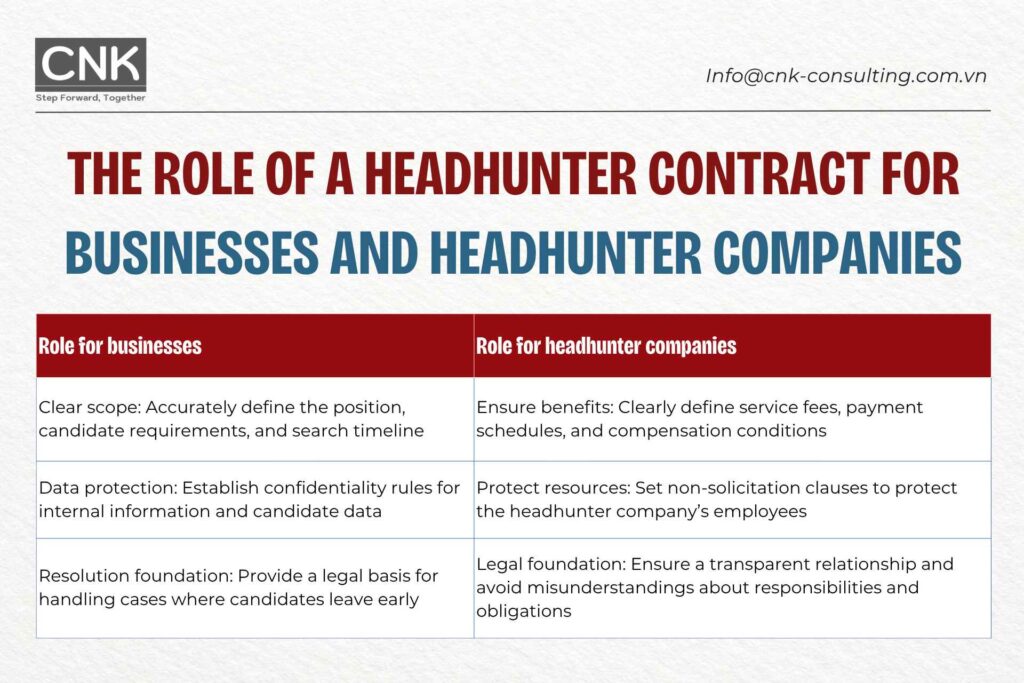
The role of a headhunter contract for businesses and headhunter companies
The role of a headhunter contract goes beyond defining the responsibilities of both parties. It also helps establish a transparent and effective foundation for cooperation between businesses and headhunter companies.
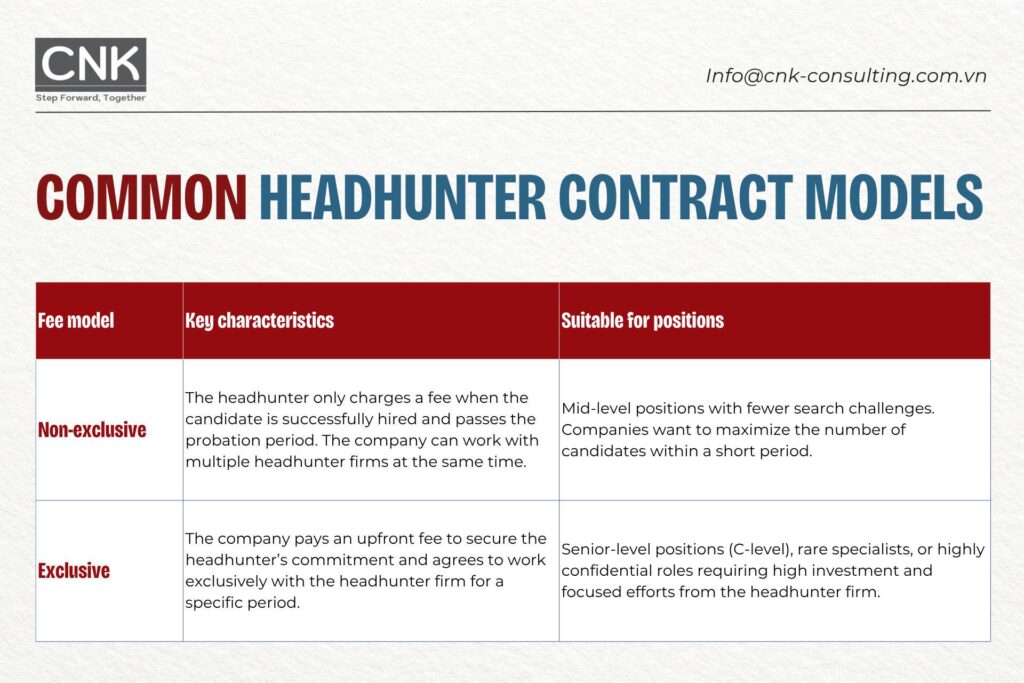
Classification of the most common headhunter contract models
The service fees and commitments between businesses and headhunter firms will vary depending on the selected headhunter contract model:
Benefits of signing a clear headhunter agreement
A well-structured headhunter agreement enables businesses to manage the entire recruitment process better. Transparent terms not only minimize misunderstandings but also establish a stable foundation for cooperation between the company and the headhunting partner.
As a result, recruitment quality is improved while potential risks are significantly reduced.
Reducing the risk of hiring the wrong candidate
A standardized agreement helps businesses maintain better control over recruitment standards. Terms related to job descriptions, candidate requirements, and the scope of the headhunter’s responsibilities are clearly defined from the beginning, ensuring a more consistent quality of candidate shortlists.
Additionally, candidate replacement guarantee clauses help businesses minimize risks after the candidate joins the company. Businesses can protect their interests if the candidate leaves prematurely or fails to meet expectations, reducing the possibility of a mis-hire.
Saving time and optimizing resources
When the agreement clearly specifies candidate submission timelines, collaboration processes, and delivery commitments, businesses can proactively organize their recruitment plans. Relevant departments can easily follow the timeline to prepare for interviews, assessments, and final hiring decisions.
Moreover, clearly defined responsibilities help reduce the workload for internal HR teams. Headhunters take charge of talent sourcing, screening, and initial assessments, while businesses can focus on their core operations and internal decision-making processes.
Transparency in fees, commitments, and responsibilities of both parties
A clear agreement allows businesses to understand headhunter fees, payment schedules, and related conditions. All terms are specified in detail to prevent misunderstandings or unexpected additional costs.
Furthermore, the contract clarifies the cooperation process and responsibilities of each party. Headhunters commit to candidate quality, progress updates, and continuous support throughout the recruitment journey.
Businesses are responsible for providing accurate information and timely feedback to ensure a transparent and efficient recruitment process.
6 key terms that must be included in a headhunter contract
To achieve maximum efficiency when working with a headhunter, businesses need to review the key headhunter service terms carefully. These terms not only provide a legal foundation to protect both parties’ rights but also ensure transparency in costs, timelines, and candidate quality.
Understanding each headhunter service term will help minimize risks, optimize the recruitment process, and ensure the highest effectiveness of the collaboration.
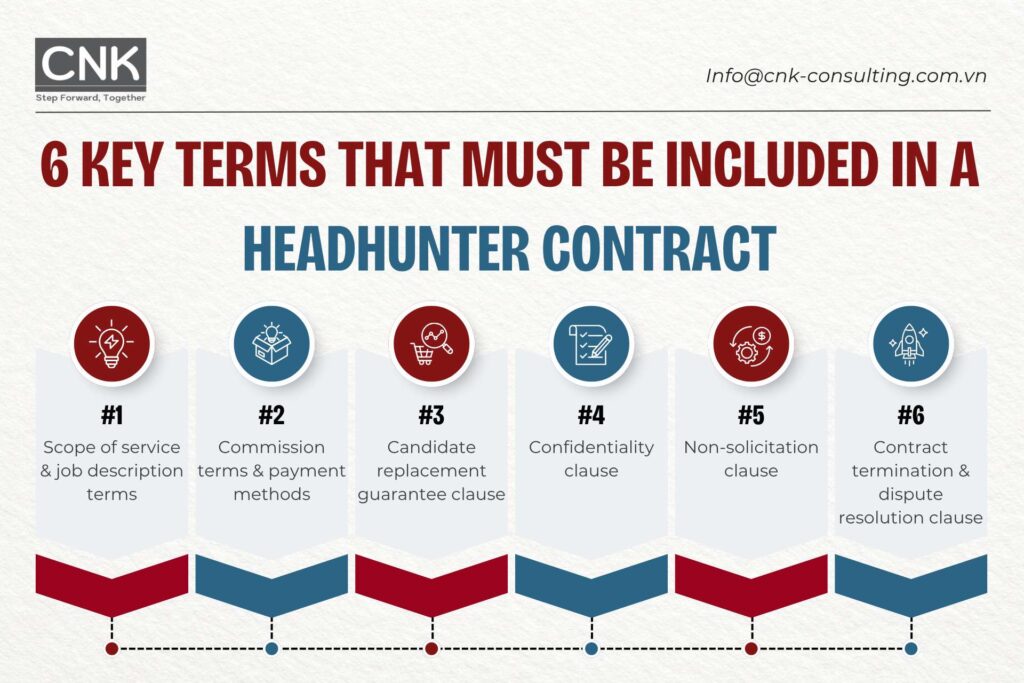
Scope of service and job description terms
Clearly defining the scope of service and recruitment position is an important step that helps businesses and headhunters align their expectations. This ensures that suitable candidates are presented, the recruitment process runs smoothly, and potential disputes are avoided in the future.
Recruitment position:
- Exact title of the position to be recruited.
- Department or functional unit.
- Position level and authority level (Junior, Senior, Manager, Director, etc.).
Candidate criteria:
- Experience: Number of years, professional expertise, and notable projects.
- Required technical skills and soft skills.
- Educational background, certifications, or mandatory qualifications.
- Additional requirements regarding foreign languages, technology, or target markets, if any.
Commission terms and payment methods
Commission terms and payment methods are the most important section of a headhunter contract, clearly defining how service fees are calculated and the payment schedule to ensure transparency and prevent disputes.
How headhunter service fees are calculated
- Headhunter fees are typically calculated as a percentage of the hired candidate’s total annual base salary. For example, if the service fee is 20% and the candidate’s annual base salary is VND 300 million, the headhunter contract service fee will be VND 60 million (excluding VAT).
- The percentage may vary depending on the position being recruited or the agreement between the company and the headhunter.
Some important considerations for businesses
- The headhunter contract should clearly specify the payment due date and accepted payment method.
- VAT, taxes, and any additional costs should be clearly defined to ensure transparency.
- If the candidate’s salary changes after being hired, the headhunter contract should clearly state how the service fee will be adjusted to protect both parties’ interests and maintain transparency.
Candidate replacement guarantee clause
The candidate replacement guarantee clause protects the company against the risk of a candidate leaving shortly after joining, while ensuring the headhunter contract clearly defines the headhunter’s responsibility for recruitment quality.
- Headhunter responsibilities: If the hired candidate resigns during the agreed guarantee period, typically within 30 to 90 days from the employment start date, the headhunter is responsible for sourcing and presenting a replacement candidate at no additional cost, as specified in the headhunter contract.
- Standard recruitment guarantee period: Most professional headhunter contracts include a recruitment guarantee period of 60–90 days. The company and the headhunter should clearly agree on the guarantee duration to avoid misunderstandings.
- Refund policy: If the headhunter is unable to provide a replacement candidate within the guarantee period, the headhunter contract should clearly specify whether the company is entitled to a partial refund of the service fee, ensuring the client’s interests are protected.
This clause helps businesses minimize the risk of hiring the wrong candidate while establishing a transparent framework for collaboration between the company and the headhunter, ensuring a smooth and effective recruitment process under the headhunter contract.
Confidentiality clause
The confidentiality clause protects the interests of both the company and the candidate throughout the recruitment process conducted under the headhunter contract.
- Company confidentiality: The headhunter must agree not to disclose any of the company’s confidential information, including business strategies, organizational structure, proposed salary ranges, or any other sensitive information, except where disclosure is necessary to candidates directly introduced for the relevant position, as permitted under the headhunter contract.
- Candidate confidentiality: The company must agree not to use candidate information provided by the headhunter for any purpose other than recruiting for the agreed position. All candidate data, resumes, and related information must be handled confidentially and used only within the scope of the headhunter contract.
Non-solicitation clause
This clause protects the headhunter’s interests, ensures fairness throughout the partnership, and helps prevent disputes related to recruitment activities under the headhunter contract.
- Scope of application: The company agrees not to directly hire any employees currently working for the headhunter firm for a specified period (typically 6–12 months) after the headhunter contract ends.
- Restriction scope: This clause defines the competing companies or market segments in which the headhunter agrees not to approach candidates on behalf of the company. It establishes clear boundaries for both parties when engaging with candidates, minimizes conflicts of interest, and promotes a transparent and fair working relationship.
Contract termination and dispute resolution clause
The contract termination and dispute resolution clause clearly defines the rights and obligations of both the company and the headhunter when either party wishes to terminate the headhunter contract before its expiration or when disputes arise.
- Contract termination conditions: Both parties should agree on the circumstances under which the headhunter contract may be terminated. For example, the headhunter fails to meet the agreed KPIs, the company changes its hiring requirements, or force majeure events occur. Clearly defining these conditions helps minimize risks and protect the interests of both parties.
- Governing law and dispute resolution authority: The headhunter contract should specify the governing law applicable to any disputes and identify the appropriate dispute resolution authority, such as a court of competent jurisdiction. This provides a clear legal framework to ensure that disputes are resolved fairly, transparently, and efficiently.
Legal issues and risks to consider when signing a headhunter contract
When signing a headhunter contract, companies should not focus solely on service fees while overlooking potential legal risks. Understanding the relevant legal issues helps protect the company’s interests, minimize disputes, and maintain a transparent and efficient recruitment process.
Common mistakes when negotiating headhunter fees
Many companies focus only on negotiating a lower service fee percentage without clearly defining the fee calculation basis, which can lead to misunderstandings and unexpected costs.
When negotiating a headhunter contract, the parties should clearly agree that the service fee is calculated based on the candidate’s base salary only, excluding irregular benefits such as bonuses, stock awards, or non-fixed allowances.
Clearly defining the fee calculation basis helps companies manage their recruitment budget more accurately, avoid excessive additional charges, and ensure transparency in the headhunter contract.
Be cautious with exclusivity clauses
When a company signs an exclusive headhunter contract (Retained Search or Exclusive Contingency), it means that only one headhunter is authorized to source candidates for the position.
During the term of the headhunter contract, the company cannot engage another headhunter or independently recruit candidates for the same position. This arrangement may expose the company to several risks, including:
- If the headhunter performs poorly or fails to meet the agreed timeline, the company may lose valuable time and miss opportunities to reach qualified candidates through other recruitment channels.
- Delays in the recruitment process may negatively impact the company’s workforce planning and other business projects.
How to mitigate the risk
- The company should include a time limit on the exclusivity clause in the headhunter contract. For example, if the headhunter fails to present the minimum agreed number of candidates within 30 days from the contract start date, the exclusivity provision will automatically terminate.
- This allows the company to proactively source candidates through other recruitment channels while maintaining a fair balance of interests between the headhunter and the company.
Risk of disputes over candidate data ownership
One of the most common legal risks when working under a headhunter contract is disputes over candidate data ownership. This issue typically arises in situations such as:
- The company interviews a candidate introduced by Headhunter A but later hires the same candidate through its internal recruitment team or through Headhunter B after a significant period.
- Such situations may result in disputes over service fees and the rights of the parties involved.
How to mitigate the risk
- The headhunter contract should clearly define the validity period of candidate ownership. For example, if a candidate is introduced by Headhunter A, the company must hire that candidate within 6–12 months from the introduction date for Headhunter A to be entitled to the service fee.
- After this validity period expires, the company may hire the candidate without incurring any payment obligation to Headhunter A.
Tax and invoicing considerations for headhunter payments
The headhunter contract should clearly specify whether the service fee is inclusive or exclusive of VAT to avoid misunderstandings and unexpected costs.
When working with an overseas headhunter, the contract should also define which party is responsible for tax obligations, as well as the invoicing method and issuance timeline.
This helps the company manage costs accurately, maintain transparency, and ensure compliance with applicable laws.
How to negotiate a headhunter contract effectively
Negotiating a headhunter contract effectively enables companies to protect their interests, control recruitment costs, and minimize legal risks. Careful preparation and a thorough understanding of each contractual clause provide the foundation for a transparent, smooth, and successful partnership.
Five key questions to ask a headhunter before signing a headhunter contract
- How does your candidate replacement guarantee work if the hired candidate resigns within the first 90 days?
- Does your non-solicitation policy also apply to employees who have already left the headhunter firm?
- Are you willing to accept a milestone-based payment schedule (for example, 30% upon signing and 70% when the candidate starts work)?
- What is the maximum timeframe you commit to presenting qualified candidates?
- Is your service fee calculated based on the candidate’s gross salary or net salary, and does it include non-recurring bonuses?
Standard headhunter contract template for businesses
A standard headhunter contract should include the following sections:
- Detailed information of both parties (company name, tax identification number, and registered address).
- Service fee clause.
- Candidate replacement guarantee clause.
- Exclusivity clause (if applicable).
- Contract termination and compensation clause.
Conclude
A well-drafted headhunter contract that is clear, comprehensive, and tailored to the company’s actual hiring needs can help optimize recruitment costs, reduce legal risks, and ensure high-quality hiring outcomes.
This is a crucial step toward ensuring a smooth, professional, and effective recruitment process.
>> Need confidential executive recruitment? Partner with CNK Consulting for professional headhunting solutions tailored to your hiring needs
CNK Consulting Vietnam
Helping businesses build high-performing teams
Hotline: +84 369 882 579
Email: info@cnk-consulting.com.vn
Địa chỉ: 12BT.6 Thanh Binh Garden, 3 Nguyen Canh Di, Dinh Cong, Ha Noi, VietNam
Nguồn tham khảo:
- Headhunters.co.uk: Executive Search Agreement (Explore key terms in the headhunting industry, including the definition and role of headhunter contracts).
- Dr. Abhishek Gandhi – Executive Search Agreement: A Comprehensive Legal, Commercial, and Practical Guide for Businesses and Recruitment Partners (A Comprehensive Guide to Headhunter Contracts).
- FMC Talent: Full Search Term Headhunting Services (Explain the terms and conditions of using headhunting services, including fees and payment obligations).