

Getting noticed by headhunters isn’t a matter of luck – it’s the result of a strategic personal branding approach across professional platforms. From creating a strong CV for headhunters to optimizing your LinkedIn profile and expanding your professional network, every element should be tailored to increase your visibility. Discover how to get noticed by headhunters with the practical steps below and position yourself as a top candidate for new career opportunities.
Get noticed by headhunters at first glance
Today, headhunters rarely wait for candidates to apply – they proactively search for hidden talent across online platforms. That’s why understanding how to get noticed by headhunters and turning these channels into magnets for new opportunities is the first strategic step.
Make sure your profile is not only easy to find but also creates an immediate impression of your expertise and professional achievements.
>> A strong profile helps headhunters find you. Follow CNK Consulting Vietnam for the latest career opportunities.
Build a LinkedIn profile that attracts headhunters: 5 steps to maximize your visibility
LinkedIn is the number one platform headhunters use to search for candidates. Optimizing your LinkedIn profile is the key to appearing in headhunter search results and improving how to get noticed by headhunters.
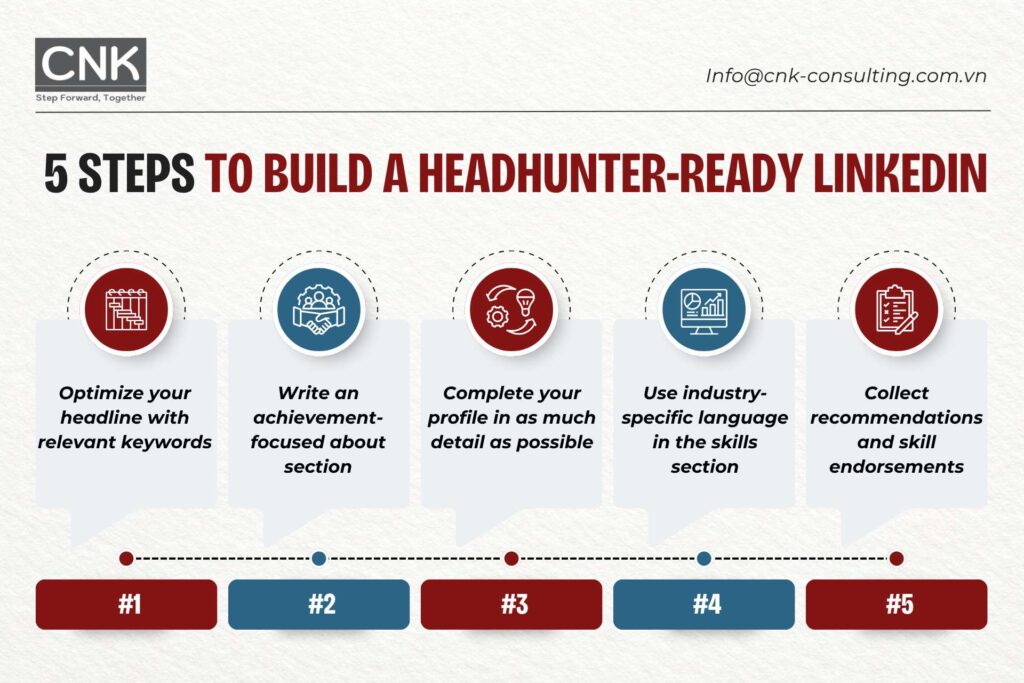
Optimize your headline with relevant keywords
Your headline is the first thing headhunters see, so use it to clearly showcase your core expertise rather than simply listing your job title. Include the most relevant industry keywords, key skills, or specialization you want to be recognized for. This increases your chances of appearing in headhunter search results.
For example, instead of writing “Marketing Executive,” you can optimize it as “Performance Marketing Specialist | ROI Optimization | Google Ads & Meta Ads Expert.” This version highlights your strengths while incorporating keywords that headhunters commonly search for.
Write an achievement-focused about section
Your About section is your 30-second elevator pitch—a place to make a strong first impression on headhunters and hiring managers. Summarize your experience, core strengths, and career goals concisely and compellingly.
Most importantly, quantify your achievements with measurable results to make your profile more convincing.
For example, mention that you increased revenue by X%, reduced costs by Y%, managed a team of Z people, or successfully delivered a major project. This approach helps headhunters quickly understand the value you bring, rather than simply reading a list of job responsibilities.
Complete your profile in as much detail as possible
A fully completed profile is up to 40 times more likely to attract headhunters and hiring managers than one with only basic information. To achieve All-Star status, make sure you complete every essential section of your profile:
- Professional profile photo: Create a strong and positive first impression.
- Work experience: Provide detailed information about each role, highlight key achievements, and include measurable results.
- Education: List your educational background, field of study, and relevant certifications.
- Skills: Add both technical and soft skills, along with relevant industry keywords, to improve your visibility in headhunter searches.
The more detailed and specific your profile is, the higher your chances of being approached by headhunters and invited for interviews.
Use industry-specific language in the skills section
The skills section is where you directly showcase your capabilities and help headhunters find your profile more easily. To optimize it:
- Ensure industry keywords: List skills that align with what headhunters and hiring managers are searching for.
- Update regularly: Add new skills and remove those that are no longer relevant.
- Prioritize skills: Place your most important core skills at the top to make them stand out on your profile.
This approach not only improves your profile’s visibility in search results but also creates a professional impression and makes it easier to demonstrate your capabilities to hiring managers.
Collect recommendations and skill endorsements
Recommendations from managers, former colleagues, or key clients are strong social proof that demonstrates your capabilities and credibility. To optimize your profile:
- Proactively request authentic recommendations: Ask former colleagues or managers to write specific reviews highlighting your achievements, skills, and contributions.
- Get skills endorsed: Encourage colleagues to endorse the key skills listed on your profile to increase credibility.
- Highlight important sections: Place valuable recommendations and core skill endorsements at the top of your profile so headhunters can easily recognize your strengths.
This approach not only helps your profile stand out to headhunters but also increases your credibility and reputation within your professional community.
Professional CV design
To create an impressive CV for headhunters, you need to follow a structured format that can pass Applicant Tracking Systems (ATS) and quickly capture the attention of headhunters.
- Professional formatting: Use easy-to-read fonts (Arial, Calibri) and avoid designs with too many columns or complex images. A simple format helps ATS easily scan and analyze your information.
- Length: Keep your CV between 1–2 pages (depending on your experience level). Headhunters spend an average of only 6 seconds reviewing a CV, so the most important information should be placed in the upper half of the first page.
- Use strong action verbs and quantify results: Describe your responsibilities with powerful action verbs (e.g., led, innovated, achieved, optimized) and always answer the question: “What did I do and what were the results?” This makes your profile more specific, convincing, and stands out to headhunters. For example, instead of writing “Responsible for managing Email Marketing campaigns,” you should highlight the achievement: “Developed and managed Email Marketing campaigns, increasing conversion rates by 25% within 6 months.”
Cleverly utilize specialized social media platforms.
Besides LinkedIn, headhunters also monitor professional groups and communities to identify individuals with strong expertise and industry influence:
- Participate in valuable discussions: Select industry-specific Facebook groups or forums where professionals and headhunters frequently engage. Don’t just read – actively participate by asking insightful questions or sharing in-depth professional opinions.
- Share unique knowledge: Use Facebook or LinkedIn to share articles, analyses, or personal perspectives on industry trends. This helps you build a personal brand as a trusted expert.
- Maintain a professional and consistent image: Ensure that your public profiles reflect professionalism. Avoid engaging in negative controversies or posting inappropriate content.
Build a strong personal brand
Optimizing your profile is the first step, but to truly attract headhunters and new career opportunities, you need to build a strong personal brand. This demonstrates that you are not only an effective professional but also an influential expert in your industry.
Become a “content creator” who shares professional knowledge
Headhunters look for thought leaders. Creating professional content helps position you as someone with deep expertise and up-to-date industry knowledge.
- Write industry blogs or in-depth analysis articles: Create a personal blog or leverage platforms like LinkedIn to share your unique perspectives on trending topics in your industry. Your content should focus on solving problems or analyzing trends that professionals in your field are interested in.
- Create short videos or podcasts: Videos and podcasts are effective ways to deliver knowledge in an engaging format and increase personal brand recognition. You can summarize books, important reports, or share professional tips.
- Regularly publish analytical posts on LinkedIn: Don’t just click “Like”—share short, thought-provoking analysis posts or professional knowledge summaries. This not only attracts colleagues but also captures the attention of headhunters who are monitoring these activities.
- Leverage presentations: Upload presentations you have created to Slideshare or share links on LinkedIn. This provides visual evidence of your communication skills and depth of knowledge.
Participate in industry communities and events: Expand your influence
Your professional network is the most valuable asset of an expert. Headhunters often look for candidates through referrals or individuals who actively participate in professional communities.
- Engage effectively in communities: Participate in industry events, seminars, and professional groups. Instead of simply exchanging business cards, find ways to help others with your knowledge. Apply the principle of “give before you receive.” Generosity in sharing knowledge will help strengthen your credibility.
- Approach speakers and influencers: After events, send concise and specific emails or LinkedIn messages expressing your appreciation and clearly highlighting the value you can bring. Maintain relationships by selectively engaging with their content.
- Become a community leader: When possible, volunteer to become a speaker or organize a small workshop. Taking the stage immediately positions you as an expert.
Excel in your current role
Real achievements at your current company are undeniable evidence of your capabilities. Headhunters always prioritize professionals who create a significant “impact.”
- Create outstanding and breakthrough achievements: Focus on projects that deliver significant impacts on the company’s revenue, costs, or operational efficiency. Regularly document your accomplishments, especially measurable achievements (this is a valuable source of data for your CV and LinkedIn profile).
- Lead new initiatives and projects: Voluntarily take responsibility for complex and groundbreaking projects that others may avoid. This demonstrates your leadership, problem-solving ability, and commitment.
- Act as a mentor: If colleagues or team members seek your advice, take advantage of that opportunity. Becoming a mentor shows your deep expertise and ability to share knowledge. This is a quality that professional headhunters pay close attention to.
Interact and manage relationships with headhunters professionally
Being contacted by a headhunter is a positive signal, but to make the most of this opportunity, you need to know how to get noticed by headhunters and maintain professional interactions.
Clear, polite, and transparent communication helps strengthen your credibility and open up more career opportunities.
Proactively connect with specialized headhunters in your field
Proactively connecting with headhunters who specialize in your field is an effective job search strategy.
How to find the “right headhunter for the right opportunity”
- Use LinkedIn search effectively: Filter results by job titles such as Recruiter, Talent Acquisition, and Headhunter, then add your industry-specific keywords such as IT, Finance, or E-commerce.
- Evaluate headhunters’ expertise: Look for headhunters with a track record of recruiting senior-level positions or those with a strong network of reputable clients in your industry.
Effective connection message template
When approaching headhunters, avoid sending generic messages. Instead, personalize your message by:
- Directly mention their content, job openings, or clients they are working with: Show that you have researched and understand their expertise or current recruitment activities.
- Clearly highlight the value you bring: Briefly summarize your experience, skills, and outstanding achievements, preferably with measurable results to demonstrate your capabilities.
- Maintain a professional and friendly tone: Focus on building a long-term relationship rather than making it a one-time connection.
Sample message:
- Hello [Headhunter’s Name], I have been following your activities in the [Industry] field and am impressed by the way you build teams for [Client’s Name]. With 5 years of experience in [Specialization], I have helped achieve [Specific Achievement], and I would love to connect and discuss potential opportunities in the future.
How to respond to headhunter emails/messages
Maintaining a good relationship with headhunters is a long-term investment in your career. Never ignore their messages, even when you have no intention of changing jobs.
Principles for maintaining relationships
- Respond quickly and professionally: Replying within 24–48 hours demonstrates respect and professionalism, helping you stay top of mind with headhunters.
- Provide valuable information: If you are not interested, express your appreciation and, if possible, recommend a suitable colleague for the position. This action helps build strong trust and long-term relationships.
Provide a polite reason for declining
If you are satisfied with your current job and have no intention of changing roles, politely decline the headhunter’s offer.
For example: “Thank you for this interesting opportunity. At the moment, I am very happy with my current role and projects here, but I would be glad to stay connected for suitable opportunities in the coming months.”
Set clear expectations
If you would like to stay in touch, ask when and how they should contact you again to provide updates and keep your profile current.
Prepare necessary information to help headhunters connect you with employers more easily
Headhunters are the ones who market your profile to employers. To help them work effectively, you need to provide complete information and necessary documents, just like giving them a powerful “sales tool.”
- Be transparent about your expected salary: Research the market salary range carefully. Provide a specific yet flexible salary range instead of a fixed figure. This helps headhunters filter out unsuitable positions from the beginning and saves time for both sides.
- Define your reason for changing jobs: Prepare a clear and positive answer to the question, “What makes you want to change jobs?” (For example: Seeking greater challenges, opportunities to develop leadership skills, expanding business scope, etc.).
- Identify your criteria for the next role: List the 3–5 most important criteria you are looking for in a new role (for example: team size, technology used, company culture, project scope). This helps headhunters better understand your motivations and avoid suggesting opportunities that do not align with your goals.
Mistakes to avoid when trying to get noticed by headhunters
Building a personal brand and optimizing your profile is a time-consuming process, but even a basic mistake can cause headhunters to overlook or underestimate your potential. Make sure you avoid the following mistakes:
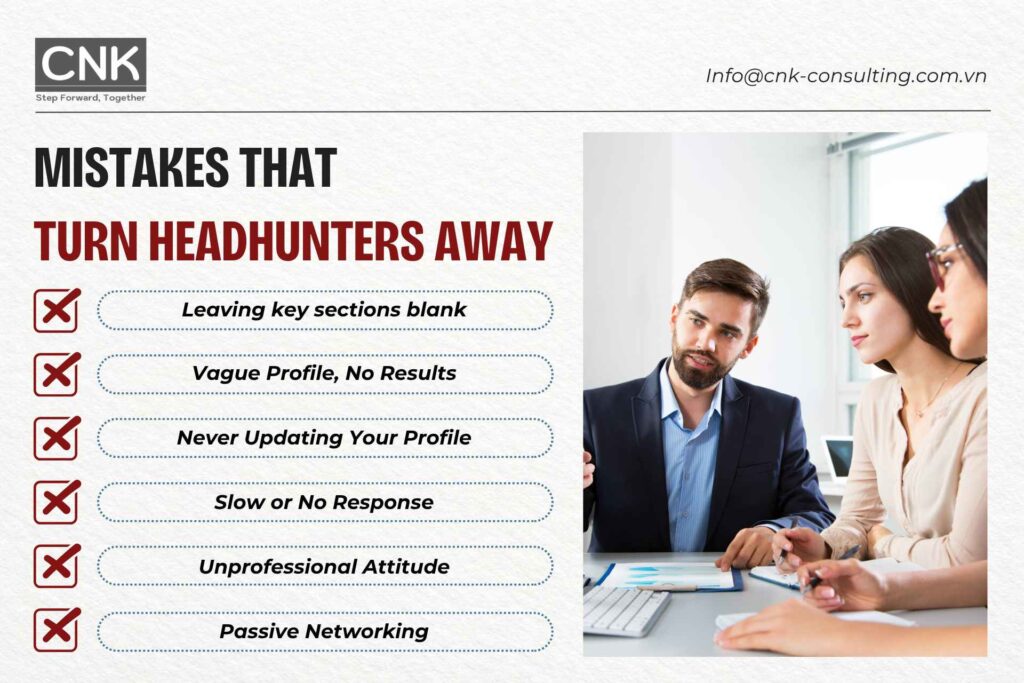
Leaving your profile vague, incomplete, or outdated
Your online profile is your professional “storefront.” If it is incomplete and unclear, headhunters will move on to the next candidate.
Never leave important sections blank
- Mistake: Leaving the “About” section on LinkedIn blank or only listing job titles without providing detailed descriptions of your roles and companies. Headhunters need specific information to filter and evaluate you effectively.
- Solution: Fully complete every section of your profile with achievements, skills, and especially relevant professional keywords.
Vague profile with a lack of measurable achievements
- Mistake: Describing work responsibilities using generic phrases such as “responsible for marketing” or “participated in project X”. Headhunters may find it more difficult to evaluate candidates when there are no measurable results to support their capabilities.
- Solution: Always quantify your achievements and provide specific evidence (for example: managing a budget of X million, increasing revenue growth by Y%).
Keeping your profile outdated and not regularly updated
- Mistake: Keeping work information from many years ago at the top of your CV or leaving your LinkedIn profile outdated for more than a year. This can create the impression that you are passive or not serious about your career development.
- Solution: Update your profile quarterly, even when you are not actively looking for a job. Add new skills and recently completed projects to keep your profile relevant.
Showing an unprofessional or overly passive attitude
Your attitude and interaction behavior are key factors in determining whether headhunters want to work with you.
Responding slowly or ignoring messages
- Mistake: Not responding to messages from headhunters or replying after several weeks. Headhunters need quick responses to meet their clients’ deadlines. Ignoring messages means you may be turning down a potential opportunity.
- Solution: Respond within 48 hours, even if you simply say, “Thank you. I am not looking for new opportunities at the moment, but I would be happy to stay connected.”
Showing a lack of respect or making excessive demands
- Mistake: Asking for detailed information about salary or the company immediately, or showing a negative attitude toward your former employer. This creates the impression that you are difficult to work with or lack tact.
- Solution: Always maintain a respectful and cooperative tone. Ask strategic questions and show genuine interest in the opportunity rather than focusing solely on compensation.
Being passive in building your network
- Mistake: Having only a LinkedIn profile without any interaction (no connections, posts, or comments). Headhunters may see this as a sign of a lack of enthusiasm or an indication that you are not a standout professional in your industry.
- Solution: Actively engage selectively on professional platforms to maintain your presence and demonstrate that you continuously update your knowledge.
Conclude
Knowing how to get noticed by headhunters not only increases your chances of being approached for suitable opportunities but also helps you build a professional and credible image in the eyes of employers.
Start with small but strategic steps to transform your profile into a true magnet that attracts headhunters and opens doors to valuable career opportunities.
CNK Consulting Vietnam
On-demand talent recruitment services
Hotline: +84 369 882 579
Email: info@cnk-consulting.com.vn
Địa chỉ: 12BT.6 Thanh Binh Garden, 3 Nguyen Canh Di, Dinh Cong, Ha Noi, VietNam
Nguồn tham khảo:
- Robert Half: How do recruiters use LinkedIn? (An extremely detailed technical guide on how to “hack” the LinkedIn algorithm).
- TopResume: How to Get Noticed by Headhunters (Explaining the psychology of headhunters when searching for candidates).
- Coursera: How to Get a Job: 10 Strategic Tips to Land the Right Role (A guide on how to optimize your digital presence not only on LinkedIn but also on industry-specific platforms).