



Need to expand your leadership team in Vietnam in 2026, but still unclear about the budget? Unclear pricing from service providers, combined with concerns about business strategy leaks, can cause companies to waste billions of VND while still failing to secure top talent. Discover the latest detailed breakdown of executive search fees in the article below!
Overview: Pricing for Senior-Level Talent Search Services in 2026
The explosive growth of digital technology, green energy, artificial intelligence (AI), and the global supply chain shift has driven demand for senior leadership talent to record levels.
This has led to notable adjustments in the cost of headhunting services for management and C-Level positions, calibrated to match the difficulty and scarcity of the talent involved.
What are the average executive search fees in 2026?
In Vietnam’s recruitment market in 2026, executive headhunting service fees are not determined by a fixed rate. Instead, they typically range from 18% to 30% of the candidate’s total annual income, or the equivalent of 2 to 3.5 months of the candidate’s Gross salary.
Specifically, the general market pricing is divided into three standard fee tiers:
- Standard Fee Tier (18% – 22% of Annual Total Income): Applied to mid-level management positions such as department managers, team leaders, or functional directors in industries with relatively stable talent supply, including business development, marketing, HR, and accounting.
- Premium Fee Tier (23% – 27% of Annual Total Income): Designed for senior leadership roles such as division directors, heads of departments, vice presidents (VPs), or highly specialized technical experts who are difficult to source in the market.
- Special/C-Suite Fee Tier (28% – 35% of Annual Total Income): Applied to top executive positions such as CEO, Managing Director, CFO, CTO, or strategic roles that directly influence the long-term success and survival of the business.
Executive Search Fee Comparison by Position Level
Each level of seniority presents different challenges in identifying and engaging suitable candidates. As a result, executive search fees can vary considerably based on the role’s complexity, talent scarcity, and strategic importance.
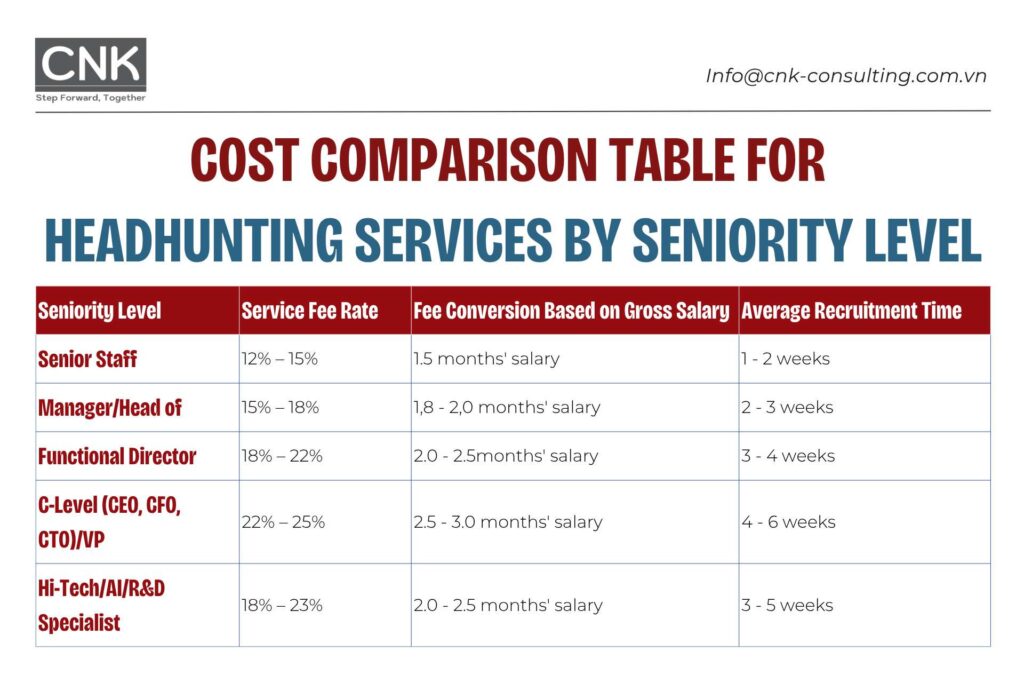
The above rates are for reference only and may vary depending on the industry, talent scarcity, and the scope of the recruitment process. These factors also have a significant impact on the overall cost of executive search.
Popular Headhunting Fee Models in Vietnam
In the Vietnamese market in 2026, executive search firms do not apply a single fee structure. Depending on the seniority level, candidate scarcity, and urgency of the recruitment project, businesses can choose from one of the three most common fee models below.

Contingency fee model
The contingency fee model is one of the most common recruitment models, accounting for more than 70% of transactions in the Vietnamese market today. As the name suggests, businesses only pay the service fee once the candidate officially signs an employment contract and starts working for the company.
How It Works & Fee Structure
- Initial cost: 0 VND. Businesses are not required to pay any upfront deposit or project initiation fees.
- Standard fee: Typically ranges from 1.5 to 2.0 months of the candidate’s Gross salary (equivalent to 15% – 18% of annual total income).
- Payment timing: Payment is made within 7–15 working days from the date the first candidate officially starts working at the company.
- Flexibility: Businesses can work with 2–3 headhunting agencies simultaneously for the same position. The agency that successfully provides the suitable candidate first will receive the service fee.
Advantage
- Zero financial risk: If no suitable candidate is found, businesses do not incur any recruitment costs.
- Fast recruitment speed: Due to competitive pressure, headhunters are highly proactive in screening and presenting candidate profiles (CVs) within a short timeframe.
Disadvantage
- Lower depth of evaluation: Because they are racing against time, headhunters may easily focus on readily available CVs rather than actively hunting for passive candidates who are stably employed at competitor companies.
- Lack of exclusivity: A headhunter may send the profile of an outstanding candidate to multiple different companies at the same time.
The contingency (results-based) fee model is especially well-suited for senior specialist positions, manager-level roles, or positions where there is an abundant supply of candidates on the market.
Retainer-Based Fee Model
arrangement. The company chooses to work exclusively with a single headhunting firm and agrees to pay a committed fee right from the start of the project.
Cash flow allocation mechanism (typically split into 3 installments)
The total fee for the retained search model usually falls in the range of 20% – 25% of total annual income (or 2.5 – 3 months’ gross salary), divided across the following milestones:
- Phase 1: Pay 30%–33% of the total contract value upon signing to initiate the search project, including market research and talent mapping.
- Phase 2: Pay another 30%–33% when the headhunter provides a shortlist of qualified candidates and conducts the first-round interviews.
- Phase 3: Pay the remaining balance after the candidate officially signs the employment contract and starts working.
Advantage
- Maximum resource allocation: Headhunters will establish dedicated research teams to identify, approach, and engage high-level candidates within the industry.
- Absolute confidentiality: Suitable for sensitive C-Suite replacement projects or confidential market expansion initiatives.
- Extended guarantee period: Retained search contracts typically come with longer candidate replacement guarantees, ranging from 90 to 180 days.
Disadvantage
- Upfront financial pressure: The company must pay out costs even before there is certainty that a suitable candidate will be successfully hired.
Fixed package fee model
The fixed package fee model is a hybrid pricing approach in which businesses and headhunting firms agree on a fixed fee for each successfully filled position, regardless of the candidate’s final negotiated salary.
How It Works
- The fee is not tied to a percentage of gross salary or the annual income package.
- Example: The company and the headhunting firm agree on a flat package fee of VND 30,000,000 for a Sales Manager position. Whether the company negotiates a salary of VND 25 million or VND 35 million with the candidate, the service fee remains fixed at VND 30 million.
- Payment terms can apply 100% upon successful placement, or be split into 2 installments (a 20% – 30% deposit, with the remainder paid after the candidate starts work).
Advantage
- Accurate budget control (budget certainty): Finance and HR teams can plan recruitment costs from the beginning of the year without worrying about exceeding the allocated budget.
- Avoiding conflict of interest: This model eliminates the risk of headhunters intentionally pushing candidates’ salary expectations higher to increase their percentage-based fees.
Disadvantage
- Less Common for C-Level Positions: This model is less frequently applied to top executive roles due to the complexity of these positions and the difficulty of defining a standardized package price.
Factors affecting executive search fees
In reality, executive headhunting service fees are not fixed across recruitment firms and can vary significantly. Whether a headhunt service contract is priced at 1.5 months of salary or 3.0 months of salary is not a random decision, but rather depends on the complexity of the role and the resources required for the search project.
Below are three key factors that directly determine executive search service fees in Vietnam:

Talent scarcity and job requirement complexity
The complexity of the job description (JD) and the scarcity of qualified candidates in the market are two key variables that directly impact headhunting service costs.
Roles requiring a combination of rare skills or emerging technologies typically come with significantly higher service fees.
For example, the talent pool in Vietnam for positions such as an AI Director or a Chief Cloud Solution Architect who possesses fluent English communication skills and has successfully delivered systems for European and American markets is extremely limited. As a result, the search fee for these roles is often pushed up to 22%–28% of the candidate’s annual income.
Furthermore, recruiting C-Level executives requires more than just academic qualifications or professional experience. Candidates must also demonstrate proven track records and measurable achievements.
For instance, finding a conventional CFO is considerably easier than sourcing a CFO who has successfully led at least two publicly listed companies (IPO) or completed a successful Series C fundraising round.
The higher the complexity of the role, the more time headhunters must invest in validating hidden information, approaching passive candidates from competitors, and convincing top talent to consider a career move. This significantly increases the overall cost of executive search.
Recruitment timeline
The time factor and urgency of a recruitment position are directly proportional to the service budget a company must allocate.
When a key leadership position is suddenly vacated (due to a sudden resignation or organizational crisis), the company faces the risk of serious revenue loss with every passing day.
When a company requires the headhunter to deliver a shortlist of qualified candidates within 5 – 7 days instead of the usual 3 – 4 weeks, the headhunter is forced to:
- Pause other projects to prioritize the search: Headhunters may temporarily suspend other assignments to allocate 100% of their resources to this critical position.
- Work beyond standard hours and activate direct senior-level outreach channels immediately: The search team will proactively engage high-level networks and direct sourcing channels to approach potential candidates as quickly as possible.
Depending on the level of urgency, headhunting firms may apply an additional surcharge of 20% to 30% on top of the standard fee.
In addition, if a company requests extending the candidate guarantee period from 60 days to 120 – 180 days, headhunting firms will also factor in the risk of personnel turnover during this extended period, adjusting the contract’s percentage fee accordingly to cover the potential cost of finding a replacement.
Headhunter’s brand reputation and talent network
The brand reputation and capabilities of a headhunting service provider are key factors that create significant differences in pricing across the market.
Experienced executive search firms typically have built extensive talent ecosystems and large candidate databases, including:
- Verified candidate profiles.
- Expert networks across multiple industries.
- Relationships with senior executives at leading companies.
- A database of passive candidates who are not actively seeking new opportunities.
- Data on salary benchmarks, compensation packages, and talent mobility trends.
With these data resources, executive search firms can quickly identify suitable candidate pools without having to start from scratch for every project. This helps shorten the recruitment timeline and improve the success rate, especially for strategic positions.
Beyond data capabilities, brand reputation also directly influences a firm’s ability to access and persuade candidates. A reputable headhunting company does not simply provide CVs but also delivers businesses:
- Comprehensive Competency Assessment: An in-depth analysis of the candidate’s strengths, weaknesses, leadership style, and cultural fit with the organization.
- Market Research Report: A detailed report providing businesses with insights into current salary levels and compensation packages offered by competitors for equivalent positions.
Guarantee terms & cost-related risk policies
Executive hiring always comes with significant financial risks if a candidate fails to pass the probation period or leaves the company shortly after joining. To protect business budgets, professional headhunting service contracts typically include detailed guarantee policies and risk management terms.
This demonstrates the accountability of headhunting firms for the quality of candidates they provide.
Standard guarantee period for executive positions
The guarantee period refers to the commitment period during which the headhunting service provider remains responsible for supporting the business after the candidate officially starts working. In the Vietnamese market, the guarantee period varies significantly depending on the seniority level of the position:
- Standard guarantee period (60 days): The most common period applied to senior specialists, managers, or mid-level directors. This timeframe aligns with the 2-month probation period regulated under Vietnam’s Labor Law.
- Extended guarantee period (90 days – 180 days): Applied to C-Suite positions (CEO, CFO, CTO) or senior foreign executives (Expats). Top leadership roles typically require 3 to 6 months to fully demonstrate management capabilities, cultural adaptability, and effectiveness in executing business strategies.
Guarantee eligibility conditions: The guarantee policy is only applicable when the candidate leaves the company voluntarily or when the business terminates the employment contract due to the candidate’s failure to meet professional requirements.
Exceptions: The guarantee policy does not apply if the company changes the job description (JD) compared to the original agreement, reduces staff due to restructuring or bankruptcy, or fails to fulfill the agreed compensation commitments.
Free replacement candidate search policy
Free candidate replacement is the most common and prioritized risk mitigation solution included in headhunt service contracts.
When a candidate leaves the company during the guarantee period, the headhunting firm will initiate a new candidate search process completely free of charge, subject to the following conditions:
- The position, job requirements (JD), and proposed salary must remain unchanged from the original agreement.
- Activation Period: The business must provide written notice to the headhunting firm within 3–5 working days from the date the candidate’s employment issue occurs.
Typically, headhunting firms have 30 to 45 days to present a new shortlist of replacement candidates. Throughout this process, businesses are not required to pay any additional fees.
Most standard contracts in the market only include one free replacement for each position. If the second replacement candidate also leaves the company, the contract will move to a refund or termination arrangement based on mutual agreement.
Refund and pro-rata fee adjustment policy
If a candidate leaves the company during the guarantee period and the headhunting firm is unable to provide a suitable replacement within the committed timeframe (typically 30–45 days), the refund clause will be activated. Currently, headhunting firms apply two main refund methods:
100% refund or credit offset
- Credit note (preferred by agencies): The service fee already paid will be converted into a credit balance. The business can use this credit amount to offset recruitment costs for other positions within the next 6–12 months.
- Cash refund (preferred by businesses): The agency will refund the payment directly to the company’s bank account based on the agreed refund rate.
Fee Deduction Formula Based on Actual Days Worked
To ensure fairness for both the headhunter’s recruitment effort and the company’s financial interests, many contracts apply a refund formula proportional to the length of time the candidate has actually worked:
[Refund Amount] = [Total Service Fee Paid] x (1 − [Number of Days Candidate Actually Worked] / [Total Guarantee Period per Contract])
Practical example:
- Service fee paid: 60,000,000 VND.
- Guarantee period: 60 days.
- Candidate resignation: The candidate leaves the company after 20 working days.
- Refund amount required from the headhunting firm:
- 60,000,000 × (1 – 20/60) = 40,000,000 VND.
Understanding these guarantee terms clearly will help HR departments and company leadership negotiate contracts more rigorously, optimize budgets, and proactively manage risk in any situation that may arise.
Frequently asked questions about headhunt service fees
The FAQ section below helps businesses better understand fee structures, related costs, and important considerations when using headhunting services.
Are headhunt service fees subject to VAT?
Most headhunting companies in Vietnam issue value-added tax (VAT) invoices in accordance with legal regulations. Therefore, when receiving a service quotation, businesses should clearly confirm whether the quoted fee includes VAT or excludes VAT to proactively plan their budget and avoid unexpected additional costs.
Do senior-level candidates have to pay any fees when working with a headhunter?
In the headhunting model, the hiring company is responsible for paying the entire service fee to the headhunting firm. Candidates are not required to pay any fees when they are introduced to job opportunities, receive career advice, or receive support throughout the recruitment process.
If any organization asks candidates to pay a fee to be introduced to a job opportunity, candidates should carefully review and verify the transparency and credibility of that organization.
>> Turn executive hiring challenges into growth opportunities with CNK Consulting’s professional headhunt services.
Conclude
Executive search service fees in Vietnam in 2026 are directly influenced by talent scarcity, position urgency, and the level of confidentiality commitments involved. Depending on their actual needs, businesses can flexibly choose the most suitable service fee models.
Do not let cost considerations become a barrier to securing outstanding leaders. Take the initiative to negotiate a transparent service agreement and turn executive search fees into a strategic driver for sustainable business growth.
CNK Consulting Vietnam
Offering professional executive search solutions
Hotline: +84 369 882 579
Email: info@cnk-consulting.com.vn
Địa chỉ: 12BT.6 Thanh Binh Garden, 3 Nguyen Canh Di, Dinh Cong, Ha Noi, VietNam
Nguồn tham khảo:
- Advius Group: How Much Does Executive Search Cost? A Practical Guide (Executive search cost breakdown: retained vs contingency fees, what drives cost variation, and how to evaluate cost against failure risk).
- SHRM – 2026 Recruiting Executives Benchmarking: Attracting Critical Talent (These results provide key metrics pertinent to executives who manage recruiting functions for organizations).
- De Vore Recruiting: How Much Does Executive Search Cost? (Detailed explanation of the fee structure for executive search services)
.