


Working effectively with a headhunter starts with clear hiring needs, role objectives and candidate assessment criteria. A well-defined brief and close collaboration help shorten the hiring process and improve recruitment quality. This article explains how employers can manage that partnership effectively.
The role of headhunters in recruitment
Employers often face challenges finding high-quality talent, particularly for middle and senior management roles. Headhunters play an important role in connecting employers with suitable candidates, reducing hiring time and managing recruitment costs.

>> Executive search and specialist recruitment services from CNK Consulting Vietnam
Headhunters specialise in identifying and introducing potential candidates to employers, particularly for roles that are difficult to fill. Their main responsibilities typically include:
- Approaching passive candidates: Contacting professionals who work for other companies and meet the employer’s requirements.
- Screening candidates: Assessing skills, experience and personality to establish fit with the employer’s culture.
- Supporting interviews: Advising employers on candidate engagement, interview questions and competency assessment.
Headhunters connect employers with talent that conventional recruitment channels struggle to reach.
Benefits of working with a headhunter
Working with a headhunter offers practical benefits that help employers improve recruitment, including:
- Access to high-quality candidates, particularly passive candidates with relevant skills and experience.
- Less time spent hiring: The headhunter screens candidates, allowing the employer to focus on interviewing those who meet the requirements.
- Labour market insight: Headhunters provide information on salaries, hiring trends and competition for talent within the industry.
- A lasting recruitment partnership: Employers can maintain the relationship to support future hiring campaigns.
Risks and limitations of working with a headhunter
Alongside these benefits, employers should consider several potential risks and limitations:
- High fees: Headhunters typically charge a percentage of the candidate’s salary for the 1st year. Costs can exceed the budget without careful oversight.
- Inconsistent candidate quality: A headhunter who lacks industry expertise or a clear understanding of the employer’s needs may introduce unsuitable candidates.
- Limited control over the full hiring process: Employers depend on headhunters to screen and approach candidates.
- Confidentiality risks: Without a contract and confidentiality agreement, internal information or workforce plans could be disclosed.
To reduce these risks, employers should select a reputable headhunter, establish clear KPIs and agree detailed contractual terms covering rights, responsibilities and confidentiality.
Choosing the right headhunter for your business
Choosing the right headhunter accounts for up to 50% of recruitment success. Employers should approach the decision as the selection of a strategic partner, with expectations that extend beyond service delivery.
Assessing hiring needs: when should you engage a headhunter?
Working with a headhunter is an optimal solution when employers face recruitment challenges that their internal HR team struggles to resolve:
- Senior and strategic appointments: C-level roles such as CEO, CFO and CTO, as well as middle management and more senior positions, require extensive networks and access to passive candidates who are not actively looking for work.
- Scarce specialist talent: For information technology (IT), AI/Machine Learning and other roles requiring specialised skills, headhunters have candidate databases and tools to identify potential candidates.
- Speed and confidentiality: A headhunter can support an urgent appointment or a confidential search requiring complete discretion, for example when replacing an incumbent senior executive or opening a new branch.
- Rapid expansion: The internal HR team may lack the resources to fill a large number of vacancies within a short period.
>> Learn more: Confidential search with a headhunter
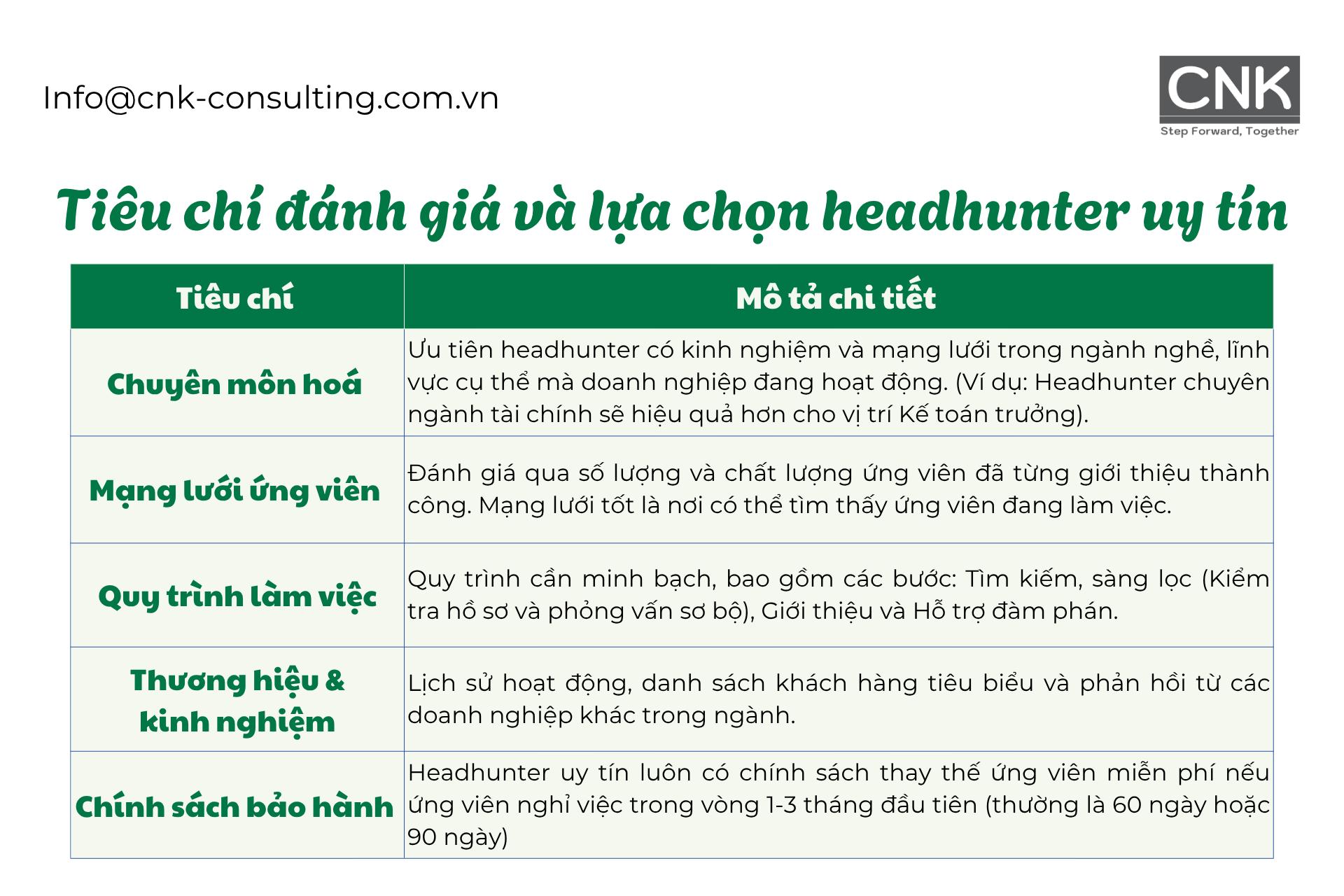
Criteria for assessing and selecting a reputable headhunter
To ensure service quality, employers should assess headhunters against the following criteria:
Common headhunter fee models
Employers need to understand headhunter fees to select an arrangement that suits their hiring needs. The 2 most common models are:
Contingency fees
Many employers choose this model, particularly for middle management appointments. Its main features include:
- The employer pays only when a candidate introduced by the headhunter officially starts work.
- Fees typically range from 15% – 25% of the candidate’s total annual salary.
- The model suits general or mid-level roles where candidates are relatively accessible but still require careful screening.
- Advantages: Flexibility and low risk.
- Disadvantages: Headhunters may give the assignment less attention if they are handling several other searches simultaneously.
Retained search fees
This model typically applies to senior, strategic or particularly difficult appointments that require focused attention and commitment from the headhunter. Its main features include:
- The employer pays an initial retainer, usually around 30% – 50% of the total fee, in return for the headhunter’s commitment to devote all necessary resources to the search.
- The fee percentage may be higher, starting at 25%, with greater accountability and guaranteed candidate profile quality.
- The model suits roles requiring highly specific expertise that is scarce in the market, where every potential candidate matters.
- Advantages: The headhunter gives the search full attention, introduces high-quality candidates and supports the employer from screening through offer negotiations.
- Disadvantages: A larger financial commitment and a requirement for the employer to commit to a longer-term partnership.
Managing the headhunter relationship effectively
Once an employer has selected a partner, close collaboration and effective oversight are essential to ensuring that the headhunter introduces candidates who meet the role’s professional requirements and fit the company culture.

Preparing the job description and ideal candidate profile
A headhunter can identify and introduce suitable candidates effectively only when the employer provides a clear, detailed and compelling brief. Employers should focus on 3 elements:
- Provide a clear and compelling job description: The job description should explain responsibilities and communicate the employee value proposition. Include career progression and personal development opportunities, workplace culture and environment, management structure and leadership style, and the role’s challenges and learning opportunities.
- Define the ideal candidate profile: Share specific details about the previous employee’s strengths and weaknesses, if applicable, and distinguish essential skills from desirable ones.
- Agree on compensation and benefits: Provide a realistic salary range that the employer is prepared to pay. Withholding salary information can waste time for both parties and exclude potential candidates at the outset.
Improving day-to-day collaboration
To avoid wasting time and resources, employers need to establish a structured search process and manage the partnership effectively. The following steps are important:
Establish a communication schedule:
- Meet regularly: Hold brief weekly meetings of around 15 minutes to review recruitment progress, discuss submitted candidate profiles and adjust the search strategy if necessary.
- Share information openly: Communicate hiring plans, changes to role requirements and workforce priorities promptly so the headhunter can adjust resources and strategy.
- Use accessible communication channels: Exchange important updates quickly through email, Slack or project management platforms.
Provide prompt feedback:
- Be specific: Explain why a candidate has been rejected. For example, say “Lacks budget management experience” rather than simply “Not suitable”.
- Clarify what needs to improve: If a candidate comes close to meeting the requirements, acknowledge their strengths and explain what else is needed so the headhunter can better understand the selection criteria.
- Improve subsequent shortlists: Detailed feedback helps the headhunter screen and introduce candidates more accurately in subsequent rounds.
Streamline interviews
- Keep interviews moving: Complete internal interview rounds within a maximum of 1 – 2 weeks.
- Avoid losing strong candidates: Strong candidates often have several opportunities. Long waits for feedback may lead them to accept an offer elsewhere.
- Standardise assessment: Use a consistent evaluation scorecard to reduce deliberation time and improve objectivity.
Measure the partnership’s performance
Tracking these metrics helps employers and headhunters improve the process:
- Ratio of CVs submitted to candidates interviewed: Measures the quality of candidate submissions.
- Time from CV submission to the candidate’s start date: Helps assess how quickly the hiring process is completed.
- Placement success rate for candidates introduced by the headhunter: Reflects the headhunter’s understanding of the employer’s needs and the effectiveness of their collaboration.
Effective collaboration requires transparency, prompt feedback and continuous process improvement. Following these steps helps employers shorten hiring time, improve candidate quality and increase the success rate of each recruitment campaign.
Contract terms and confidentiality
A headhunter agreement protects the employer’s interests. Key points to address include:
- Confidentiality: The headhunter commits to keeping information about the vacancy, business strategy and candidates’ personal details confidential.
- Employee non-solicitation: The agreement should explicitly prohibit the headhunter from approaching or inviting the employer’s current employees to join another company for a specified period, typically 6 – 12 months after the agreement ends.
- Exclusivity: Clarify whether the employer is working with multiple headhunters simultaneously to prevent disputes over introduction fees for the same candidate.
Improving the candidate experience through headhunters
A positive candidate experience helps employers attract and retain talent. Headhunters play an important role in communicating the employer’s values and culture, maintaining transparency and building a pool of strong candidates for future opportunities.

Communicating company culture to candidates
Potential candidates consider the company culture and working environment as well as the role itself. Employers should work with their headhunter to:
- Explain the culture and core values: Clearly describe the working environment, leadership style and opportunities for personal development.
- Share real examples: Describe projects, challenges or achievements involving the current team.
- Create a positive impression: Transparent information builds candidates’ trust and interest in the role.
A clear account of the company culture helps headhunters approach and engage suitable candidates and increases the proportion who ultimately join.
Maintaining transparency throughout recruitment
Transparency helps candidates understand expectations, strengthens the employer’s credibility and reduces the risk of losing strong candidates. Priorities include:
- Clear role information: Explain responsibilities, required skills, salary and benefits.
- A standardised interview process: Set out the timeline, number of rounds, participants and assessment criteria.
- Prompt, detailed feedback: Communicate interview outcomes, reasons for rejection or guidance on areas for improvement where appropriate.
A transparent process helps candidates plan ahead, improves their experience and increases the likelihood that they will accept an offer.
Building a candidate pool for future hiring
A pool of potential candidates helps employers prepare for future hiring needs:
- Keep records of strong candidates: Retain profiles of suitable candidates who are not hired immediately.
- Organise profiles by skills and experience: Make candidates easier to identify for subsequent recruitment campaigns.
- Stay in regular contact: Update candidate information and build lasting relationships to increase the likelihood that candidates will accept an offer when a vacancy arises.
A candidate pool reduces hiring time, improves recruitment efficiency and maintains a steady supply of talent for strategic needs.
Read more: How Employers Can Work Effectively with Headhunters
Common mistakes and practical lessons
Working with a headhunter does not always go smoothly. Recognising and avoiding common mistakes helps employers build a more effective partnership.
Common employer mistakes
Employers often encounter difficulties when they fail to avoid the following mistakes:
- Lack of internal commitment: Hiring managers or relevant departments delay interviews and decisions, or repeatedly change the selection criteria. This causes candidates to withdraw and damages the headhunter’s credibility.
- Unrealistic expectations: Expecting a perfect candidate at a salary below the market rate. Headhunters can search only within the talent available in the market; they cannot create an ideal candidate.
- Keeping the headhunter at a distance: Treating the headhunter solely as an external service provider and withholding details about company culture, internal challenges or specific needs. This makes it harder to explain the value of the opportunity to candidates.
Building a lasting partnership
To make the headhunter an effective extension of the HR team, employers should:
- Treat the headhunter as an employer brand representative: Ensure they understand and accurately communicate the employer brand. They are the initial point of contact with external talent.
- Discuss market trends: Ask the headhunter for information on average salaries, talent movement and skills gaining importance in the industry. These insights help employers update job descriptions and compensation packages promptly.
- Pay on time: Honour agreed service fees and payment terms to build trust and encourage the headhunter to prioritise future assignments.
- Be candid and respectful: When rejecting a candidate, provide constructive feedback and acknowledge the headhunter’s search efforts.
Avoiding common mistakes and building a lasting partnership helps employers improve recruitment efficiency, reduce search time and strengthen their reputation as an employer.
Conclusion
Working with a headhunter helps employers compete more effectively for talent and build a flexible, sustainable recruitment approach that supports future growth.
CNK Consulting Vietnam
Connecting talent – Partnering with businesses
Hotline: +84 369 882 579
Email: info@cnk-consulting.com.vn
Address: 12BT6 Thanh Bình Garden, No. 3 Nguyễn Cảnh Dị, Định Công Ward, Hà Nội, Vietnam
References:
- Forbes Council: How To Leverage Headhunters To Your Career Advantage (The article emphasises that headhunters work for the employer—the client—rather than the candidate.)
- SHRM: The Complete Guide to Effective Recruiting Practices (A comprehensive guide to integrating headhunter services into internal recruitment processes.)
- Robert Half – Working with a recruiter: Your partner in finding your next great job (An analysis of the headhunter’s role as a “strategic adviser”.)