



An unsuccessful hire, particularly at management or executive level, can cost an employer time and money and disrupt business operations. A recruitment guarantee helps reduce this risk by setting clear terms for replacing a candidate. Understanding those terms helps employers choose a reliable recruitment partner and improve hiring outcomes.
What is a recruitment guarantee?
A recruitment guarantee is a key provision in the service agreement between an executive search firm and an employer.
Even a thorough assessment and interview process cannot eliminate uncertainty about a candidate’s fit or performance after joining an organisation. A recruitment guarantee provides a mechanism for managing that risk.
What a recruitment guarantee covers
A recruitment guarantee is a legal and commercial commitment by a search firm to find, assess and recruit a replacement candidate at no additional charge, or refund fees as agreed, if the original candidate resigns or is dismissed within a specified period after starting work.
Common guarantee periods in the market are:
- Specialist and middle management roles: 60 – 90 days, often corresponding to the 2-month probationary period under labour law.
- Executive and senior leadership roles, including C-level executives and directors: 90 – 180 days, depending on the complexity and scope of the role.
A guarantee provides more than compensation when a placement does not work out. It also serves the following purposes:
- Sharing risk: Employers pay a substantial fee for executive search services. A recruitment guarantee shares the risk of an unsuccessful hire between the employer and the search firm, rather than leaving the employer to bear the full loss.
- Demonstrating confidence in candidate assessment: The guarantee period indicates the search firm’s confidence in its assessment process, candidate verification and professional capabilities.
- Supporting a lasting working relationship: Professional executive search aims to create lasting employment relationships. A guarantee requires the search firm to follow up and support the candidate’s integration, extending its responsibility beyond submitting a CV.
Why should employers request a recruitment guarantee?
Executive recruitment is a significant investment. Including detailed guarantee provisions in the agreement offers employers 4 strategic benefits:
Protecting recruitment spend and improving return on investment (ROI)
Search fees typically range from 1.5 to 3 months of the candidate’s salary, equivalent to 15% – 25% of total annual earnings. Without a guarantee, an employer whose new hire leaves in the first month loses that investment and must fund a new search from the beginning.
Reducing the impact of unforeseen risks
Even a professionally conducted interview process can assess only around 70-80% of a candidate’s actual capabilities and attitude. Common situations include:
- A candidate performs well at interview but falls short once in the role.
- A candidate struggles to adapt to the organisation’s culture or their manager’s leadership style.
- A candidate receives a better offer from a competitor and resigns unexpectedly.
A recruitment guarantee protects the employer against these risks, whether they arise from external circumstances or individual decisions and behaviour.
Maintaining business continuity
An unexpected vacancy in a key role can bring a project or an entire department’s work to a halt.
With a guarantee in place, the search firm immediately restarts the search for a replacement. The employer does not need to spend time arranging a new agreement or negotiating additional fees.
Strengthening the search firm’s accountability and performance
When a guarantee carries financial obligations:
- The search firm screens candidates more carefully from the outset, avoiding fabricated profiles or candidates with a high risk of leaving quickly simply to close an assignment.
- The search firm acts as an intermediary, monitoring the candidate’s concerns and adjustment during the first 2-3 months to minimise the risk of an early departure.
Common types of recruitment guarantee
Recruitment assignments vary in risk, budget and role requirements. To accommodate these differences, executive search firms offer a range of flexible recruitment guarantees.

Free replacement guarantee
This is the most common arrangement and a standard provision in most executive search service agreements.
How it works
If the original candidate resigns or their employment is terminated during the guarantee period, and all contractual conditions are met, the search firm must:
- Restart the search, screening and interview process for the same role.
- Complete the replacement assignment without charging the employer any additional service fee.
Common accompanying conditions:
- Replacement search timeline: Search firms typically commit to presenting a new shortlist within 15 – 30 working days of receiving formal notification from the employer.
- Number of replacements: Most agreements allow only 1 replacement per role. If the 2nd candidate also leaves during the remaining guarantee period, the parties renegotiate or move to a fee credit arrangement.
- Unchanged job description (JD): The replacement role must retain the competency framework, salary and job requirements specified in the original agreement. If the employer changes the JD substantially, the search firm may decline a free replacement or charge an adjustment fee.
Refund and fee credit guarantees
These arrangements involve a greater financial commitment from the search firm and are often found in premium recruitment services or agreements with international executive search providers.
Direct refund
- How it works: If a candidate leaves during the guarantee period and the search firm cannot find a suitable replacement within the agreed timeframe, usually 30 – 45 days, it refunds some or all of the service fee received.
- Refund percentage: This usually decreases according to the candidate’s length of service. For example, the employer receives a 100% refund if the candidate leaves in the first month, 50% in month 2 and 25% in month 3.
Fee credit towards a future assignment
- How it works: Instead of issuing a cash refund, the search firm issues a credit note. The fee paid for the candidate who has left is retained as a credit and deducted directly from fees for future recruitment assignments.
- Benefits: This protects the employer’s long-term recruitment budget and maintains the relationship with the search firm without disrupting either party’s cash flow.
Standard guarantee periods: 30, 60, 90 or 180 days?
Guarantee periods vary according to seniority, role complexity and contract value.
30 – 60 days: specialist and middle management roles
- Roles covered: Highly skilled specialists, supervisors, team leaders and middle management positions, including junior managers.
- Rationale: This period provides enough time to assess work attitude, technical skills and cultural fit during the standard probationary period of 60 days under labour law.
90 days: senior managers and directors
- Roles covered: Department heads and departmental directors.
- Rationale: A 90-day period, equivalent to 3 months, is currently the most common standard for management roles. A senior hire needs at least 3 months to understand the organisation, implement plans and demonstrate their management capabilities in practice.
180 days: C-level executives and top leadership
- C-level executives need 3 – 6 months to make a clear impact on business operations and corporate strategy.
- A 180-day guarantee usually comes with a higher service fee and staged payments to manage risk for both parties.
Eligibility and the process for invoking a guarantee
To ensure transparency and fairness for the employer and the recruitment consultancy, agreements include strict eligibility conditions and a standard process for handling claims.
When a recruitment guarantee applies
An employer can invoke the guarantee for a free replacement, refund or fee credit in the following circumstances, subject to the payment requirement below:
The candidate resigns
- The candidate submits their resignation during the guarantee period for personal reasons, difficulty adapting to the company culture or a new opportunity.
- The candidate leaves without notice or stops communicating with the employer during the guarantee period.
The employer terminates employment because the candidate does not meet requirements
- Inadequate professional performance: The candidate fails to meet the probationary criteria or KPIs clearly agreed in advance.
- Misconduct: The candidate breaches workplace rules or confidentiality requirements, or acts dishonestly, such as falsifying a CV or qualifications, resulting in dismissal or mutually agreed termination of employment in accordance with the law.
The employer has met all payment obligations
- The employer is eligible for the guarantee only if it has paid the original recruitment fee in full and on time, within the contractual deadline, usually 7–15 days after the candidate starts work.
Exclusions: when a search firm can decline a guarantee claim
To protect the search firm against risks arising from the client’s working environment, the guarantee does not apply in the following circumstances:
The employer breaches its commitments or changes working conditions
- Changes to the job description or organisational structure: Without the candidate’s consent, the employer substantially changes the JD, restructures the organisation or transfers the candidate to a role or department that differs entirely from the original agreement.
- Failure to honour compensation commitments: The employer reduces salary, bonuses or benefits, or fails to honour the terms of the offer letter agreed with the candidate.
Unlawful or unethical working conditions
- The employer pays wages late, leaves wages unpaid or seriously breaches the Labour Code in its treatment of the candidate.
- The candidate resigns because of mistreatment, harassment, bullying or pressure to carry out unlawful acts.
Force majeure and redundancies for economic reasons
- Redundancy: The employer terminates the candidate’s employment because of excess headcount, restructuring, an economic downturn or financial difficulties, rather than shortcomings in the candidate’s capabilities.
- Force majeure: The candidate dies, becomes unable to work because of a serious accident or illness, or is affected by other force majeure events recognised by law.
Late payment or notification
- The employer pays the original service fee after the contractual deadline without a written agreement extending it.
- The employer submits its guarantee claim after the guarantee period has expired.
A 4-step process for employers to invoke a guarantee promptly
To protect their contractual rights and reduce the time needed to find a replacement, HR teams and hiring managers should follow this standard 4-step process:
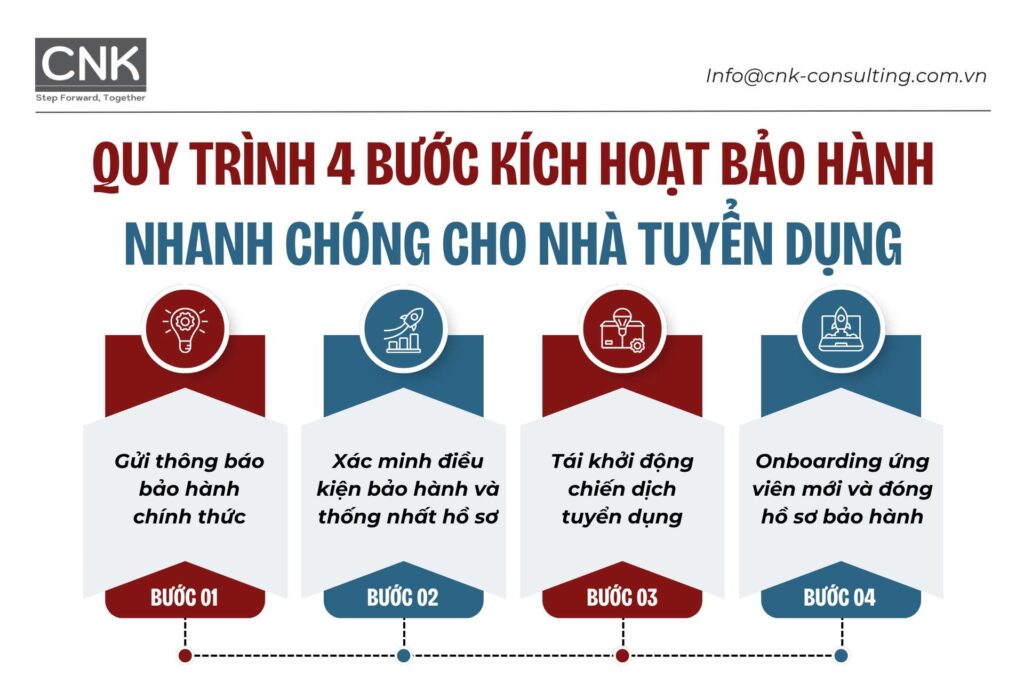
Step 1: Submit formal notification
Once it is clear that a candidate will leave or has not passed probation, HR should notify the search firm in writing, by email or formal letter.
The notification must be submitted during the guarantee period. Agreements typically require notice before, or within 3–5 working days of, the candidate’s departure or the decision to terminate employment.
The notification must state the candidate’s final working day and the reason for termination.
Step 2: Confirm eligibility and agree the supporting documentation
- The search firm reviews the notification against the agreement’s terms.
- Both parties verify the reason for the departure. The search firm may conduct an independent exit interview with the candidate to support an objective assessment.
- They also review the JD to determine whether any adjustments are needed to reflect the role’s practical requirements.
Step 3: Restart the search
Once eligibility is confirmed, the search firm immediately restarts the replacement assignment.
Delivery commitment: The search firm presents a new shortlist of qualified candidates within approximately 10–20 working days, depending on the seniority of the role.
The employer interviews and assesses the replacement candidates through its standard process.
Step 4: Onboard the replacement and close the guarantee claim
Once the replacement candidate receives an offer letter and starts work, the guarantee obligation for the role is formally fulfilled. If separately agreed, the remaining guarantee period continues to apply.
If the search firm cannot find a replacement within the agreed timeframe, usually 30–45 days, the parties apply the refund or credit note provisions in the agreement.
How employers can reduce the need to invoke a guarantee
A recruitment guarantee protects employers from losing their entire recruitment fee. However, an unsuccessful placement still carries indirect costs in training time, business opportunities and organisational stability.
Employers should therefore take preventive action to reduce the likelihood of an unsuccessful hire.
Plan onboarding and assessment for the first 60 days
Create a clear onboarding plan with specific KPIs or OKRs at the 30 – 60-day milestones. Pair this with a buddy programme to help the new hire settle into the working environment.
Hold regular 1-on-1 discussions during the first 2 months to resolve difficulties and address concerns about company culture promptly. This supports retention and helps avoid the need to invoke the recruitment guarantee.
According to a CNK Consulting expert, 70% of candidates who leave within the first 60 days do so because they feel disconnected, rather than because they cannot do the job. On that basis, effective onboarding is the least expensive way to avoid ever needing to invoke a guarantee.
Choose a search firm that assesses capabilities and cultural fit thoroughly
- Assessing cultural fit: A professional search firm goes beyond technical skills to examine a candidate’s mindset and working style in depth, with the aim of securing a lasting employment relationship.
- Thorough employment verification: Carefully checking references with former managers and colleagues helps verify the candidate’s honesty and actual capabilities.
- Support during probation: The search firm acts as a neutral intermediary, listening to feedback from both parties and intervening promptly when problems arise. This makes the recruitment guarantee more effective and reduces the need for replacements.
Conclusion
A recruitment guarantee provides a contractual remedy when a placement fails and indicates the search firm’s capability and reliability. Transparent guarantee terms help employers protect their budgets and make better use of their recruitment investment.
Looking for a way to manage risk and costs in executive recruitment? Contact CNK Consulting Vietnam to discuss a talent search strategy with transparent guarantee terms and a superior rate of cultural fit.
CNK Consulting Vietnam
Comprehensive HR services for employers, with a focus on executive search and specialist recruitment in Vietnam
Hotline: +84 369 882 579
Email: info@cnk-consulting.com.vn
Address: 12BT6 Thanh Bình Garden, No. 3 Nguyễn Cảnh Dị, Định Công Ward, Hanoi, Vietnam
References:
- Roark FS: What is a recruitment guarantee and why you should understand it? (Outlines common guarantee arrangements, including free replacements and partial or full refunds.)
- Xpertize Africa: Replacement Guarantee in Executive Search: How It Works (Explains that guarantees do not apply when an employer restructures, cuts budgets, dismisses employees for financial reasons or changes the original job description.)
- Outside GC: 9 Provisions to Look for in Corporate Recruitment Contracts (Highlights the need for employers to negotiate the guarantee’s start date and their responsibilities for supporting onboarding.)