


High commissions are only part of a headhunter’s working life. Behind them are demanding performance targets and candidates who withdraw at the last minute. This article examines the daily work of a headhunter and the pressures that come with the role.
Agency and in-house headhunters: 2 common models
Headhunters need to understand 2 main operating models when planning their careers: agency recruitment and in-house recruitment. Each involves different working practices, responsibilities and objectives.
Agency headhunters
This is the most common model. Headhunters work for an independent recruitment firm:
- Structure: They serve multiple employer clients at the same time and recruit across different industries and professions.
- Role: They act as professional intermediaries in a role with a strong sales component. Competition and revenue targets create considerable pressure, while commissions offer the potential for high earnings.
- Advantage: Exposure to a wide range of industries and an extensive candidate network.
>> Explore CNK Consulting Vietnam’s executive search and specialist recruitment services to see how employers identify and assess talent every day.
In-house headhunters
In-house headhunters work within large corporations or companies recruiting substantial numbers of senior professionals and specialists with scarce skills.
- Structure: The headhunter is a direct employee of the company.
- Role: They recruit exclusively for their employer. Their work has a stronger strategic focus and requires a deeper understanding of company culture. They often specialise in searches for management and advanced technical roles.
- Advantage: Detailed knowledge of the company’s culture and business needs, with a focus on building its employer brand over the long term.
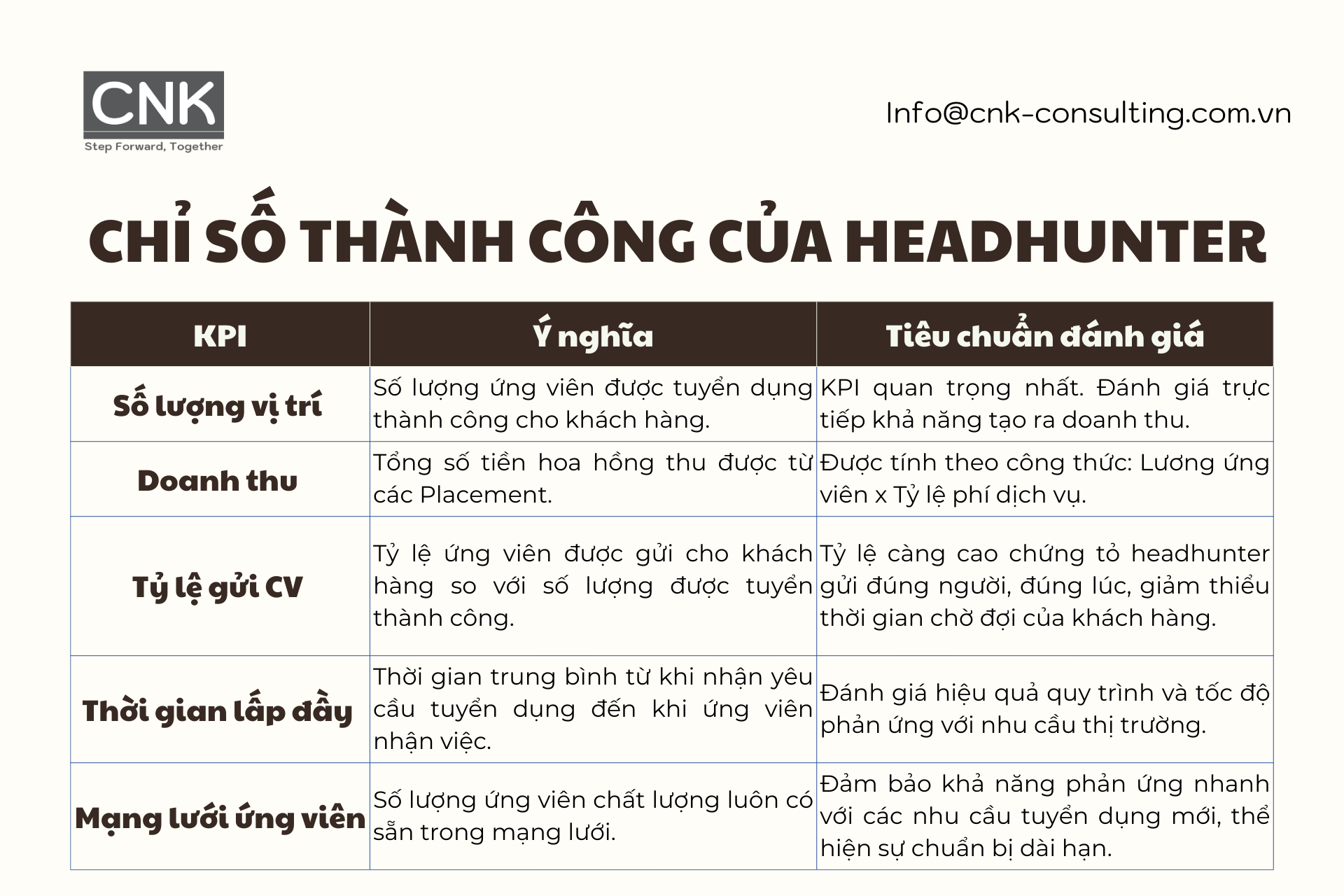
Key performance indicators for professional headhunters
Key performance indicators assess a headhunter’s performance across both the recruitment process and its results.
A headhunter’s daily responsibilities
A closer look at a headhunter’s work reveals a structured process: understanding hiring needs, sourcing and screening candidates, and securing offer acceptance. Each stage contributes to the overall effectiveness of the search.

Stage 1: Assess hiring needs and define the candidate profile
Stage 1 lays the foundation for the success of the entire process. The headhunter must move beyond taking instructions to become a strategic adviser to the client.
Meet the client to review the job description
- Analyse the job description (JD): Headhunters need to look beyond the written brief and ask why the employer is hiring, how the role fits into the business and which specific KPIs the successful candidate must meet.
- Identify essential requirements: Clearly distinguish mandatory skills, experience and qualifications from desirable attributes.
- Understand company culture: Headhunters need to understand the working environment, leadership style and core values to assess cultural fit and minimise early departures.
Develop the search strategy
- Talent mapping: This essential skill helps headhunters identify where prospective candidates work. They compile lists of competitors, companies in the same industry and businesses with similar structures.
- Select sourcing channels: The ideal candidate profile guides the choice of primary channels, such as LinkedIn Recruiter for management roles, professional forums for engineers or personal networks.
- Establish salary expectations: Research current market salaries for the role to advise the client and prepare for negotiations.
Stage 2: Source and approach candidates
In stage 2, headhunters focus on identifying and approaching passive candidates.
Use the main sourcing channels
- LinkedIn Recruiter: The most powerful tool for finding candidates by experience, job title and skills. Headhunters use Boolean search operators (AND, NOT, OR) to refine results.
- Personal networks: Established professional relationships provide referrals. These are often the most reliable source of high-quality candidates.
- Specialist platforms: These include GitHub/Stack Overflow for IT professionals, Behance/Dribbble for designers and the recruitment firm’s proprietary databases.
Make an effective initial approach
- Personalised outreach: Passive candidates are not looking to move, so headhunters need to tailor their messages to the benefits and career development opportunities the role offers.
- Cold calling: This is a headhunter’s biggest challenge. They must introduce themselves and explain the opportunity’s value within 30 seconds to capture the candidate’s attention. If the candidate declines, they need to remain calm, redirect the conversation and leave a professional impression.
- Initial assessment: During the initial conversation, headhunters quickly explore the candidate’s motivation for a move: why might they consider a new opportunity, and what leaves them dissatisfied in their current role?
Stage 3: Conduct in-depth interviews and assessments
After sourcing candidates, headhunters assess them in depth, examining technical skills, cultural fit and motivation.
Ask questions that reveal motivation and suitability
Interviews go beyond verifying the experience listed on a CV to explore qualities that are harder to measure:
- Technical skills: Use behavioural interview methods such as STAR to ask candidates for examples from their experience.
- Personality and cultural fit: Ask situational questions to understand how candidates would respond in the client’s working environment. For example: how do you respond to pressure or conflict with colleagues?
- Career stability: Review how often candidates have changed jobs and their reasons for doing so to establish their commitment to a long-term role.
Manage candidate information and track progress
Headhunters update and manage large volumes of information every day:
- Applicant tracking system (ATS): Record detailed interview notes and the reasons for rejecting candidates or keeping them under consideration.
- Progress reporting: Regularly update clients on the number of candidates approached, the number being interviewed and the expected time to fill the role.
- Candidate network: Keep in touch with promising candidates who are unsuitable for the current role but may suit future opportunities.
Stage 4: Negotiate the offer and support the transition
The final stage requires careful negotiation and expectation management to complete the placement successfully.
Negotiate salary and the offer package
Headhunters act as intermediaries, helping candidates and clients reach the best possible agreement for both parties:
- Establish from the outset that the candidate’s salary expectations fall within the client’s budget.
- Negotiate bonuses, shares, insurance and other benefits alongside base salary to make the offer more attractive.
- Counteroffers from candidates’ current employers are common. Headhunters need to revisit the candidate’s original reasons for considering a move to help them decide whether to proceed.
Support the candidate’s transition and follow up after joining
- Resignation support: Guide candidates through submitting a professional resignation and completing their handover.
- Candidate follow-up: Contact candidates during their 1st week, 1st month and after 3 months to check that they are settling in well. This matters because the recruitment fee is often only secured once the candidate has remained successfully in the role for 60-90 days.
- Client feedback: Ask clients for feedback on candidate quality to improve the process for future searches.
Building the foundations for effective recruitment
Working as a headhunter also involves building relationships and researching the market. These activities prepare headhunters to take on urgent recruitment assignments.

Develop client relationships
Clients are strategic partners as well as a source of recruitment assignments. Effective relationship management helps maintain a steady flow of work and secure high-quality assignments.
Maintain and expand the client portfolio
- Marketing and sales: Set aside time to approach prospective employers and introduce the firm’s services. Headhunters need strong sales skills to explain how their work addresses the employer’s hiring needs.
- Credibility as an adviser: Regularly share useful information on the labour market, hiring trends and salaries with existing clients. This builds recognition of the headhunter’s advisory expertise.
- Expectations and feedback: Seek client feedback after every assignment, whether successful or unsuccessful, to improve the process. Transparent communication about challenges and progress is essential to the success of future searches.
Manage service agreements
- Participate in negotiating service agreement terms, particularly fee percentages and placement guarantee provisions.
- Manage payment and invoicing administration so that financial processes run smoothly and support good client relationships.
Build and expand the candidate network
The quality and depth of a headhunter’s candidate network are the biggest differentiators between successful and average performers.
Develop and maintain candidate relationships
- Ongoing sourcing: Even without a specific vacancy, headhunters spend time finding and connecting with strong candidates in their specialist fields.
- Candidate segmentation: Organise candidate information by industry, job title, skills and, above all, motivation for a move. For example, candidate A may be ready to move after 6 months if an opportunity offers career progression.
- Regular contact: Maintain contact between vacancies through personalised emails, messages recognising achievements and invitations to networking events. This helps candidates keep the headhunter in mind.
Build a personal professional reputation
- LinkedIn activity: Maintain a professional profile and share useful articles on the employment market and industry trends.
- Event networking: Attend conferences and industry events to meet business leaders and senior candidates and build relationships in person.
Research the labour market and track salary trends
Headhunters need detailed market knowledge to provide informed advice alongside search delivery.
Analyse salary data
- Collect data: Continually update information on what companies actually pay for each role, drawing on both public reports and recently agreed offers.
- Analyse trends: Assess changes in salaries over time. For example, what is the percentage increase in pay for IT professionals with 3-5 years of experience compared with the previous year?
- Provide strategic advice: Use this data to advise clients on competitive salaries and candidates on their market value.
Monitor industry and macroeconomic trends
- Track the growth of emerging industries, the decline of traditional sectors and the impact of technology on hiring demand.
- Understand workforce trends, including remote and hybrid working, to provide well-rounded advice on clients’ HR policies.
Challenges and skills for a successful headhunting career
Headhunting offers attractive earnings and opportunities to build relationships with senior professionals. It also requires persistence and a specific combination of skills to manage the industry’s ongoing pressures.
Common pressures and challenges
Headhunting demands speed, persistence and the ability to work under pressure. The most common challenges include:
- Revenue targets: This is the greatest source of pressure, particularly in recruitment agencies. Performance is measured through revenue KPIs and the number of roles filled. Headhunters must continually find new clients and suitable candidates to complete placements. Missing targets can significantly affect earnings.
- Candidate rejection: Headhunters mainly work with passive candidates who are not actively seeking jobs. Rejection by phone or email is a daily occurrence and requires emotional resilience. Candidates may also stop responding just before or after receiving an offer.
- Confidentiality and professional ethics: Headhunters handle sensitive candidate information, including salaries and intentions to move, as well as client information such as business strategies and new positions. Confidentiality and ethical conduct are essential to a lasting professional reputation.
- Intense competition: Headhunters compete with other recruitment firms and their clients’ in-house recruitment teams. They are expected to fill vacancies faster, deliver better results and identify candidates competitors cannot find.
- Expectation management: Headhunters must continually balance clients’ expectations of ideal candidates at low salaries with candidates’ expectations of higher pay and better roles.
Essential skills for headhunters
To meet these challenges, headhunters need a distinctive combination of technical and interpersonal skills:
Sales and negotiation
- Sales: Present opportunities convincingly to candidates and explain candidates’ strengths to clients. Headhunters need the confidence to demonstrate the value each party offers the other.
- Negotiation: This is a core skill, particularly at the offer stage, when headhunters negotiate salary, benefits and the start date.
Communication and relationship building
- Active listening: Understand candidates’ motivations and concerns in depth to identify the most suitable opportunities, rather than simply pressing them to consider a vacancy.
- Networking: Build and maintain lasting relationships with industry professionals.
Psychological insight and candidate assessment
- Understanding people: Quickly assess a candidate’s cultural fit and underlying personality through a few brief conversations.
- Emotional self-management: Remain professional and positive when facing rejection or an unsuccessful search.
Data and market analysis
- Use sourcing and recruitment tools, such as Boolean search and an ATS, effectively to analyse candidate information and salary market data.
- Quickly develop an understanding of an unfamiliar industry or complex technical role to communicate effectively with specialists.
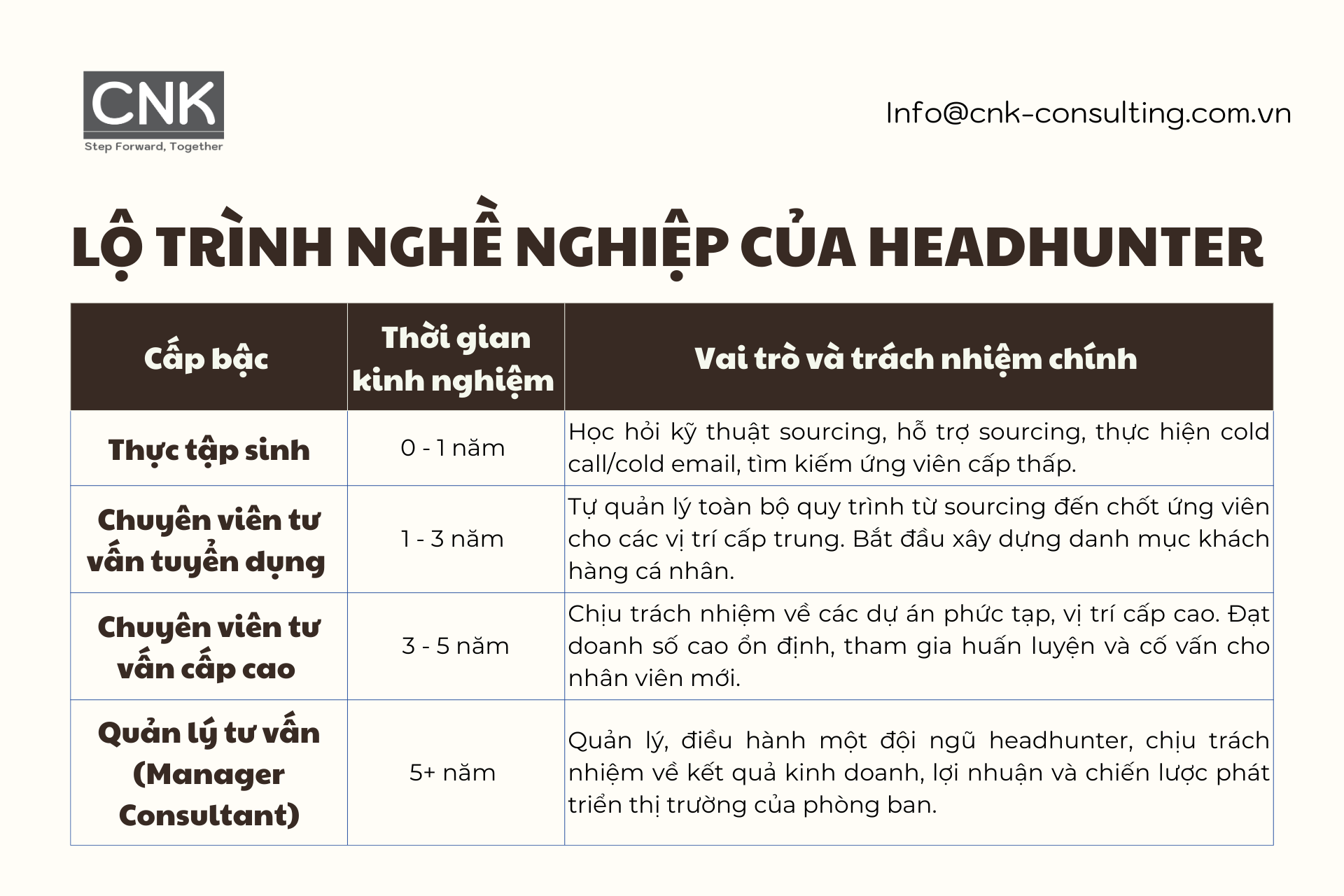
Career progression for headhunters
Headhunting offers a clear career path, with progression based on sales performance and the ability to build a team.
Conclusion
From assessing hiring needs to completing a placement, headhunting is demanding work that delivers value. Understanding the process provides a realistic view of the profession and helps prospective headhunters prepare for a career in the field.
CNK Consulting Vietnam
Executive search and specialist recruitment tailored to your needs
Hotline: +84 369 882 579
Email: info@cnk-consulting.com.vn
Address: 12BT6 Thanh Bình Garden, No. 3 Nguyễn Cảnh Dị, Định Công Ward, Hanoi, Vietnam
References: