


Is your business spending hundreds of millions of VND and still hiring the wrong people? Confusing staffing with executive search can lead employers to choose the wrong service, wasting money and delaying hiring. Understanding the difference helps you control costs and find the right talent for each role.
What are staffing and executive search?
Staffing and executive search are widely used workforce solutions, but they address very different hiring needs.
What are staffing services and labour leasing?
Staffing, also referred to here as labour leasing, is an arrangement in which a provider supplies workers to meet an employer’s requirements for a specified period.
Purpose: Employers use this form of recruitment outsourcing to meet short-term, project-based or seasonal workforce needs quickly without increasing their permanent payroll.
Key features:
- The staffing provider manages employment contracts, payroll, insurance and legal formalities.
- The employer directs the workers’ day-to-day activities.
- The model suits general labour, administrative, production and technical roles within a recruitment outsourcing strategy.
What is executive search, also known as headhunting?
While staffing focuses on volume, executive search takes a targeted approach to identifying and attracting senior talent and specialists whose skills are scarce in the market.
Purpose: Executive search consultants act as strategic advisers, approaching potential candidates directly, including those who are not looking for a new role, to persuade them to join the client employer.
Key features:
- The focus is on management roles, executive leadership positions and specialists with specific skills.
- Assessment, interviews and compensation negotiations follow a highly rigorous process.
- This form of recruitment outsourcing provides a high degree of confidentiality and helps reduce the time needed to fill critical roles.
Combining staffing and executive search gives employers the flexibility to address hiring needs efficiently across all levels, from general labour to senior leadership.
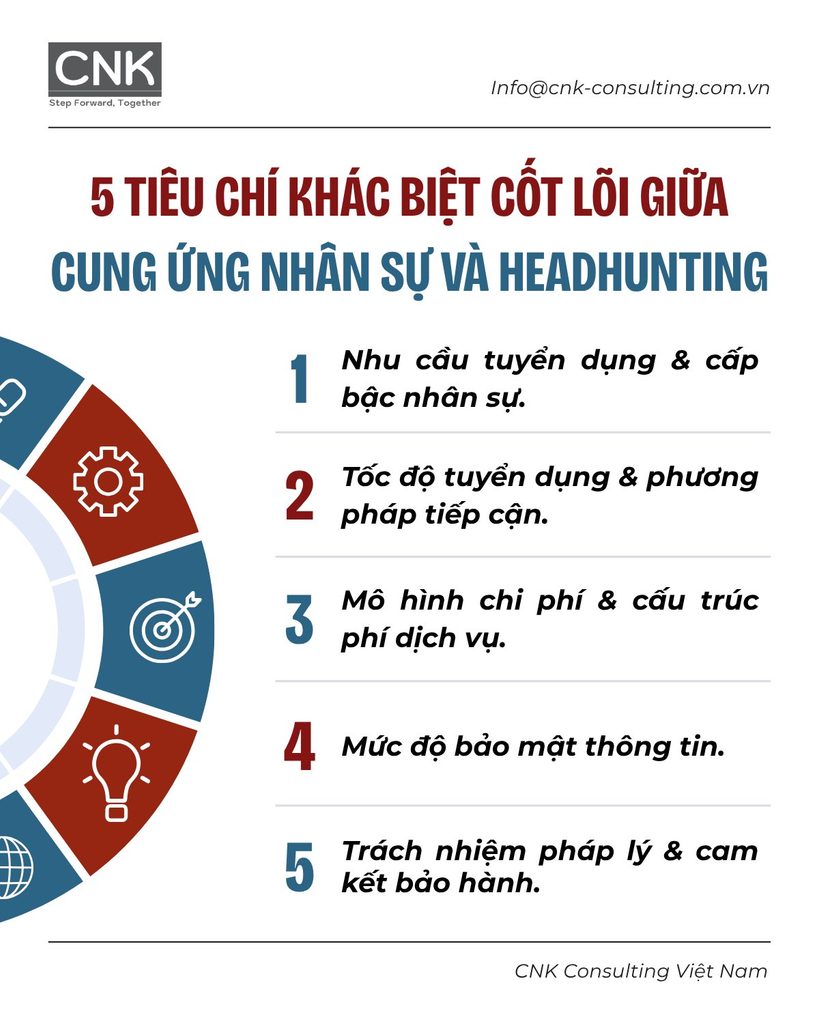
Staffing vs executive search: 5 key criteria
Staffing and executive search differ in their objectives, methods and operating models. Comparing them helps employers choose a recruitment outsourcing service that fits their resources and growth plans.
Hiring needs and seniority
Staffing addresses high-volume workforce needs at short notice. It primarily covers general labour, office staff, seasonal workers and technicians supporting project operations.
Executive search focuses on roles requiring greater expertise, experience or management capability. Examples include Engineering Manager, Sales Director, Finance Manager, CTO and other C-level positions.
If the priority is to add a large team quickly, staffing is usually more suitable. If the employer needs someone with a specific background or candidates who are difficult to reach, executive search offers more advantages.
Hiring speed and sourcing methods
Staffing providers can respond very quickly because they have existing candidate databases. Their recruitment outsourcing approach relies primarily on widely advertised vacancies and high-volume application screening.
Executive search typically involves more extensive research. Consultants define the candidate profile, conduct talent mapping and use professional networks, databases, LinkedIn and specialist sourcing methods to approach people who may not be considering a move.
Speed is therefore not always the deciding factor. The more senior the role or scarce the expertise, the more time an employer may need to find the right person, rather than simply someone who can start quickly.
Recruitment outsourcing is a broader category encompassing these models. Employers can engage an external partner to manage part or all of the recruitment process, from sourcing and screening to interview coordination.
Costs and service fees
Staffing costs usually depend on the number of workers, the assignment duration or an agreed rate per worker. Employers can budget more easily when workforce demand is relatively stable and the required headcount can be established in advance.
Executive search fees are generally charged per assignment and may be based on the successful candidate’s salary or set at a fixed amount. Fees depend on the role’s seniority, talent scarcity, the difficulty of the assignment and the scope of service.
Confidentiality
Staffing generally suits open recruitment needs, where an employer needs additional workers and does not necessarily need to keep the vacancies confidential.
Executive search is often used when a high degree of confidentiality is required, such as replacing an incumbent leader, preparing for an unannounced market expansion or recruiting for a strategic project.
Search consultants can approach candidates directly without widely publicising the vacancy. For sensitive assignments, employers can also require a non-disclosure agreement (NDA) and restrict the information shared at each stage of a confidential search.
Legal responsibilities and replacement guarantees
Employers should clarify these responsibilities before choosing between staffing and executive search.
In staffing arrangements, the responsibilities of the employer and provider depend on the engagement model and applicable law. Both parties should establish clear responsibilities for contracts, wages, insurance, working hours and worker management from the outset.
In executive search, the provider is primarily responsible for identifying, assessing and presenting candidates against the hiring requirements. Contracts also commonly specify the duration and conditions of a placement or replacement guarantee if the candidate leaves within the agreed period.
Before signing, employers should review the scope of responsibility, replacement conditions, guarantee period and circumstances in which the policy does or does not apply. Recruitment outsourcing agreements should also specify recruitment key performance indicators (KPIs), service-level agreements (SLAs), deadlines for submitting candidate profiles and each party’s responsibilities.
Which service should your business choose?
The choice depends on your hiring objectives, the seniority of the role and candidate scarcity. Employers can combine services for different employee groups rather than relying on a single model.
When should employers use staffing services?
Staffing suits employers that need additional workers quickly, in large numbers or for a defined period. It helps businesses plan for changes in workforce demand driven by seasonal activity, projects or expansion.
Consider staffing services in the following situations:
- Urgent production or project expansion: You need tens to hundreds of operations workers, factory workers or event staff at short notice.
- Reducing administrative workloads: You want to reduce administration, payroll and social insurance tasks by outsourcing recruitment for your entire seasonal workforce.
- Seasonal workforce demand: Peak trading periods, including public holidays, Tet and major promotions, require additional workers quickly without creating long-term fixed staffing costs.
- Temporary cover: You need flexible recruitment outsourcing to cover maternity leave or long-term sick leave.
If you want an external partner to manage several stages of recruitment, from building candidate pipelines to screening and coordinating recruitment activities, a broader recruitment outsourcing arrangement may be more suitable.
When is an executive search consultant necessary?
Not every senior appointment requires an executive search consultant. However, executive search becomes particularly valuable when employers struggle to reach suitable candidates through conventional recruitment channels. Consider working with executive search firms in the following situations:
- Senior leadership appointments: You need to recruit C-level leaders, such as a CEO, CFO or CTO, or divisional directors whose decisions shape the business’s future.
- Roles requiring scarce skills: You need technology specialists, engineers with deep technical expertise or professionals with niche skills whom conventional job advertising cannot reach.
- Strict confidentiality requirements: You want to replace an incumbent senior leader or expand into a new business area without alerting competitors or the wider market in advance.
- Access to passive candidates: The strongest talent is often not actively looking for work; executive search provides the only route to reaching these candidates and persuading them to move.
Using staffing and executive search flexibly to address specific workforce needs helps employers save money while maintaining the quality of their teams.
A decision matrix for choosing the right service
The following matrix helps employers choose between staffing and executive search based on hiring volume, seniority and the nature of the work:
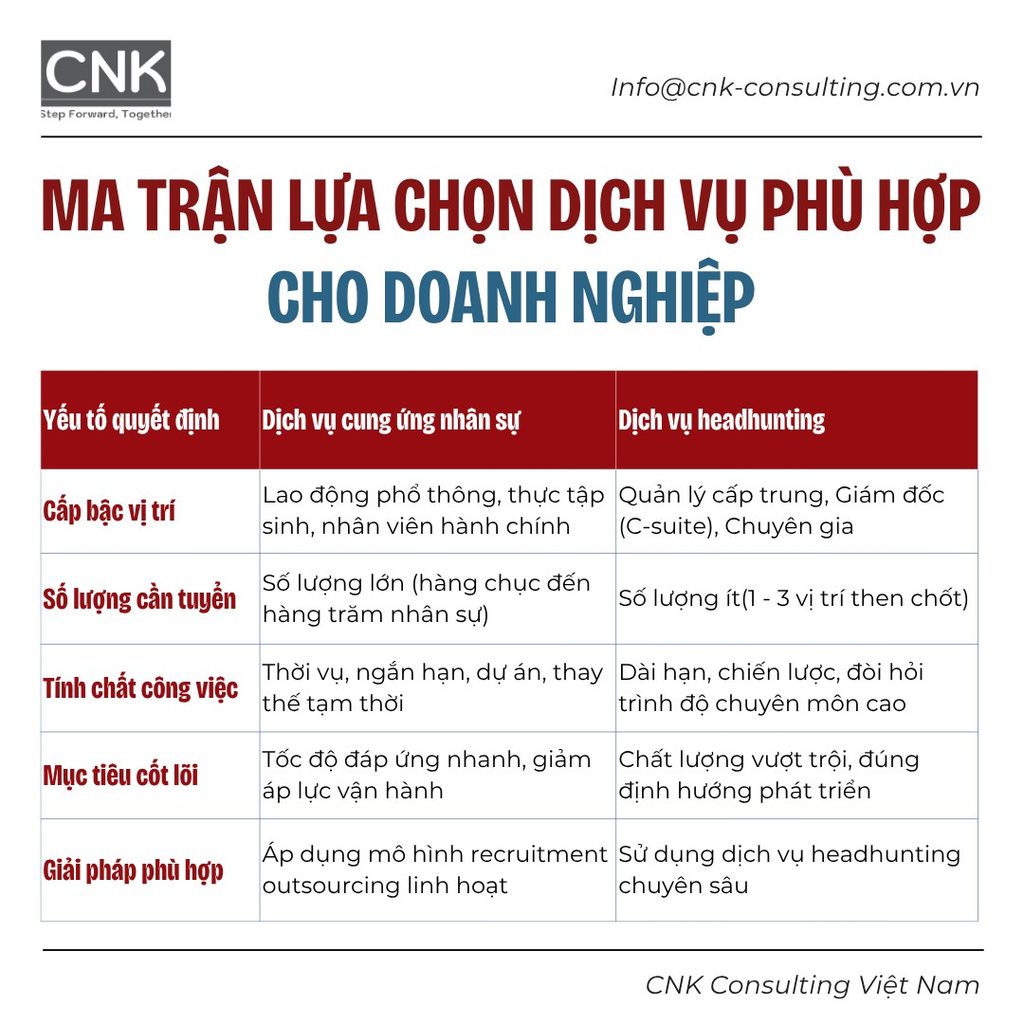
CNK Consulting Vietnam’s executive search consultants advise that employers can also combine these models. For example, a new factory could use staffing services for its operations workforce and executive search to recruit a Plant Director, Engineering Manager or other key managers.
Common mistakes that waste recruitment budgets
Many employers incur substantial costs because they misunderstand the difference between staffing and executive search and choose the wrong recruitment outsourcing model:
- Using executive search for general or junior roles: Engaging costly executive search firms to recruit administrative or seasonal staff wastes budget when staffing providers can handle these needs effectively at a much lower cost.
- Using staffing services to recruit senior leaders: Staffing providers’ networks and databases generally focus on general labour. Using this model for leadership appointments can produce unsuitable candidate profiles and waste interview time.
- Choosing a recruitment outsourcing model on price alone: Selecting the lowest-priced provider without considering quality commitments, replacement guarantees or legal compliance often leads to early departures and operational disruption.
- Failing to define role requirements: Unclear hiring needs and expectations can lead recruitment outsourcing providers to recommend the wrong solution, extending the hiring process and creating hidden costs.
Choosing the right recruitment approach
Understanding the difference between staffing and executive search helps employers choose the right service and use their recruitment time and budget effectively. For management, specialist and senior leadership roles, executive search offers an effective way to reach suitable candidates.
CNK Consulting Vietnam helps employers identify and select talent through executive search and specialist recruitment in Vietnam.
CNK Consulting Vietnam
Helping businesses achieve their goals
Hotline: +84 369 882 579
Email: info@cnk-consulting.com.vn
Address: 12BT.6 Thanh Bình Garden, No. 3 Nguyễn Cảnh Dị Street, Định Công Ward, Hanoi, Vietnam
References: