


Many recruiters struggle because they lack the right headhunter skills, rather than opportunities. Sourcing candidates, assessing capabilities and securing agreements with employers each require specific expertise. This article explores 5 essential skills that help recruiters improve performance and achieve more successful outcomes.
Why headhunter skills matter more in 2026
Specialist skills help headhunters work faster and deliver meaningful value to employers. The following changes explain why these skills became increasingly important in 2025.
A changing labour market
Entering 2025, the labour market saw substantial shifts in hiring demand, particularly for middle management and senior roles. Candidates became more selective, while employers set stricter requirements for capability, cultural fit and long-term suitability. Headhunters therefore need to look beyond matching candidates to job descriptions and develop a deeper understanding of industries, market trends and candidate behaviour.
Competition among recruitment firms and technology platforms also puts pressure on headhunters to keep developing their skills. A skilled headhunter must be able to interpret data, anticipate hiring risks and recommend appropriate strategies, as well as source candidates.
>> Learn more about CNK Consulting’s executive search and specialist recruitment services and how headhunters connect candidates with opportunities for long-term career development.
The strategic role of headhunters for employers
The headhunter’s role has expanded considerably to include strategic support for employers. Key aspects of this strategic role include:
- Advising on talent strategy: A skilled headhunter provides labour market insights, including salary levels, competitors’ hiring activity and skills shortages. These insights help employers refine job descriptions and recruitment strategies to make them relevant and attractive. They help answer the question: “Who do we need, and what is a reasonable compensation package to attract them?”
- Representing the employer brand: Headhunters are the first and most important point of contact between an employer and potential candidates, particularly passive candidates. Their approach, communication and relationship management directly affect the employer’s image and reputation in the market.
- Saving time and money: Hiring the wrong person for a senior role can be costly and delay business progress. Professional headhunters use in-depth assessment and rigorous screening to reduce these risks and ensure employers find the best fit from the outset.

Choosing which headhunter skills to develop, from foundational to advanced
Identifying the right skills to develop helps headhunters build an effective career development plan. The following criteria provide a practical, structured way to set priorities.
Understanding technical and soft skills in executive search
Understanding the role of each skill category helps headhunters plan their professional development effectively:
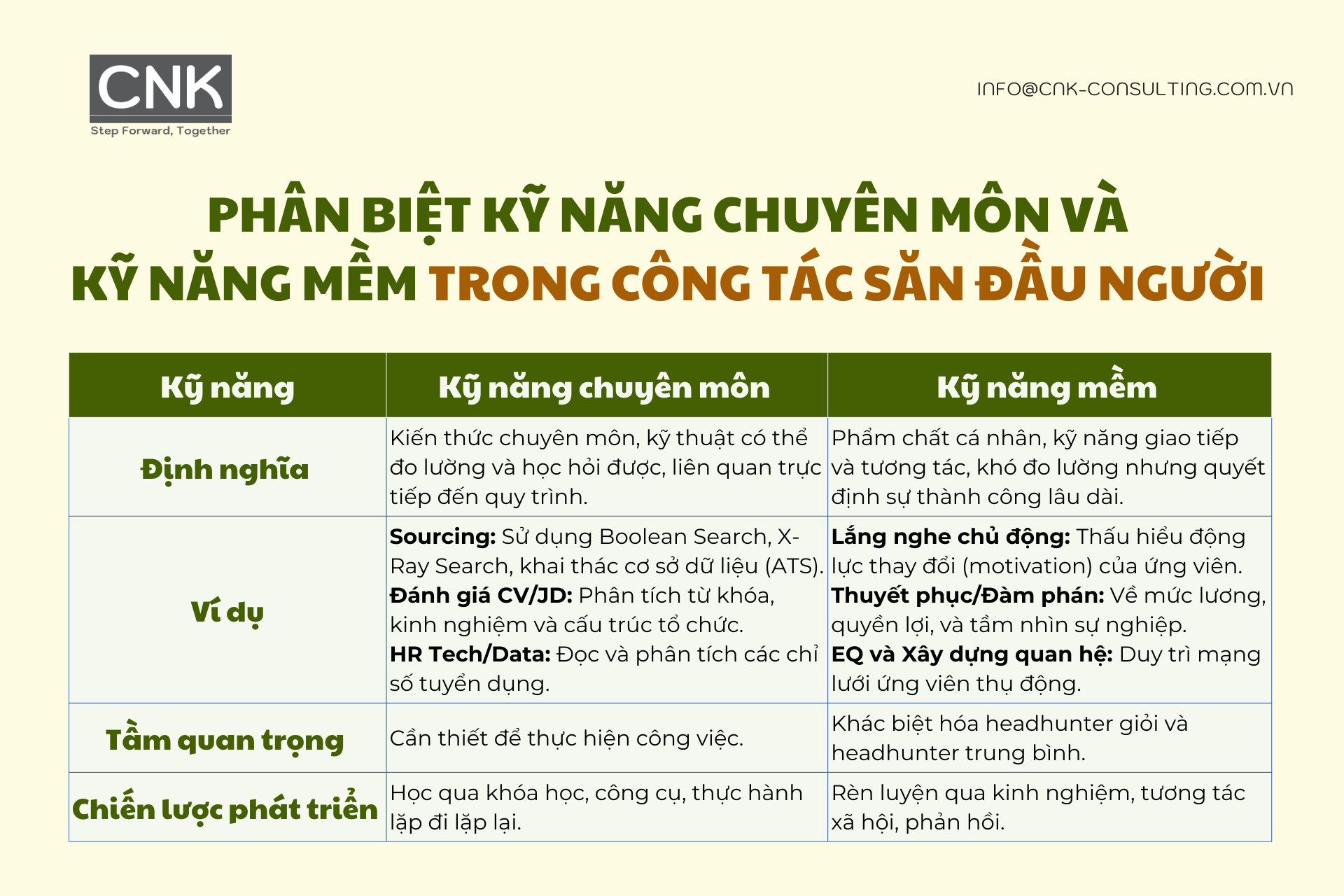
Both skill categories are essential for finding the right talent for employers. Technical skills help headhunters source sufficient candidates and screen them for initial suitability. Soft skills help them maintain candidate engagement and secure interest, particularly among senior professionals who receive multiple approaches at the same time.
Skills for modern recruitment
Headhunters need to keep developing skills that reflect advances in technology and changes in workforce attitudes:
Analytical thinking
In a digital environment, every hiring decision needs to be informed by data. Headhunters must know how to use predictive analytics to identify where to focus their searches and assess the risk of candidates leaving a role. This shifts sourcing from intuition to a structured strategy.
Proficiency with AI and automation tools
This includes using AI tools to automate basic sourcing, write personalised outreach messages and analyse sentiment in speech.
Managing expectations
When working with employers and candidates, headhunters must manage expectations around salary, benefits, hiring timelines and job descriptions. Transparent, honest communication builds trust and prevents disappointment on either side. Effective expectation management increases offer acceptance rates.
Top 5 core headhunter skills for success
Consistent recruitment performance and strong employer value require both technical skills and professional qualities developed through structured practice. The following 5 headhunter skills are important criteria for distinguishing a general recruiter from an executive search professional capable of leading and influencing the talent market.
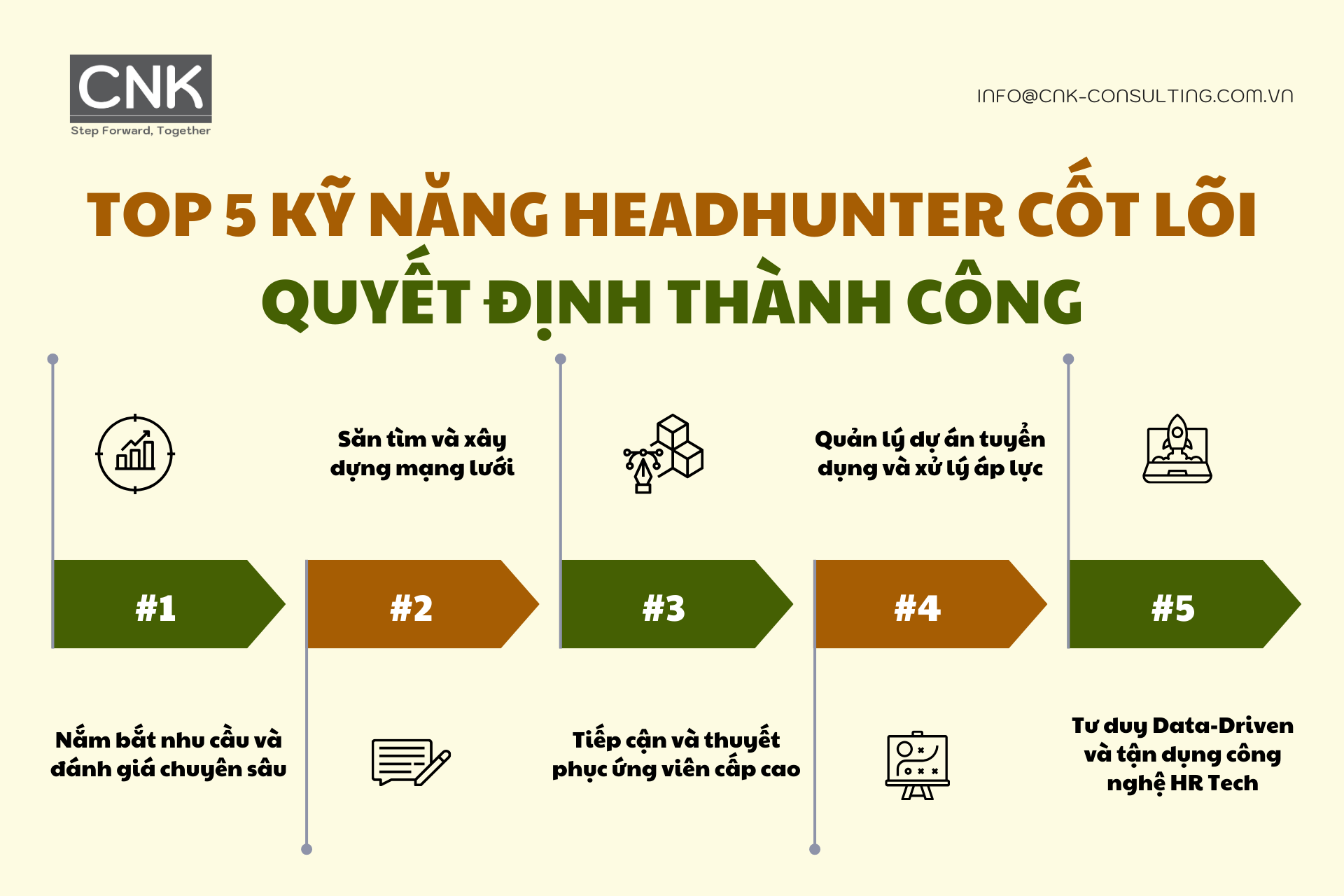
Understanding hiring needs and assessing candidates in depth
This foundational skill determines the accuracy of the entire recruitment process. Before sourcing and assessing candidates, headhunters need to understand the employer’s underlying needs and define the role’s requirements precisely. This helps align job requirements with each candidate’s actual capabilities.
Analysing the job description in depth
Headhunters need to look beyond the bullet points and understand the business objectives the role must deliver. They should interview the hiring manager to establish the most important problem the successful candidate will need to solve.
Assessing professional capabilities
Headhunters need a working knowledge of the field in which they recruit, such as commonly used programming languages or basic financial metrics. They use interview techniques such as STAR to assess past behaviour and predict a candidate’s future performance.
Assessing cultural fit
This goes beyond considering whether a candidate will settle in well. The main objective is to assess how closely their personal values, working style and behaviour align with the employer’s culture.
The assessment also considers whether the candidate can make new, positive contributions that improve team diversity and effectiveness while respecting the organisation’s core principles.
Sourcing candidates and building talent networks
Sourcing is central to a headhunter’s work, particularly when seeking passive candidates.
Mastering advanced search techniques
- Boolean search: Use logical operators (AND, OR, NOT) and parentheses to create precise, effective search strings on platforms such as LinkedIn Recruiter, Google and other databases.
- X-Ray Search/Site Operator: Use Google search operators to find candidate information on public websites that platforms such as LinkedIn cannot fully access. This approach can uncover profiles on professional forums, GitHub, career event websites and other open sources, expanding the pool of potential candidates.
Building and maintaining candidate networks
Headhunters do not wait for a hiring requirement before starting a search. They continually build talent pools by specialism, such as B2B Marketing Directors or Cloud Native Engineers, maintain relationships and update candidate information. This significantly reduces sourcing time when a role opens.
Using competitor intelligence for talent mapping
Headhunters need to know how to analyse information and identify talented candidates working for competitors or companies with similar business models.
Approaching and engaging senior candidates
Senior candidates are not looking for jobs; they expect to be approached. A headhunter’s ability to engage them determines whether they will listen.
- Personalising outreach: Avoid generic message templates. Outreach should focus on the value the candidate could bring and the career development opportunities the employer offers, beyond the job description alone. It should demonstrate thorough research into the candidate’s background.
- Listening actively and identifying concerns: Headhunters need to uncover the concerns and underlying motivations that might prompt a candidate to consider moving, such as a lack of challenge, a toxic culture or limited progression. Understanding these factors provides an essential foundation.
- Managing negotiations between all parties: Headhunters mediate between candidates seeking the highest possible salary and employers seeking to optimise costs. This requires tact, transparency and the ability to find mutually beneficial agreements on salary, bonuses and benefits.
Managing search assignments and handling pressure
Filling a senior role is often treated as a project. Headhunters therefore need to be effective project managers.
- Managing recruitment progress: Headhunters may need to track 5 to 10 roles simultaneously, each with different priorities and deadlines. This requires clear processes and proficiency with an applicant tracking system (ATS) to update candidate status and anticipate delays.
- Managing time and priorities: Sourcing, interviewing, presenting candidates and negotiating all happen concurrently. Headhunters need to judge when to move a final-stage candidate forward and when to devote time to sourcing for a difficult role.
- Handling pressure and rejection: Headhunters face high levels of rejection from both candidates and employers. Staying professional, recovering quickly and learning from unsuccessful assignments are essential to sustaining a career in the field.
Using data and HR technology
Modern headhunters need data to make sound recruitment decisions. Analytical skills and proficiency with HR technology help improve processes, increase efficiency and reduce the time needed to find suitable candidates.
Analysing key recruitment metrics
- Candidate sources: Identify which channels deliver the highest-quality candidates and focus resources accordingly.
- Time to hire: Assess process efficiency to identify bottlenecks that need attention.
- Offer acceptance rate: Analyse why candidates decline offers to improve negotiation skills and offer quality.
Using an ATS effectively
Use an ATS to manage recruitment progress, automate emails and report on data, as well as store CVs.
Applying AI and machine learning
New tools can help identify candidates with similar profiles, analyse sentiment in video interviews and automate initial CV screening. Using these tools allows headhunters to spend more time on higher-value activities, such as individual conversations and negotiations.
Common headhunter mistakes in 2025 and how to avoid them
A complex labour market and advances in technology have created new pitfalls for inexperienced headhunters and those slow to adapt. Avoiding the following common mistakes is essential to maintaining a high success rate.
Relying too heavily on active candidates
The biggest mistake new headhunters make is focusing exclusively on active jobseekers who are easy to find on job boards.
Why this is a mistake:
- Lower candidate quality: Most senior talent, particularly professionals in scarce specialisms, are passive candidates. They are satisfied with their current roles and are not actively applying for jobs.
- Greater competition: Focusing on active candidates puts headhunters in direct competition with internal HR teams and hundreds of other headhunters.
How to address it:
- Prioritise sourcing: Spend at least 60% of your time sourcing passive candidates through LinkedIn Recruiter, specialist professional networks and personal contacts.
- Build long-term relationships: Approach passive candidates to establish a relationship, without expecting an immediate placement. Introduce yourself and stay in regular contact so they think of you when they are ready to move.
Neglecting the candidate & employer experience
Executive search is a service profession. Neglecting the experience of those involved can damage your professional reputation.
The candidate experience
- The mistake: Conducting superficial interviews, making excessive promises and, especially, failing to follow up after an interview. This is a serious mistake that leaves candidates feeling disrespected and willing to speak negatively about you or the employer.
- How to address it: Always update candidates on their application status, including when the process takes longer than expected. Give unsuccessful candidates specific, courteous feedback they can learn from. This preserves relationships and leaves the door open to working together in the future.
The employer experience
- The mistake: Failing to explain the process clearly, sending too many unsuitable CVs or overlooking changes in the employer’s hiring needs.
- How to address it: Set realistic expectations for recruitment timelines and the difficulty of filling each role. Avoid overpromising on sourcing times. Use data to explain market conditions to employers, for example: “Salary levels for this role have risen by 30% compared with 3 months ago.” This strengthens your role as a strategic adviser.
Failing to keep up with technology
HR technology and AI are reshaping recruitment. Relying on manual methods leads to inefficiency and leaves headhunters behind.
Common mistakes:
- Relying on outdated Excel workflows: Managing recruitment progress without an applicant tracking system (ATS) leads to data loss and wasted time.
- Ignoring AI in sourcing: Manually screening thousands of profiles instead of using AI tools to identify candidates with similar profiles.
How to address them:
- Invest in ATS and CRM systems: Treat these tools as professional assets. Learn to use them effectively to automate repetitive tasks and maintain an organised candidate network.
- Learn about AI and automation: Regularly explore and test AI tools that can help write personalised outreach messages, analyse candidate data or schedule interviews automatically, freeing up time for other work.
Conclusion
A well-rounded set of headhunter skills helps recruiters work more effectively and deliver clear value to employers. By understanding hiring needs, assessing candidates accurately and using technology appropriately, headhunters can remain competitive and build lasting careers.
CNK Consulting Vietnam
Attracting leading talent
Hotline: +84 369 882 579
Email: info@cnk-consulting.com.vn
Address: 12BT6 Thanh Bình Garden, No. 3 Nguyễn Cảnh Dị, Định Công Ward, Hanoi, Vietnam
References:
- Forbes Human Resources Council: The Top 6 Soft Skills For A Recruiter (An article examining headhunter skills through the lens of soft skills.)
- Forbes – 15 Abilities That Set Top Executive-Level Employee Recruiters Apart (Skills for executive search professionals.)
- LinkedIn – 12 Competencies Shared by Exceptional Recruiters, According to LinkedIn’s Recruiting Leaders (12 core competencies of exceptional recruiters.)