



Is a prolonged vacancy for a Supply Chain Director driving up operating costs and delaying orders? Imagine a supply chain management (SCM) function running smoothly under a capable leader, with costs reduced by 15 – 20%. A structured 4-step recruitment process from a trusted logistics and supply chain executive search firm can help make that difference.
Why employers need a logistics and supply chain executive search specialist
Logistics and supply chain recruitment presents distinct challenges. Many employers therefore turn to specialist executive search firms to reach the right senior candidates and reduce hiring times.
How acute is the shortage of senior logistics and SCM talent?
Vietnam’s logistics and supply chain management (SCM) sector is growing rapidly, creating a severe shortage of experienced leaders.
- Surging demand, limited supply: Business expansion and multinational groups relocating supply chains to Vietnam have pushed demand for C-level and other senior appointments (COO, Supply Chain Director, Logistics Manager) to a peak.
- A broad range of capabilities: Today’s supply chain leaders need more than expertise in transport, warehousing and customs procedures. They must also master technology (ERP, WMS and AI in logistics) and think strategically about global cost optimisation.
- Low turnover among strong performers: Highly capable professionals often receive attractive compensation and are not actively looking for work through conventional recruitment channels. Supply chain executive search consultants must therefore identify and approach potential candidates individually.
Why in-house HR teams struggle to recruit a Supply Chain Director or Head of Logistics
Many employers assign senior recruitment to their in-house HR teams, but most encounter obstacles specific to these roles:
- Limited specialist networks: In-house HR teams often depend on candidates who have posted CVs on job sites and wait to be contacted. Specialist logistics search consultants, meanwhile, maintain extensive private talent pools of directors and managers working at major corporations.
- Limited sector expertise: Supply chain management spans procurement, warehousing, transportation, demand planning and more. Without practical expertise, in-house HR teams can struggle to assess a Supply Chain Director’s ability to manage risk or optimise cash flow.
- Confidentiality requirements: Replacing a senior leader or creating a strategic role often requires strict confidentiality. Shipping recruitment specialists can manage a confidential search to protect employer information and the professional standing of candidates who are still in their current roles.
The risks of hiring the wrong supply chain leader
A poor mid-level hire costs only their salary, but the wrong supply chain leader can set back an employer’s entire operation:
- Substantial financial losses: Recruitment, training, contract termination payments and opportunity costs all represent wasted investment. More significantly, a poor decision in freight rate negotiations or inventory management can wipe out billions of VND in revenue.
- Supply chain disruption: Leadership errors can disrupt the entire supply chain, causing delayed shipments, inventory bottlenecks and out-of-stock situations at points of sale. These problems can seriously damage the brand’s reputation with partners and customers.
- Time needed to recover: On average, employers take 6 to 9 months to recognise that a Supply Chain Director is unsuitable, followed by the same amount of time to find a replacement.
The logistics and supply chain executive search process: 4 steps
Recruiting supply chain leaders who combine strategic thinking with a practical understanding of an employer’s operations requires more than conventional CV screening.
A logistics and supply chain executive search specialist brings a structured, in-depth approach through a 4-step process.
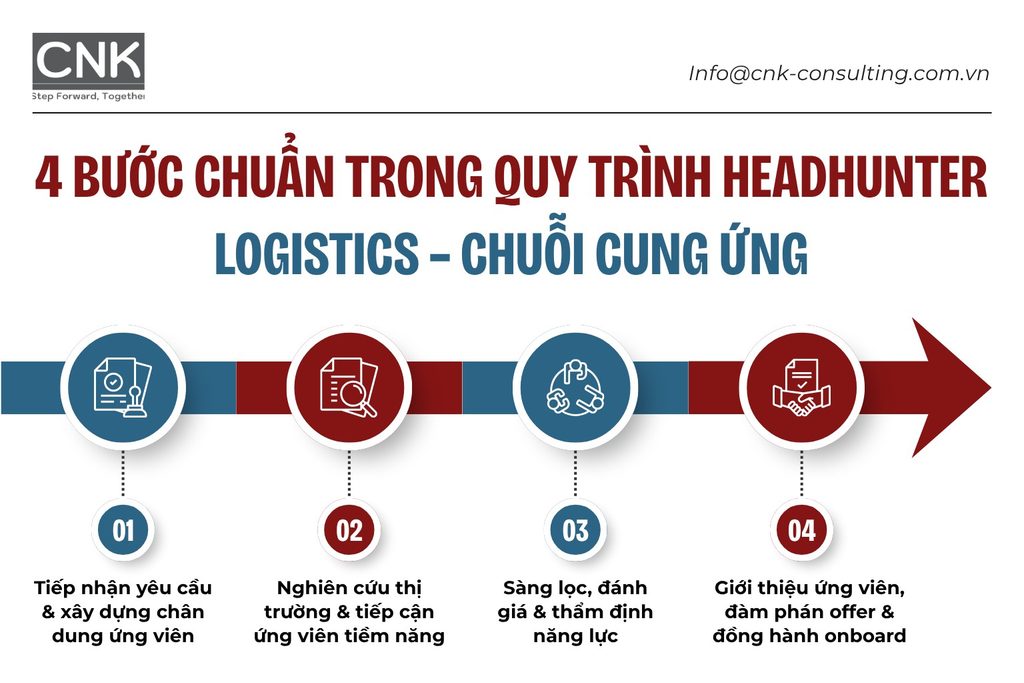
Step 1: Define the brief & candidate profile
The initial stage can account for up to 50% of a recruitment assignment’s success. Logistics executive search consultants work directly with the employer’s leadership team to:
- Clarify the job description and core KPIs: Define the operational milestones the candidate must achieve, such as reducing transport costs by 15%, shortening the inventory turnover cycle or digitising warehouse operations.
- Understand the company culture: Assess the working environment, whether a multinational group, family business or startup, to identify candidates with a suitable leadership approach and management style.
- Establish a competency framework: Define the candidate profile in terms of technical expertise (procurement, freight forwarding, customs and fleet management) and leadership capabilities (risk management, international contract negotiation and cross-functional management).
Step 2: Map the market & approach potential candidates
Once the candidate profile is complete, supply chain executive search consultants research the market to identify where suitable professionals work.
Beyond advertising vacancies and waiting for applications, consultants use talent mapping to build a list of target companies likely to employ suitable candidates.
The sourcing process typically follows this sequence:
Target Company → Target Position → Potential Candidate → Initial Qualification → Direct Approach.
A key priority is reaching passive candidates: professionals in stable employment who are not actively seeking a new opportunity. They often have substantial experience, extensive networks and significant management responsibilities.
This gives employers access to a talent pool that conventional in-house recruitment methods struggle to reach.
Step 3: Screen, assess & verify capabilities
Identifying potential candidates is only the beginning. For senior logistics and SCM roles, the priority is to establish what candidates have achieved, beyond the titles they have held.
At this stage, logistics executive search consultants conduct in-depth interviews to assess technical expertise and leadership capabilities.
Areas to explore may include:
- What scale of supply chain has the candidate managed?
- How many warehouses, transport routes or distribution centres were they responsible for?
- What cost optimisation projects have they delivered?
- Do they have experience managing 3PL providers, freight forwarders, carriers or shipping lines?
- How have they handled supply chain disruptions?
- How effectively have they managed budgets and P&L?
- How have they built and developed management teams?
- Which KPIs have they directly improved?
Consultants also cross-check information with candidates’ former managers, colleagues and business partners to verify their reported achievements, professional ethics and working style.
Step 4: Present candidates, negotiate the offer & support onboarding
A professional logistics and supply chain executive search assignment continues beyond submitting CVs, through to the candidate’s successful integration into the organisation.
- Present the shortlist: Provide the employer with 3 – 5 of the strongest candidates, accompanied by detailed consultant assessment reports.
- Support offer negotiations: Act as a neutral intermediary to help negotiate salary, bonuses, benefits and a compensation package acceptable to both parties.
- Provide onboarding support & a replacement guarantee: Stay in close contact with the candidate throughout the 2 – 3 months of probation to help them settle into their new environment. A replacement guarantee provides a free replacement if the candidate leaves within the agreed period, giving the employer confidence in its investment.
How search consultants assess Supply Chain Directors and Heads of Logistics
For Supply Chain Director and Head of Logistics roles, consultants look beyond job titles and years of experience. They typically focus on 3 competency groups: end-to-end thinking, management experience in complex environments, and leadership and technology capabilities.
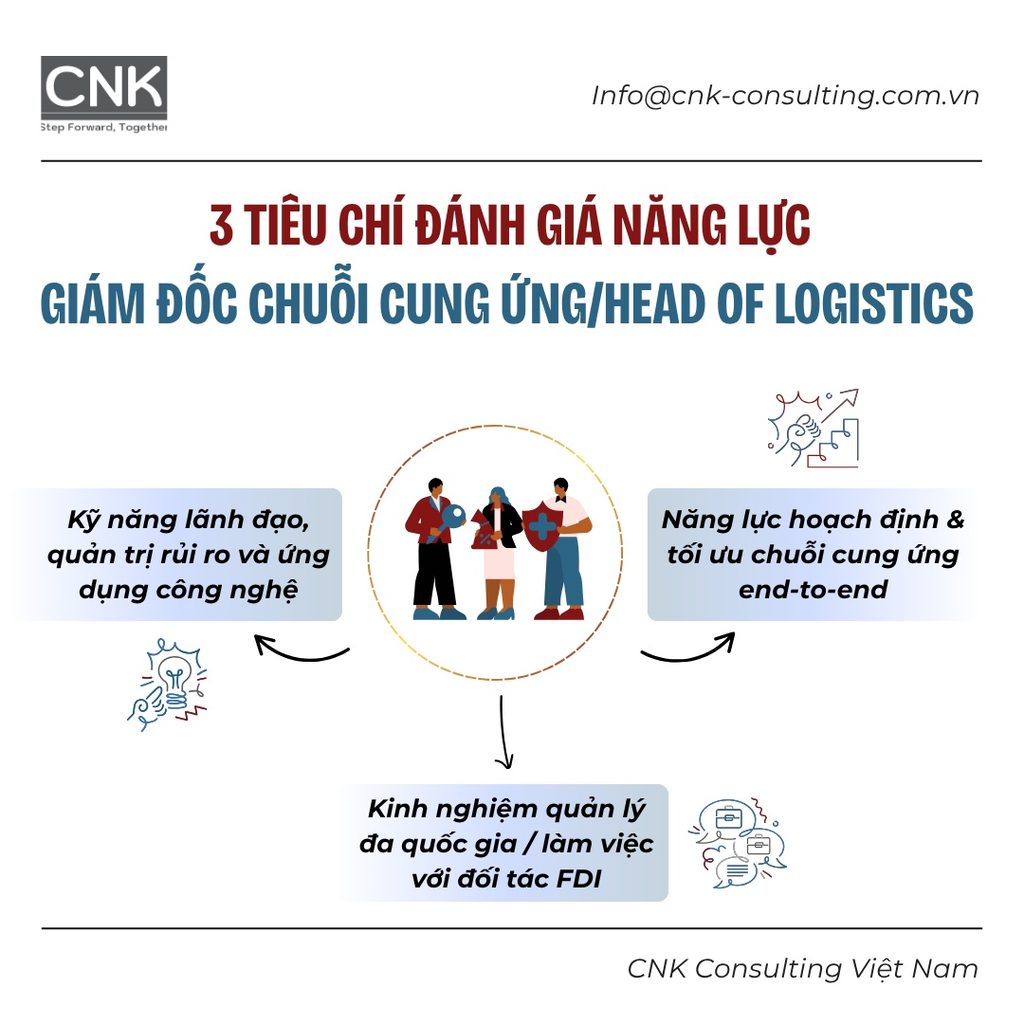
End-to-end supply chain planning & optimisation
A capable Supply Chain Director views the supply chain as an integrated system, rather than optimising each function in isolation. Logistics executive search consultants therefore assess the candidate’s ability to manage and connect the entire chain:
Demand Planning → Procurement → Production → Inventory → Warehousing → Transportation → Distribution → Customer.
Candidates must understand how KPIs interact. For example, cutting inventory too sharply can reduce service levels, while lowering transport costs at the expense of longer lead times can affect the customer experience.
Consultants may focus on questions such as:
- At what scale has the candidate designed or restructured a supply chain?
- How much have they reduced logistics or inventory costs?
- How do they balance cost, service levels, inventory and lead times?
- Do they have experience establishing S&OP or demand & supply planning processes?
- Have they redesigned a warehouse or distribution network?
- Can they develop KPIs and dashboards for the entire supply chain?
- How have they handled stock shortages, excess inventory or insufficient transport capacity?
For operationally focused Head of Logistics roles, consultants also need to assess warehouse and fleet management, 3PL providers, carriers, freight forwarding and transport networks in depth.
For roles involving maritime operations, imports and exports, or international transport, shipping recruitment specialists pay particular attention to experience with shipping lines, freight forwarders and cross-border logistics partners.
Multinational management experience / working with FDI enterprises
In an FDI enterprise, a Supply Chain Director must be able to coordinate with regional and global teams, international suppliers and stakeholders from different cultural backgrounds.
Logistics executive search consultants typically assess candidates’ experience in:
- Implementing group supply chain strategies in Vietnam.
- Managing multinational or cross-border operations.
- Working with global procurement and regional supply chain teams.
- Meeting group governance and compliance standards.
Experience with multinational groups is a significant advantage, particularly for employers expanding or restructuring their supply chains.
Leadership, risk management and technology capabilities (ERP, SCM software)
At leadership level, supply chain executive search consultants focus on team development, delegation, conflict management and the ability to lead change.
Candidates also need a risk management mindset, proactively identifying risks relating to supply, transport, inventory, suppliers and market fluctuations.
For technology, logistics executive search consultants assess experience using ERP, WMS (warehouse management systems), TMS (transport management systems), SCM software, and BI tools and dashboards to improve forecasting, control costs and optimise operations.
Logistics and supply chain executive search fees and timelines
Recruiting senior professionals such as a Supply Chain Director or Head of Logistics is a long-term strategic investment.
The reliance on passive candidates and the complexity of the expertise required mean that fees and search timelines in this segment often differ from those for conventional recruitment.
Indicative service fees
Logistics and supply chain executive search fees typically follow 2 main structures:
A percentage of total first-year compensation
This is the most common fee calculation method in executive search. Fees typically range from 20% – 33% of the candidate’s total first-year compensation, depending on the complexity of the role, talent scarcity and whether the search is domestic or international.
More senior roles and those requiring specialist expertise, such as in-depth knowledge of supply chains within FDI enterprises and multinational groups, typically attract fees towards the upper end of this range.
A fixed fee
Some logistics specialists and executive search firms offer retained search on a fixed-fee basis. They quote an overall fee, usually payable in 2-3 instalments linked to project milestones: contract signing, shortlist submission and the candidate’s receipt of an offer.
This model suits employers seeking budget clarity from the outset.
Typical time to find a suitable Supply Chain Director or Head of Logistics
Recruiting a Supply Chain Director or Head of Logistics typically takes considerably longer than filling a middle-management role. Few candidates on the market combine all 3 competency groups: end-to-end planning, multinational experience, and leadership and technology capabilities.
Based on the practical experience of logistics and supply chain executive search consultants, indicative timelines are:
- 6-8 weeks: For employers with relatively flexible requirements who are willing to consider candidates from related sectors, including manufacturing, retail and e-commerce.
- 8-12 weeks: For roles requiring extensive experience with FDI enterprises or multinational groups, or specific language skills and professional certifications such as CSCP or CPIM. This is also the most common timeframe quoted by supply chain executive search consultants.
- More than 12 weeks: For highly specialised roles, positions with salary budgets that are less competitive than market rates, or searches requiring experience in a very narrow geographical area or product category.
How to choose a trusted logistics and supply chain executive search firm
Choosing the right executive search partner helps employers save time, protect confidential information and appoint capable operational leaders quickly. Use these 3 core criteria to assess a specialist firm:
Sector experience and specialist networks
A credible firm needs consultants with a thorough understanding of supply chain functions (procurement, warehousing, freight forwarding and customs) and a clear grasp of market developments.
It must also maintain a strong private talent pool of capable supply chain directors and managers who are not actively job hunting but are open to a suitable opportunity.
A replacement guarantee after placement
A replacement guarantee reflects a search firm’s accountability and assessment capabilities. A professional firm should be prepared to commit to:
- A clearly defined guarantee period: Typically 60 to 90 days, or up to 120 days for C-level appointments.
- Free replacement terms: A commitment to conduct a replacement search at no additional charge if the appointed candidate fails to meet requirements or resigns during the guarantee period.
- Post-placement support: Regular follow-up and support as the candidate settles into the organisation during the initial months.
Case studies and evidence of successful assignments
Employers should ask prospective partners for evidence of their capabilities, rather than relying on promises:
- Number of senior roles filled: Review placement success rates for comparable roles, such as Supply Chain Director, Head of Logistics and Factory Logistics Manager.
- Client portfolio: Firms that have successfully worked with multinational groups, major 3PL/4PL providers, or manufacturing and retail businesses of a similar scale will understand your operational challenges.
- Assignment completion times: Assess how quickly the firm delivers a shortlist and the proportion of candidates who progress through employer interviews.
When assessing potential partners, employers can also consult this review of specialist IT recruitment firms in Vietnam for a broader perspective on search firms’ capabilities, candidate networks and sector expertise.
Choosing the right supply chain leader
Appointing the right logistics and supply chain leader directly affects costs and operational performance. Specialist executive search firms use their sector networks and assessment expertise to help employers find candidates whose capabilities align with their growth strategy.
Contact CNK Consulting Vietnam for executive search advice tailored to your organisation’s hiring needs.
CNK Consulting Vietnam
Strengthening human resource management
Hotline: +84 369 882 579
Email: info@cnk-consulting.com.vn
Address: 12BT.6 Thanh Bình Garden, No. 3 Nguyễn Cảnh Dị Street, Định Công Ward, Hanoi, Vietnam
References: