


An executive search startup offers considerable potential, but launching a business does not guarantee success. Many founders fail because they lack a clear strategy or misunderstand the industry. This article explores 6 essential considerations to help you avoid those mistakes before starting your firm.
Preparation: build a solid business foundation
To run an executive search startup efficiently and support sustainable growth, focus on the following 3 priorities. They will help you establish professional working practices from the outset.
Choose a niche to establish your position
Large recruitment firms already dominate the general recruitment market. Trying to serve every industry is a serious mistake for a startup. A clearly defined niche helps protect your position.
According to this in-depth analysis of Vietnam’s executive search market, recruitment demand is shifting strongly towards specialist fields such as IT, fintech and logistics, as well as middle and senior management roles.
Specialising in a particular field therefore helps shorten searches and improve your success rate in securing assignments. To identify a suitable niche:
- Build on the founder’s existing expertise and professional relationships.
- Research sectors where employers compete intensely for a limited supply of candidates.
- Prioritise niches where service fees support healthy margins.
Drawing on her experience, Lê Phương, Founder of CNK Consulting Vietnam, advises founders not to fear missing out on larger opportunities. Developing expertise in a niche helps you build credibility and a client base much faster than spreading your efforts too thinly and struggling to stand out.
Establish your credentials and legal status
A professional company profile and clearly established legal status are essential to earning employers’ trust. They also make it easier to secure assignments, particularly with large corporate clients.
Company profile
Your profile should cover:
- An introduction to the firm and its market positioning.
- Your specialist recruitment niche.
- Your executive search process.
- Case studies or relevant experience, where available.
- Quality commitments & your placement guarantee policy.
Legal status
- Incorporate the business as an LLC or equivalent.
- Register the relevant recruitment consultancy business activities.
- Prepare clear service agreements.
- Establish a transparent fee policy.
Brand presence
- A professional website optimised for search engines.
- A LinkedIn company page.
- Email addresses using your own domain; avoid personal email accounts.
Clear legal status and a professional company profile make it easier to approach corporate clients and avoid being dismissed as “a freelancer with limited credibility”.
Develop standard operating procedures for executive search
Standard operating procedures (SOPs) help an executive search startup work consistently, save time and scale as the team grows.
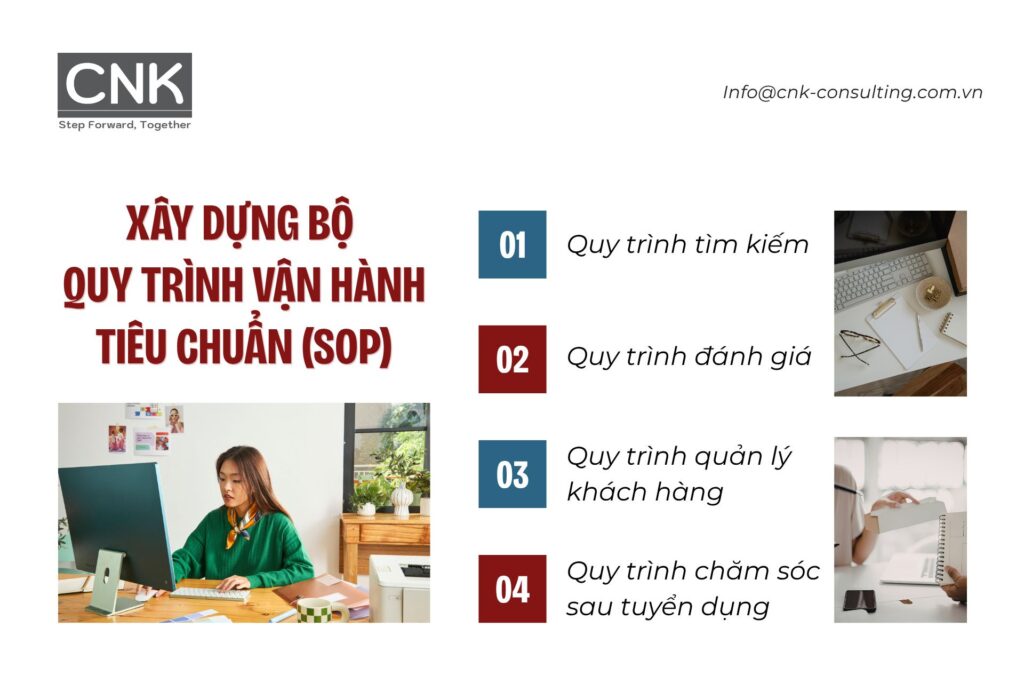
A comprehensive set of SOPs should include:
- Candidate sourcing: How to use LinkedIn and Boolean search, and how to approach passive candidates.
- Candidate assessment: Standard interview questions and criteria for assessing interpersonal skills and cultural fit.
- Client management: How to take a job description (JD) brief, provide regular reports and share feedback after interviews.
- Post-placement support: How to monitor candidates’ progress during probation, address emerging issues promptly and prevent the placement guarantee from being triggered.
Based on her experience, Lê Phương, Founder of CNK Consulting, recommends documenting all SOPs digitally in work management tools such as Notion, Trello or a dedicated applicant tracking system (ATS). This helps new team members get up to speed without constant, direct guidance from you.
>> Learn more about CNK Consulting Vietnam’s executive search process
What if your candidate database is still small?
Candidate data is a core asset for an executive search startup. You do not need a vast database from day one. What matters is how effectively you source candidates, maintain relationships and turn those relationships into placements.
Source candidates through LinkedIn, Facebook and professional communities
LinkedIn, Facebook and professional communities offer free sources of candidate information, but finding suitable people takes skill. Use more targeted search techniques to identify overlooked talent:
- Master Boolean search on Google & LinkedIn: This is a key tool for an executive search consultant. Use the operators AND, OR, NOT and quotation marks (“” ) to uncover profiles that are difficult to find. For example: site: [linkedin.com/in/](https://linkedin.com/in/) “Python Developer” AND “Fintech” AND “Ho Chi Minh”.
- Participate in Facebook & Zalo communities: Go beyond routinely posting vacancies. Join specialist groups and follow discussions to identify experts and people who may be considering a change of employer.
- Use X-ray search: Search specialist websites such as GitHub and Stack Overflow for IT candidates, or Behance for creative professionals, to find portfolios alongside conventional CVs.
- Explore webinar and event attendee lists: People who actively invest in learning and keeping their knowledge current are among the most promising candidates to prioritise.
Keep your talent pool current
A professional search startup builds a talent pool it can draw on whenever an assignment arises. Collecting CVs is only part of that work: focus on candidates’ current availability and engagement, as well as the size of the database.
Classify candidates by readiness to move, using 3 groups:
- Hot: Ready to change jobs.
- Warm: Settled in their current role but open to hearing about opportunities.
- Cold: No recent contact.
Establish a process for reconnecting:
Every 3-6 months, send a brief email or message asking about the candidate’s career progress. Updating their current position and newly acquired skills keeps your records accurate.
Use digital tools to manage your records:
From the outset, use an applicant tracking system (ATS) or a well-designed Notion or Trello board to organise candidates by skills, salary expectations and the date of your most recent interaction.
Approach and engage passive candidates
Passive candidates are people who are not actively looking for a job. They are also the highest-quality candidate group that every client wants to attract. Engaging them requires a thoughtful, consultative approach.
- Personalise your introduction: Avoid template messages. Start by acknowledging a project or article they have shared on LinkedIn. Show that you have researched their background before making contact.
- Present the career opportunity: Before sending the JD, explain what the move could offer. For example: “This role would let you address the challenge X that interests you,” or “This is a stepping stone towards a C-level role within the next 2 years.”
- Establish yourself as a trusted adviser: Share useful market information, average industry salaries or emerging technology trends. When candidates trust your expertise and commitment, they will approach you when they want to change jobs.
- Be persistent without becoming intrusive: If someone declines, politely ask whether you can stay in touch. A candidate on today’s follow-up list may become a successful placement in the future.
A small database need not be a weakness if you use it effectively. Managing these 3 areas well will help your database grow into a lasting competitive advantage.
How can a new agency earn employers’ trust?
For an executive search startup, the biggest barrier is often a lack of employer trust, rather than a shortage of candidates. Clear positioning, effective outreach and professional contract management can help a new firm secure assignments from large clients.
Approach large employers as a small startup
Be open about your size. A startup’s personal commitment and flexibility can be valuable competitive strengths when approaching large employers:
- Expand your client base gradually: If you have yet to establish your credentials, start with medium-sized enterprises (SMEs) or startups that have secured Series A or B funding before targeting the largest corporations. Completing 3-5 successful assignments gives you a track record to present to larger clients.
- Use the founder’s personal brand for direct outreach: Build the founder’s presence on LinkedIn. A direct “Founder to CEO” or “Founder to HR Manager” message carries much more weight than an anonymous marketing email sent to a general company inbox.
- Demonstrate results when presenting your services: Replace a generic statement such as “We provide executive search services” with a specific example: “We recently helped a fintech company hire 2 senior developers within 14 days.” Concrete figures provide the strongest evidence of your capabilities.
Negotiate contracts and protect your fees
Many new search firms cut fees to win assignments. This can inadvertently make clients question the quality of their candidates.
Explain your value in terms of cost per hire. Help clients understand that a failed senior hire can cost many times more than an executive search fee. When you demonstrate your ability to find the right person, a fee equivalent to 2-3 months’ salary is reasonable.
You can offer flexibility in the payment structure while maintaining the fee. Instead of reducing it from 20% to 15%, propose staged payments: a deposit, a payment when the candidate starts and a final payment when they pass probation. Alternatively, offer a longer placement guarantee.
Be prepared to decline assignments with excessively low fees or demanding terms, such as a 6-month guarantee. A credible search startup needs to recognise the value of its work and candidate database.
Manage late payments and clients who refuse to pay
Cash flow is critical to a search startup. Unpaid service fees can force the business into bankruptcy even when it has plenty of signed assignments.
Set clear contractual terms from the outset:
- Specify the payment deadline, for example within 7-15 days of the candidate’s start date.
- Include late-payment penalties to encourage compliance.
Follow up tactfully but firmly
- 3 days before payment is due: Send an email reminder with the electronic invoice.
- 1 day overdue: Call the accounts team or hiring manager directly to check the status. The delay may simply be an administrative issue.
- 7 days overdue: Send a formal payment reminder on behalf of the firm.
Before signing a contract, ask within recruiter communities about the employer’s payment record. If a company has a history of unpaid debts, require a partial advance payment before starting the search.
How many people does a new search firm need?
For a new executive search startup, the ideal team typically consists of 2 to 5 people. The founder usually acts as the lead consultant, handling external relationships and securing assignments while the rest of the team focuses on delivery.
Should you use freelance recruiters or permanent employees?
Working with freelance recruiters is a common way for search startups to control costs and maintain flexibility in their early stages.
When to use freelance recruiters:
- During the early stages, when cash flow is not stable enough to cover fixed salaries, insurance and office costs.
- When taking on assignments in an unfamiliar niche, where an established industry network can help you find candidates quickly.
- The advantage: lower operating costs, with payment tied to results.
When to hire permanent employees:
- When you want to build a company culture and protect the confidentiality of your candidate database.
- When you need to maintain consistent response times for clients.
Based on our team’s experience, we recommend starting with a hybrid model. Keep a small core team to manage the business and use a broader network of freelance recruiters to extend your candidate sourcing across different market segments.
Design commissions that retain employees and freelance recruiters
Commission is a major source of motivation in executive search. An attractive commission structure helps you recruit and retain capable people. Consider the following approach:
For permanent employees, use the formula: [Base salary + % Commission].
- Commission typically ranges from 10% – 30% of total revenue, depending on the base salary.
- Offer additional bonuses for exceeding monthly or quarterly KPIs to encourage consultants to take on difficult assignments.
Freelance recruiters receive no base salary, so their commission should be higher, typically from 30% to 50%.
Pay commissions promptly once the client settles the service fee. Delayed commission payments can quickly cause a startup team to fall apart.
Train your team in interviewing and candidate assessment
The quality of a search startup is reflected in the proportion of candidates clients accept, rather than the volume of CVs it submits. Consultants need to go beyond CV screening and assess whether each candidate has the capabilities the employer requires.

Train your team in these 4 skills to improve placement success:
- Behavioural interviewing: Teach consultants to structure questions using the STAR model (Situation – Task – Action – Result). Replace questions such as “Are you a good manager?” with “Tell me about a time you resolved a conflict within your team. What was the outcome?”
- Assessing cultural fit: This helps reduce candidate departures during the guarantee period. Consultants need to understand the client’s culture to identify candidates who will work well within it.
- Presenting career opportunities: Executive search involves high-level sales skills. Train consultants to identify candidates’ needs, understand their concerns and explain how a role could support their career progression.
- Reference checking: Teach the team how to approach candidates’ former managers tactfully to verify information and reduce the risk of fabricated CVs damaging client trust.
Manage risk and maintain sustainable cash flow
The greatest risk for a search startup is often having assignments but failing to receive payment on time, or encountering problems after a candidate starts work.
Effective risk management protects your reputation and keeps cash available for reinvestment.
Handle candidate departures during the guarantee period
This is the most common risk in executive search. Under standard industry practice, guarantee periods are typically 30, 60 or 90 days. If a candidate leaves during this period, you must find a replacement free of charge or refund the fee.
Identify the root cause
When a candidate leaves, conduct a brief exit interview. If the employer is responsible, for example because of a misleading job description or a toxic workplace culture, you have grounds to renegotiate the guarantee terms. If the issue lies with the candidate, start the replacement search promptly to protect your reputation.
Reduce risk from the outset
Stay involved after the candidate signs the employment contract. Maintain regular contact during the first 1-3 months. Listening to the difficulties they encounter helps you intervene promptly or advise the employer on retaining them.
Maintain a financial reserve
Do not spend the entire service fee as soon as it arrives. Set aside approximately 20-30% of revenue until the candidate’s guarantee period ends, so you can cover operating costs if a replacement search becomes necessary.
Control operating costs and manage receivables
Reliable cash flow keeps the business operating. Maintaining it requires a practical financial management strategy:
Control fixed costs
During the startup stage, consider coworking spaces or remote working. Reserve significant investment for tools that directly generate revenue, such as LinkedIn Recruiter accounts or an ATS.
Manage receivables actively:
- Assess clients by payment risk: Review each client’s payment history. For new clients or startups without an established reputation, require an upfront payment (retainer fee) before starting the assignment.
- Automate payment reminders: Use professional email templates for reminders before and after the due date. Call the accounts team directly when necessary to confirm payment progress.
Diversify your revenue:
Avoid relying on 1-2 large clients. If a single client accounts for more than 40% of revenue, losing that relationship or receiving payment late creates a substantial risk.
Grow from a freelance practice into a professional agency
Many founders start as freelance recruiters and aim to build a professional search firm. Growth requires a clear strategy; otherwise, your operating systems can quickly become overwhelmed. The following roadmap outlines the transition from freelance practice to professional agency:
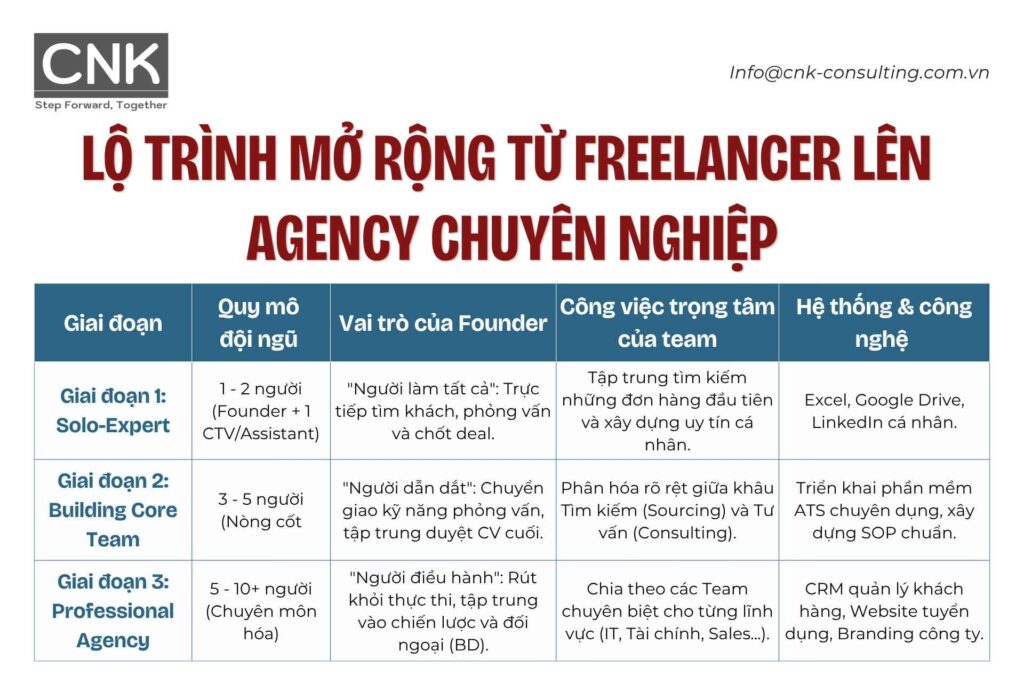
Following the roadmap in the table above requires a clear understanding of the relevant tools and processes, and the ability to apply them effectively. These 3 foundations help an agency move from informal working practices to structured operations:
SOP — Standard Operating Procedure
In recruitment, SOPs define how the business works and the standards it expects.
As the team grows, SOPs ensure every consultant follows the same high standards for interviewing, reference checking and client service.
Well-designed SOPs reduce the risk of candidates withdrawing and shorten training for new employees from several months to a few weeks.
ATS — Applicant Tracking System
While Excel provides a place to record information, an ATS helps you manage the entire candidate lifecycle.
Once you hold thousands of profiles, you cannot rely on memory to track previous interviews or candidates’ skills. An ATS automates CV screening, stores interaction histories and measures conversion rates for each vacancy.
An ATS helps a startup maintain a current talent pool, allowing consultants to retrieve promising candidates in seconds instead of starting another LinkedIn search from scratch.
BD — Business Development
In executive search, business development involves identifying and building relationships with employers that need to hire.
Recruitment business development requires strategic advice beyond a conventional sales approach. You offer solutions that help employers build the workforce they need to grow.
As the agency becomes more established, the founder should focus on business development to secure exclusive assignments or searches for C-level roles, directors and senior managers. These assignments offer high margins and strengthen the agency’s market position.
Our team’s experience suggests you should establish these practices before the business becomes large. Develop SOPs while you are still working alone, and introduce an ATS when you have your first 100 CVs. Preparing your systems early helps your startup grow faster than competitors in the same segment.
Building a sustainable search firm
Building an executive search startup involves market positioning, clear processes, risk management and cash flow control alongside candidate sourcing and CV submissions. Establishing these foundations early gives a startup the ability to grow sustainably and compete with larger agencies.
CNK Consulting Vietnam
Executive search and specialist recruitment for high-quality talent in Vietnam
Hotline: +84 369 882 579
Email: info@cnk-consulting.com.vn
Address: 12BT6 Thanh Bình Garden, No. 3 Nguyễn Cảnh Dị, Định Công Ward, Hanoi, Vietnam
References:
- Herohunt.ai: How to start a recruitment agency (complete guide 2024) (A guide to starting a recruitment agency).
- Fronted – Top Recruitment Strategies for Startups: Boost Your Team (Leading recruitment strategies for startups).
- Digipal: Effective Startup Recruitment Strategies (Effective recruitment strategies for startups).
Receive workforce market updates
Recruitment, talent market and workforce development updates from CNK.