

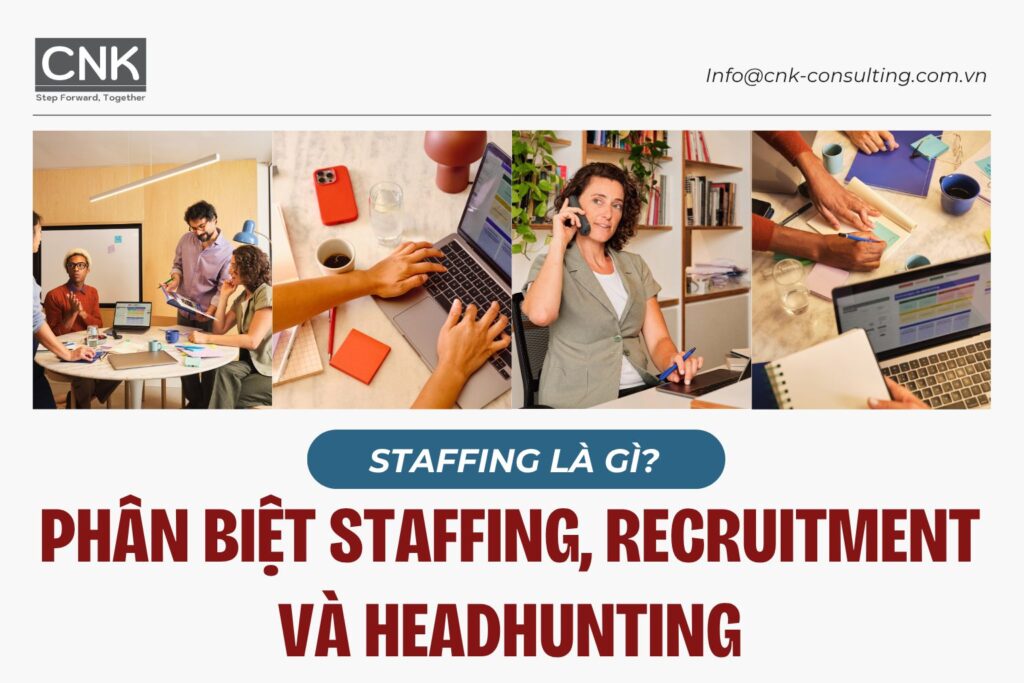
Maintaining a large permanent workforce puts substantial pressure on operating costs. Imagine a workforce that could expand or contract within days, without legal barriers. This article explains staffing and compares it with recruitment and headhunting, helping HR directors and C-suite leaders choose an approach that meets their business needs.
What is staffing? Its role in workforce management
Staffing helps employers source, deploy and manage people according to actual business needs, rather than relying solely on permanent recruitment.
It goes beyond filling roles to balance headcount, workforce capabilities, assignment duration and operating costs.
This is why employers increasingly use staffing services when workforce demand fluctuates or they need people at short notice.
Defining staffing: HR management and executive search perspectives
To understand what staffing means, consider 2 perspectives: internal workforce management and professional recruitment services.
- From an HR management perspective: Staffing is an ongoing process of identifying workforce needs, attracting and selecting candidates, assigning responsibilities, training employees and retaining people to support organisational objectives. It is 1 of the 5 core management functions: planning, organising, staffing, leading and controlling.
- From an executive search perspective: Staffing usually refers to external workforce provision, or staffing services. A professional staffing agency sources and screens candidates and may directly manage employment relationships for temporary, project-based or long-term assignments on behalf of its client.
Managers often confuse staffing with recruitment. Recruitment is a stage within the broader staffing process.
Recruitment focuses on attracting candidates and filling vacancies. Staffing also covers headcount planning, capability management and maintaining an appropriate workforce throughout the business’s operating lifecycle.
Traditional staffing versus agile and modern HR models
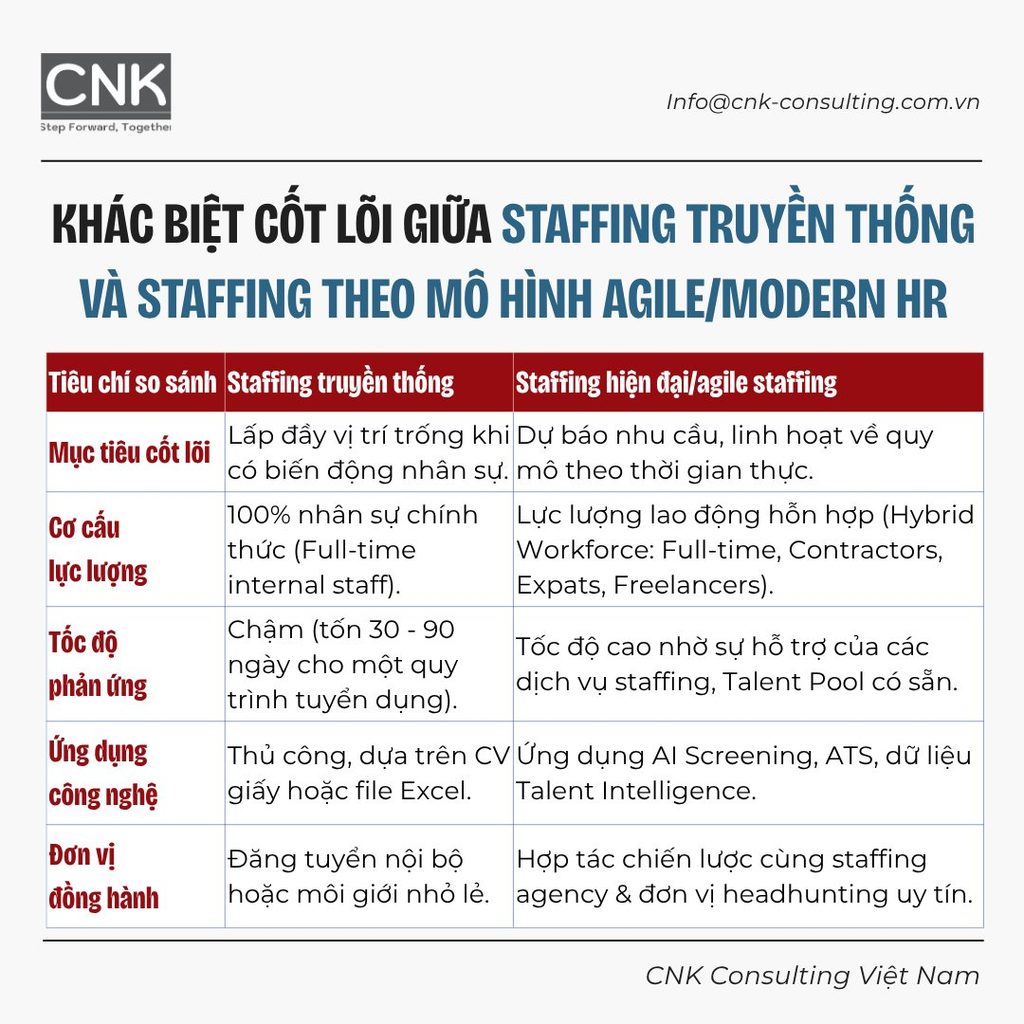
Changes in the global labour market have reshaped staffing. The comparison below illustrates this shift in workforce strategy.
Why employers use staffing to manage operating costs
Understanding staffing also means examining its financial benefits and return on investment (ROI).
- Converting fixed costs into variable costs (CAPEX to OPEX): An oversized permanent workforce creates substantial fixed payroll and benefit costs, including social insurance, bonuses, health insurance and workspace. Staffing services convert payroll expenditure into service fees that vary with revenue and project scale.
- Reducing hidden recruitment costs: Prolonged vacancies directly reduce revenue. Working with a staffing agency that maintains a strong talent pool can shorten recruitment and initial training time by up to 70%.
- Reducing legal and employment administration risks: Understanding the relationship between staffing and recruitment helps employers delegate complex tasks to an external provider, including employment contracts, payroll, insurance contributions and labour dispute resolution.
- Strengthening FDI enterprise competitiveness: FDI enterprises entering Vietnam often choose professional staffing services to establish operations quickly without barriers from local administrative procedures.
Common staffing models
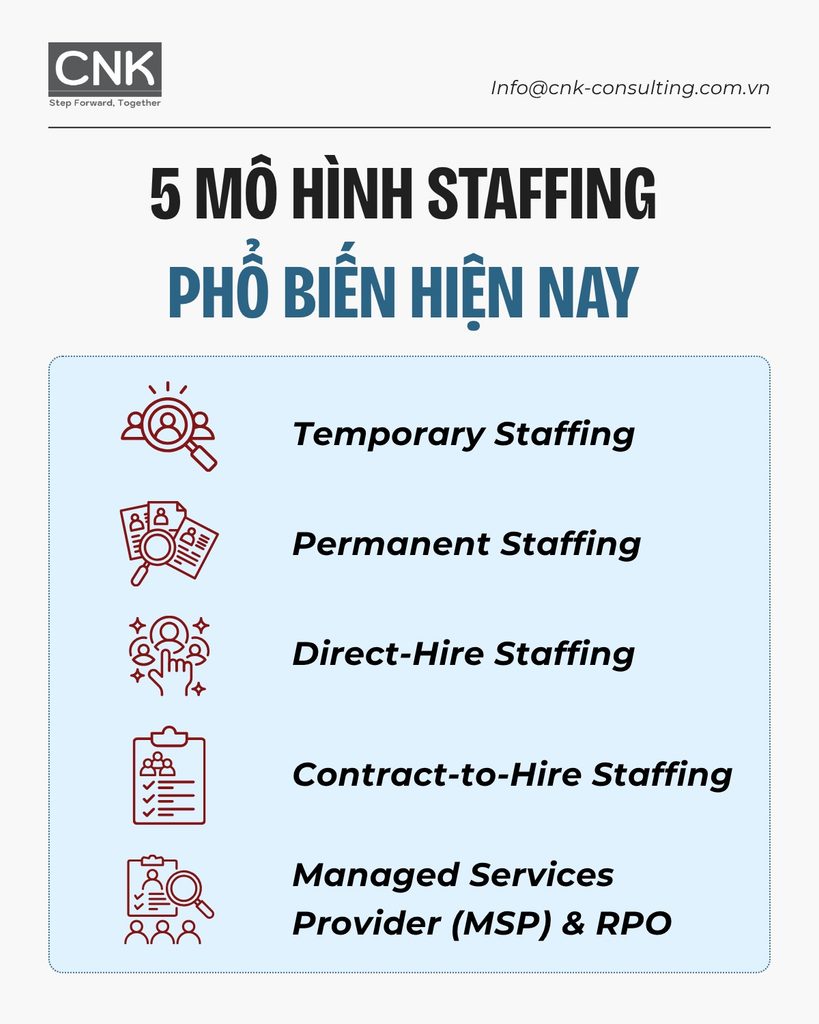
Staffing encompasses several models. Employers, particularly foreign direct investment (FDI) enterprises, choose different arrangements according to their business strategy, project cycles and financial resources.
Temporary and project-based staffing
Temporary staffing provides people for a defined period, ranging from a few weeks to a few months, to cover immediate workforce gaps or support short-term projects.
The staffing agency acts as the legal employer. The client pays an hourly or monthly fee under a service agreement.
Typical uses include managing peak-season workloads, covering maternity leave and delivering short-term audit or IT projects.
Permanent staffing
Permanent staffing involves recruiting long-term employees with sourcing, assessment and screening support from an external provider. Once the employee successfully completes probation, the employer signs the employment contract directly and provides all benefits and insurance.
Employers use this model for core roles and specialist positions that require a long-term commitment and strict confidentiality around the company’s core operations.
Direct-hire staffing through a 3rd party
The employer delegates all candidate sourcing and screening to a service provider. Once it selects a suitable candidate, it hires that person directly, without an initial temporary assignment.
This approach gives employers access to high-quality candidates without the cost of maintaining a large internal recruitment team.
It suits employers that need to recruit middle managers, senior leaders or specialists quickly, particularly when their internal HR team lacks sufficient candidate data.
Assessing fit before permanent employment: contract-to-hire staffing
Contract-to-hire combines a fixed assignment with the possibility of permanent employment. The candidate initially works as a contractor through a staffing agency for a defined period, usually 3–6 months. If the candidate meets performance targets (KPIs), the employer offers a permanent contract.
Key feature: The initial assignment gives both the employer and the individual an opportunity to assess cultural fit and practical capabilities.
Typical use: Reducing the risk of an unsuitable hire for a critical role or a position involving new technology.
Process outsourcing: managed services providers (MSP) and RPO
Definitions:
- RPO (Recruitment Process Outsourcing): Delegating all or part of the recruitment process to an external HR consultancy.
- MSP (Managed Services Provider): A provider that manages an employer’s entire contingent workforce and its supporting staffing suppliers.
Key feature: These models provide workforce management at scale, improving workforce systems and recruitment processes against agreed service-level measures (SLAs).
Typical use: Multinational corporations recruiting hundreds to thousands of people each year across multiple geographical locations.
Staffing, recruitment and headhunting: a detailed comparison
Managers exploring staffing often confuse it with conventional recruitment and headhunting, or executive search.
All 3 aim to meet employers’ workforce needs, but they differ substantially in strategy, operating model and the value they provide.
Comparing 6 core criteria
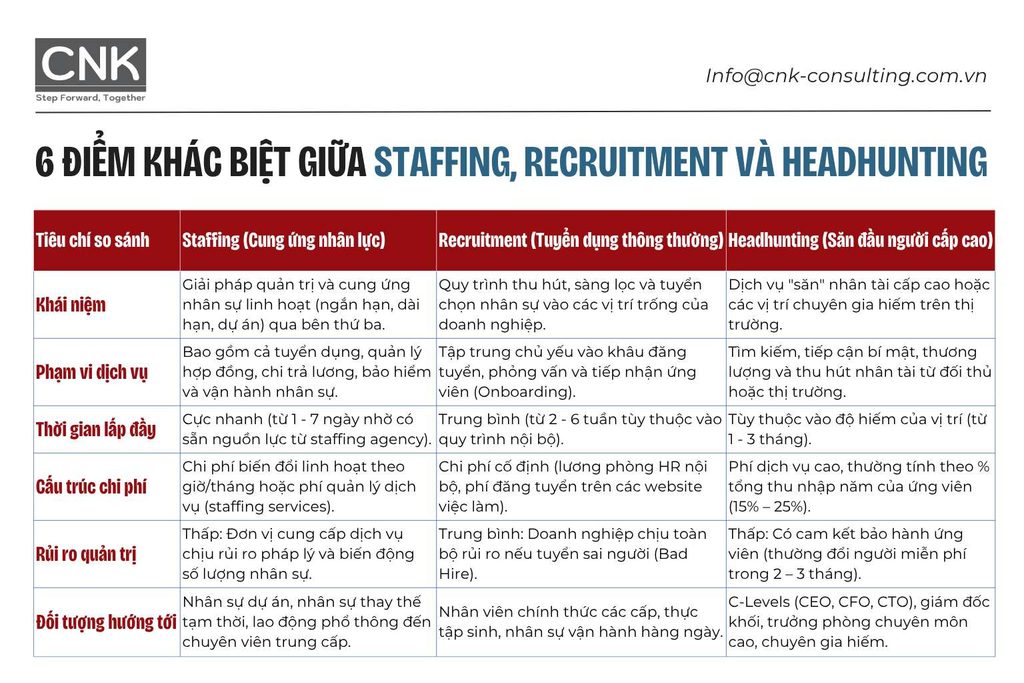
The comparison below covers 6 key criteria to help employers assess their options before appointing a recruitment or staffing partner.
Employment contracts and legal responsibilities
A core distinction between staffing and recruitment is the legal relationship among the 3 parties: the client company, the employee and the staffing or recruitment provider.
- Under the staffing model: The individual is legally employed by the staffing agency. The agency signs the employment contract, pays social and health insurance contributions, handles personal income tax finalisation, pays monthly salaries and manages termination procedures or labour disputes. The client company manages day-to-day work and pays an agreed staffing service fee.
- Under recruitment and executive search models: The consultancy acts as an intermediary through its recruiter or executive search consultant. Once the successful candidate joins, the employer signs the employment contract directly. All subsequent legal obligations, benefits, insurance responsibilities and employment risks rest entirely with the employer.
Candidate reach: active and passive talent
The candidate sources and outreach methods used by these 3 approaches shape the effectiveness of each assignment.
- Conventional recruitment: Primarily reaches active candidates who submit CVs through job boards and social media. Candidate quality varies, and this approach can miss strong performers who are settled in their current roles.
- Staffing services: Draw on extensive databases of immediately available candidates and flexible workers. Staffing agencies use established processes to deploy suitable people at a scale and speed that internal recruitment teams may struggle to match.
- Specialist executive search: Directly targets passive candidates: skilled professionals and senior executives who are not looking for a new role. Executive search consultants use extensive networks, social engineering techniques and persuasion to approach candidates discreetly and encourage them to consider a move.
When should employers choose staffing over direct recruitment or executive search?
Once leaders understand what staffing is and how it differs from recruitment, the next question is when it offers the greatest financial and operational benefit.
No workforce solution suits every situation. However, professional staffing services can offer a strategic advantage over direct recruitment or executive search in the circumstances below.
Case study 1: An FDI enterprise establishes operations quickly in Vietnam
Context: A multinational retail group from Singapore enters Vietnam with plans to open 15 stores across Hanoi and Ho Chi Minh City within 3 months.
Challenge: The group has not fully established a local employing entity, lacks familiarity with Vietnamese labour law and cannot wait 6 months to build an internal HR department before recruiting hundreds of employees.
Staffing solution: The group appoints a local staffing agency to provide a comprehensive staffing service.
- The staffing agency handles: Sourcing and recruiting all store managers, sales staff, cashiers and warehouse staff; signing employment contracts as the employer; paying salaries; and meeting social insurance and tax obligations.
- The FDI enterprise focuses on: Setting up infrastructure, transferring operating procedures and developing its marketing strategy.
Outcome: 100% of stores open on schedule. The group saves 45% on initial operating costs and completely eliminates employment-related legal risks in the new market.
>> Further reading: A recruitment roadmap for FDI enterprises entering Vietnam
Case study 2: A technology company urgently needs senior specialists for a short-term project
- Challenge: A fintech company urgently needs 5 senior IT engineers specialising in DevOps or backend development for 6 months to complete its core banking system. Executive search would be relatively expensive, at 15%–25% of total annual compensation. Direct recruitment could take 2 months and create difficulties when ending employment contracts after the project.
- Staffing solution: The company adopts a contract-to-hire model. The staffing agency immediately assigns 5 IT specialists from its existing talent pool as contractors.
- Outcome: The project launches on time. At the end of 6 months, the company retains 2 outstanding performers as permanent employees. The remaining 3 return to the agency without compensation costs for the client.
Case study 3: Managing seasonal workforce demand in manufacturing and retail
- Context: A fast-moving consumer goods (FMCG) manufacturing group enters its peak production period for Tet, from October (month 10) to January (month 1) of the following year. Workforce demand at its packaging plants and logistics facilities increases by 200%.
- Challenge: This situation highlights the distinction between staffing and recruitment. If the internal HR team directly recruits 300 short-term workers, application screening and employment administration will overwhelm its capacity. Unplanned departures could also disrupt the supply chain.
- Staffing solution: The group uses temporary staffing for seasonal labour. The staffing agency is responsible for maintaining a headcount of 300 workers at the factory and must replace any departing worker within 24 hours.
- Outcome: The group maintains 100% factory capacity throughout the 4 peak months. After Tet, workforce numbers automatically return to normal without labour disputes or redundancy payment costs.
A workforce service selection matrix for HR directors and C-suite leaders
The matrix below helps leaders choose a service based on 3 variables: the nature of the role, project duration and the employer’s budget.
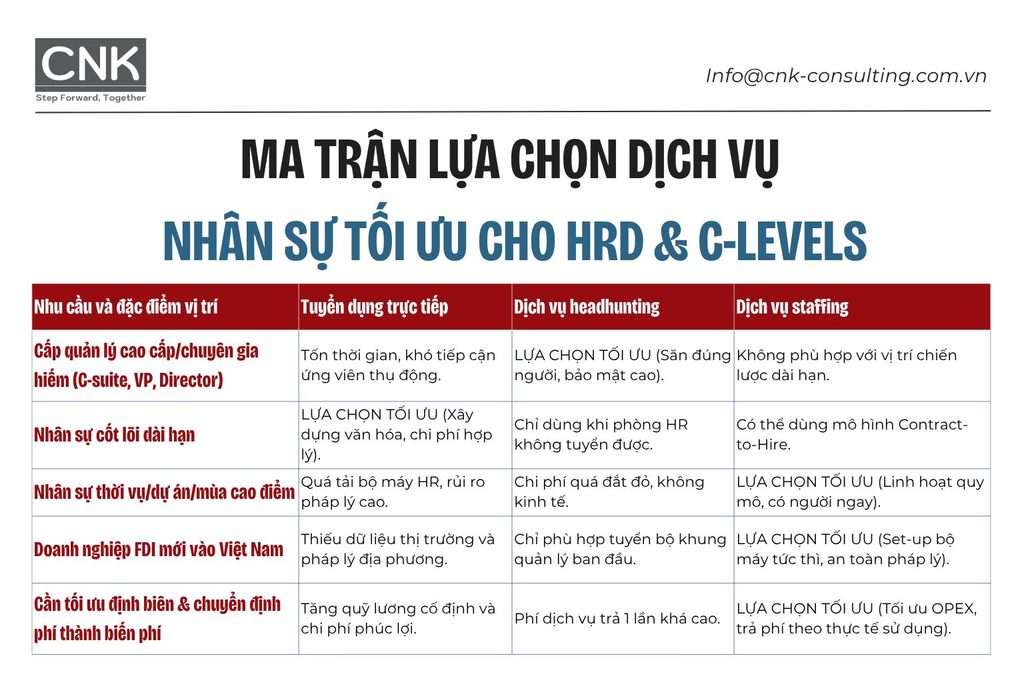
In the experience of CNK Consulting’s executive search consultants, no model is universally ideal. Staffing, recruitment and executive search each have distinct strengths. Employers should combine them according to their actual needs rather than apply a single approach rigidly.
Choosing the right approach
Understanding staffing helps employers choose a workforce solution that matches their timing, scale and job requirements. Staffing suits flexible workforce needs, while recruitment and executive search are better suited to long-term hiring, specialist positions and senior roles.
CNK Consulting Vietnam
Strengthening HR management capabilities
Hotline: +84 369 882 579
Email: info@cnk-consulting.com.vn
Address: 12BT.6 Thanh Bình Garden, No. 3 Nguyễn Cảnh Dị, Định Công Ward, Hanoi, Vietnam
References: