

Not every HR professional has the technical expertise to assess a CTO. A hiring mistake at this level can cost an employer billions of VND in lost opportunities. CTO recruitment services address this challenge, from candidate screening to replacement guarantees.
What are CTO recruitment services?
CTO (Chief Technology Officer) recruitment is a specialist executive search service that helps employers identify and recruit leading technology professionals.
CTO, VP of Engineering and Head of IT: understanding the differences
Employers often confuse the responsibilities of a CTO, VP of Engineering and Head of IT. This can lead to inaccurate job descriptions and make it harder to attract suitable candidates.
- CTO (Chief Technology Officer): Takes an external, strategic perspective. The CTO sets the technology vision, brings innovation into products and services, anticipates market trends and builds the company’s core competitive advantage.
- VP of Engineering: Focuses internally on execution. While the CTO asks “What technology should we build to lead the market?”, the VP of Engineering asks “How will we build it, and who will deliver it?” This role manages software development processes, improves engineering team productivity and keeps projects on schedule.
- Head of IT: Focuses on operating internal infrastructure. The Head of IT manages telecommunications networks, hardware, office software, internal information security and technical support to keep the business running smoothly each day.
Understanding these responsibilities helps employers write accurate job descriptions, select an appropriate recruitment approach and avoid appointing the wrong technology leader.
Why CTO recruitment calls for executive search
Recruiting C-level technology leaders places demanding requirements on internal HR teams. Working with an executive search firm or a specialist CTO search consultant offers an effective solution for the following reasons:
Strong candidates are often passive candidates
Accomplished CTOs typically hold key positions at large corporations or rapidly growing startups. They rarely submit CVs through mainstream job boards.
Only search consultants with extensive industry relationships can reach these candidates and persuade them to consider a new opportunity.
The role demands both technical and management expertise
A senior technology leader needs more than expertise in infrastructure architecture and core technologies. They must also understand financial management, people development and commercial strategy.
Executive search consultants use a multidimensional assessment process to identify candidates who combine technical insight with business judgement.
Complete confidentiality
Replacing or appointing a technology leader often involves restructuring decisions or confidential product strategies.
A confidential search allows employers to approach candidates discreetly, avoiding internal uncertainty or disclosure to the wider market.
Faster recruitment and a lower risk of a poor appointment
A poor executive appointment can carry substantial costs, including financial losses and delays across the technology function.
The executive search process shortens the search, includes thorough reference checks and provides employers with a long-term replacement guarantee.
Assessing CTO candidates: technical requirements and R&D capabilities
Selecting the right technology leader requires a comprehensive assessment framework that goes beyond a standard interview process.
An outstanding CTO combines a strong technical foundation with the strategic ability to shape the organisation’s technology future.
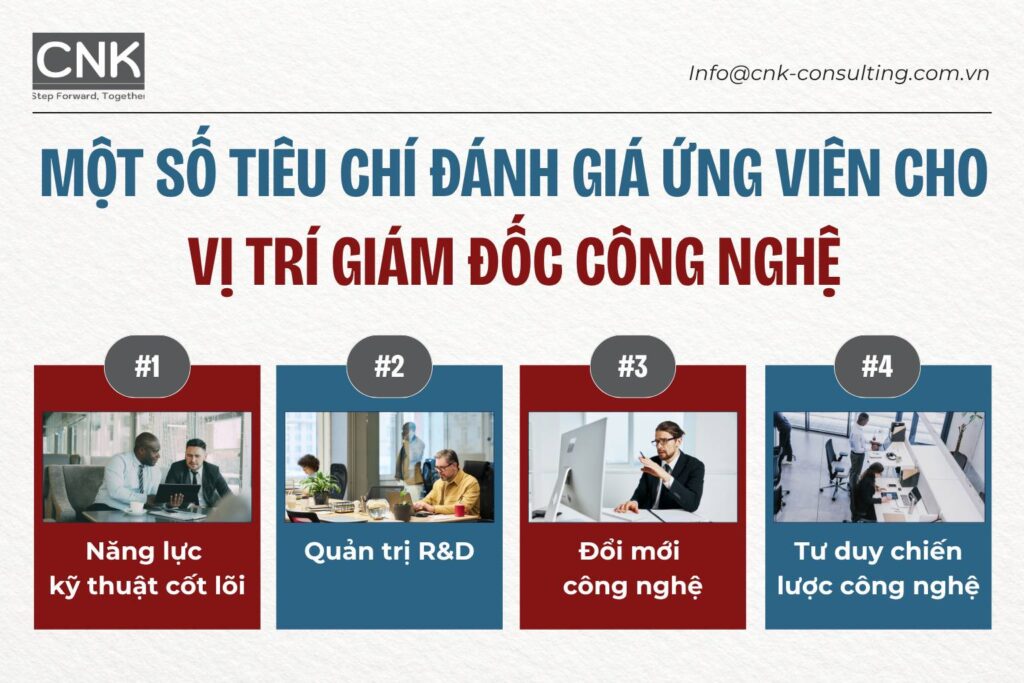
Core technical capabilities
A strong technical foundation is essential for earning engineers’ trust and making sound architectural decisions.
- System architecture & scalability: Candidates must be able to design and shape software architecture and cloud infrastructure that can handle heavy workloads, maintain strong security and scale as the business grows.
- Command of core technologies: A capable technology leader does not necessarily need to write code daily, but must understand core technologies, testing processes, continuous integration and continuous deployment (CI/CD), and information security standards in depth.
- Complex technical problem-solving: The ability to assess technology risks, manage critical system incidents and make trade-offs between time to market and technical debt.
Experience in R&D management and technology innovation
Research and development (R&D) drives long-term competitive advantage.
- Anticipating and testing new technologies: The judgement to assess emerging technologies, including AI, machine learning, big data and blockchain, and select practical applications without wasting resources on technology trends for their own sake.
- Building effective R&D processes: Setting performance measures (KPIs/OKRs) for R&D, managing research budgets and turning experimental ideas into commercially successful products or features.
- Protecting intellectual property: Experience with copyright registration for algorithms, patent registration and protection of the company’s technology intellectual property.
Aligning technology strategy with business objectives
This is the clearest distinction between an excellent technical team leader and a C-level CTO. Specialist CTO search consultants make it a priority when assessing candidates:
- Turning business objectives into technology strategy: The ability to translate the board’s growth ambitions into specific product and infrastructure roadmaps spanning 1, 3 and 5 years.
- Optimising technology spending and ROI: Balancing investment in infrastructure and technical staff against the business value generated, ensuring that every VND spent on technology delivers measurable returns.
- Cross-functional communication and collaboration: The ability to explain complex technical concepts in clear business terms when working with the CEO, CFO, CMO and investors.
How criteria vary by company size
CTO hiring criteria vary between employers. Each stage of growth requires different capabilities and experience, so CTO search consultants need to tailor the assessment framework to each assignment.
- Startups and scale-ups: Prioritise a hands-on CTO who can build products from scratch, lead the technical team and adapt quickly to change.
- Medium-sized businesses: Focus on team management, more efficient product development processes and a balance between technology and investment returns.
- Large corporations or FDI enterprises: Prioritise a CTO or Technical Director with experience managing large organisations, leading digital transformation, overseeing budgets and working with the executive team.
Matching the criteria to company size helps employers select a CTO who supports their growth strategy while reducing the risk of a poor executive appointment.
What are the steps in the CTO recruitment process?
Searching for a technology leader requires greater rigour, confidentiality and precision than standard recruitment. A professional CTO recruitment service typically follows these 5 steps:
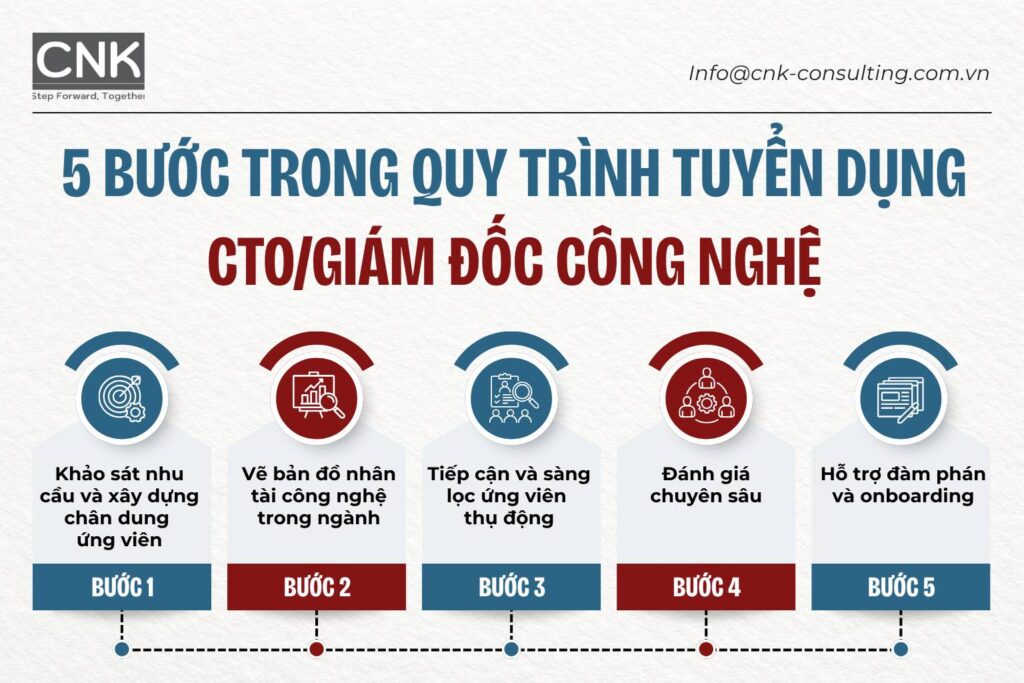
Step 1: Assess requirements and define the candidate profile
Each employer faces different technology challenges depending on its size and operating model. At this stage, the search firm works directly with the board or CEO to:
- Identify the core challenge: Does the employer need a hands-on CTO to build systems from scratch, a leader skilled in scaling infrastructure or a strategist to guide digital transformation?
- Define hiring criteria: Agree on the required technical capabilities, R&D management experience, business judgement and alignment with company culture.
- Structure the remuneration package: Advise on salary, bonuses and ESOP share awards that reflect market conditions and attract C-level candidates.
Step 2: Talent mapping across the technology sector
Compared with mid-level professionals, senior technology executives are in particularly short supply. Talent mapping provides a clearer picture of the candidate market:
- Identify target employers: Locate corporations, technology companies or competing startups whose technical organisations resemble the structure the hiring employer needs.
- Build a candidate list: Identify and compile profiles of professionals serving as CTO, VP of Engineering or Technical Director at target employers.
- Assess mobility: Evaluate each candidate’s willingness to move and the factors that could attract them to a new opportunity.
Step 3: Approach and screen passive candidates
Accomplished CTOs rarely search actively on mainstream job boards. This stage requires specialist executive search skills:
- Discreet outreach: Consultants use their own professional networks to approach passive candidates directly and tactfully, maintaining complete confidentiality for both parties.
- Present the career opportunity: Explain the employer’s vision, growth potential and business challenges to generate candidate interest.
- Initial screening: Assess alignment with career goals, remuneration expectations and readiness to move before progressing to more detailed assessments.
CNK Consulting Vietnam’s specialists observe that many employers struggle to recruit a CTO because they focus heavily on technical requirements without clearly defining the role’s strategic responsibilities, decision-making authority and development objectives.
Before starting the search, employers therefore need to define a CTO profile aligned with their business direction to select the right technology leader for the long term.
Step 4: Conduct in-depth assessments, technical interviews and reference checks
To select the right candidate, the CTO recruitment process uses several layers of assessment:
- Management & technical interviews: Assess systems architecture thinking, R&D project management, the ability to solve business problems through technology and team leadership skills.
- Reference checks: Verify employment history, actual achievements, leadership style and professional reputation through former managers, colleagues and direct reports.
Step 5: Present the shortlist and support negotiations and onboarding
Support continues throughout the process to maximise the likelihood of a successful appointment:
- Present the shortlist: Provide detailed assessment reports on leading candidates so the employer can select candidates for final interviews.
- Support remuneration negotiations: Facilitate agreement on the employment contract, salary, ESOP share purchase rights and confidentiality terms to reach a mutually acceptable outcome.
- Onboarding support & replacement guarantee: Stay in close contact with the candidate throughout the probation period, typically 60–90 days, and help resolve early difficulties so the new CTO can settle in quickly and perform effectively.
Service commitments that reduce employer risk
Appointing a C-level technology leader requires substantial investment and precise selection. A poor decision can cause financial losses and disrupt product development across the organisation.
To control costs and protect clients, CTO recruitment services establish quality commitments across 3 core areas:
Recruitment timelines and service-level agreements (SLAs)
Speed matters in technology. Leaving a technology leadership role vacant for too long can stall R&D projects and cause an employer to miss market opportunities.
- Candidate submission timeline: A professional executive search firm will commit to presenting candidates who meet 80–90% of the requirements within 10–14 working days of agreeing on the candidate profile.
- Efficient interviews: A streamlined assessment process, typically involving 2–3 interview rounds, helps employers secure a candidate within an average total of 3–5 weeks.
- Keeping the search on schedule: Agreed response times of 24–48 hours between the search consultant and HR or the board maintain continuity in the passive candidate’s experience.
Replacement guarantees and policies
Reputable executive search services include provisions to protect employers’ interests against unexpected developments after the employment contract is signed.
- Extended guarantee period: A minimum guarantee period of 60–90 days, covering the full probation period for a C-level role, begins on the candidate’s official start date.
- 100% free replacement: If the candidate resigns or the employer determines that they do not meet performance or cultural requirements during the guarantee period, the search firm immediately begins a replacement CTO search at no additional charge.
- Service fee credit: If the employer pauses recruitment during the guarantee period, fees already paid are retained as a credit towards future recruitment assignments.
Confidentiality commitments
Confidentiality is essential in CTO recruitment, protecting the employer’s reputation and business strategy.
- Strict non-disclosure agreements: All parties—the employer, search firm and candidate—sign a non-disclosure agreement (NDA) before exchanging any detailed information.
- Confidential restructuring plans: Candidates are approached without disclosing the employer’s identity when the assignment involves replacing an incumbent or preparing to launch a new technology product line.
- Candidate data security: Candidates’ personal information, current salaries and employment histories remain strictly confidential, preventing risks associated with contractual disputes or disclosure to the wider market.
Frequently asked questions (FAQ)
How long does it take to recruit a CTO?
A CTO recruitment assignment typically takes 4–8 weeks to complete.
- First 10–14 days: Assess requirements, conduct talent mapping and present qualified candidates.
- Following 2–3 weeks: Conduct in-depth interviews, check references and negotiate remuneration.
- Notice period: C-level candidates typically need 1–2 months to complete their handover with their previous employer before officially joining.
How can HR assess CTO candidates without a technical background?
HR professionals do not need to be proficient coders. They can assess candidates through the following approaches:
- Entrust technical assessment to a CTO search specialist: Work with a CTO recruitment firm that has technical advisers who can assess candidates’ systems architecture expertise and R&D capabilities.
- Focus on management judgement & business ROI: Ask how candidates have reduced infrastructure costs, resolved disagreements between engineering and product teams, or used technology to generate revenue.
- Case exercises: Present a specific business challenge and ask the candidate to give the board a concise roadmap for a technology solution.
Case study: results from CNK Consulting Vietnam’s recruitment assignments
A Series A fintech startup urgently needed a Technical Director to restructure a system with limited load capacity and complete its application within 2 months.
CNK Consulting Vietnam secured a candidate who had previously been a principal architect at a major technology corporation in just 21 working days. The appointment helped the startup reduce cloud operating costs by 40% and upgrade its system to meet PCI-DSS security standards on schedule.
Conclusion
The right CTO can make a difference to an employer’s technology capabilities and pace of growth. CNK Consulting Vietnam’s CTO recruitment service supports employers throughout the hiring process, from defining the candidate profile and identifying talent to assessment and ongoing recruitment support.
CNK Consulting Vietnam
Supporting your workforce development
Hotline: +84 369 882 579
Email: info@cnk-consulting.com.vn
Address: 12BT6 Thanh Bình Garden, No. 3 Nguyễn Cảnh Dị, Định Công Ward, Hanoi, Vietnam
References:
- Kore1: How to Hire a CTO: 2026 Complete Guide (A roadmap covering requirements definition, interviews and talent retention).
- ScaleXT: Specialist Guide to Hiring a Chief Technology Officer (An analysis of core skills through ROI measures and customer impact).
- Remote: Chief Technology Officer (CTO) job description (An analysis of technical and management requirements in the job description).