


Effective candidate selection starts with questions tailored to the role and interview context. This guide provides an interview question template that employers can adapt to any position to improve their hiring process.
Why preparing interview questions matters
Preparing for an interview requires the same care as any important meeting. You need to know what you want to learn and which questions will reveal a candidate’s qualities, skills and experience. A well-structured set of interview questions helps employers assess candidates accurately while demonstrating professionalism and leaving promising candidates with a positive impression.

This article provides a detailed, adaptable interview question template for any role. It helps you lead interviews confidently, screen candidates and identify the strongest match, making your hiring process more effective.
An adaptable interview question template for every role

Introductory questions
Introductory questions help candidates relax and give employers an overview of their background. They offer an initial sense of the candidate’s personality, experience and career direction, providing a foundation for more detailed questions.
Question 1: Could you briefly introduce yourself and describe your work experience?
This classic opening question allows candidates to present what they want the employer to know about them.
- Purpose: Assess communication skills, confidence and the candidate’s ability to summarise the highlights of their background.
- Tip: Listen for whether the candidate focuses on experience relevant to the role.
Question 2: What interests you most about this company and role?
This question helps you understand the candidate’s motivation and how thoroughly they have researched the company.
- Purpose: Assess the candidate’s initiative in researching the company and their alignment with its culture and values.
- Tip: A strong answer goes beyond describing the company and connects the candidate’s personal goals with the objectives of the role and the business.
Question 3: What are your career goals for the next 3 – 5 years?
This question helps establish whether the candidate’s career direction aligns with the development opportunities available in the role and company.
- Purpose: Assess the candidate’s outlook, ambition and plans for personal development.
- Tip: Look for clear, specific answers. Candidates with clear goals often have a strong sense of direction and a long-term commitment.
Question 4: What would you consider your greatest strength?
This question helps identify the value the candidate could bring to the role.
- Purpose: Determine whether the candidate’s core capabilities and actual strengths meet the role’s requirements.
- Tip: Ask for specific examples from their experience to support the strengths they describe.
Question 5: What is your biggest weakness?
This question explores honesty and self-awareness.
- Purpose: Assess the candidate’s maturity and whether they have a plan to address their weaknesses.
- Tip: Be wary of candidates who present disguised strengths, such as “I am too much of a perfectionist”. Prioritise those who acknowledge a real weakness and explain how they are improving.
Question 6: What interests or activities do you pursue outside work?
This question creates a relaxed atmosphere and offers further insight into the candidate’s personality.
- Purpose: Assess work–life balance and cultural fit.
- Tip: Listen thoughtfully. Interests such as reading, sport and learning new skills often suggest a positive approach to personal development.
Questions about experience and technical skills
Once the candidate feels comfortable, move on to assessing their practical capabilities. These questions help establish whether they have the technical knowledge, experience and problem-solving skills the role requires.
Question 1: Could you describe a standout achievement or project? What was your position and role in that project?
This question allows candidates to demonstrate their strengths through a concrete example.
- Purpose: Explore the candidate’s practical capabilities, contribution and effectiveness at work. Use the STAR method (Situation – Task – Action – Result) to explore their example in greater depth.
- Tip: Ask follow-up questions about results, challenges and how the candidate overcame them. Look for specific figures or measurable outcomes.
Question 2: Which specialist tools or software can you use, and how would you rate your proficiency?
This question helps verify the technical skills listed on the candidate’s CV.
- Purpose: Assess foundational knowledge and experience with the technical tools required for the role.
- Tip: Ask specific questions about tools that matter for the job. For example: “Have you used Python for data analysis? Tell me about a time you worked with a large dataset.”
Question 3: Describe a complex technical challenge you faced and how you resolved it.
This question reveals the candidate’s logical thinking, problem-solving skills and persistence.
- Purpose: Explore how the candidate approaches a problem, analyses its causes and finds a solution. This provides insight into their ability to work independently and exercise sound judgement.
- Tip: Pay attention to the full process, from identifying the problem and planning a response to implementing the solution and evaluating the results.
Question 4: How do you approach a new task when information or guidance is incomplete?
This question assesses initiative and the ability to learn independently when guidance is limited.
- Purpose: Determine whether the candidate can adapt, find solutions independently and take initiative.
- Tip: Prioritise candidates who know how to ask questions, find resources, consult colleagues and plan their own learning.
Question 5: What steps do you usually follow to work efficiently and minimise errors?
This question examines how the candidate organises their work.
- Purpose: Assess systematic thinking, planning skills and the ability to manage work quality.
- Tip: Strong candidates describe a clear process rather than offering a vague answer such as “I just rely on my experience”.
Question 6: What do you consider the most important factor in performing effectively in your field?
This question explores the candidate’s professional outlook.
- Purpose: Understand the candidate’s professional values and how they define effective performance.
- Tip: Compare the answer with your company’s culture, including its emphasis on results, process improvement or quality.
Situational and problem-solving questions
Situational and problem-solving questions explore how candidates behave in real workplace situations, beyond their knowledge and experience. They help you understand the candidate’s personality, patience and ability to adapt to the working environment.
Question 1: How do you handle pressure at work or a tight deadline?
This question reveals the candidate’s ability to work under pressure, manage time and respond to challenges.
- Purpose: Assess composure, prioritisation and problem-solving when workloads intensify.
- Tip: Look for answers that describe concrete actions, such as “I would review the workload, prioritise the most important tasks and focus on completing each in turn”.
Question 2: Tell me about a time you worked with a team to resolve a conflict or disagreement with a colleague.
Conflict is inevitable in teamwork. The candidate’s response reveals their communication skills, willingness to listen and collaborative approach.
- Purpose: Explore teamwork, tact and the ability to put shared interests ahead of personal pride.
- Tip: Be cautious of answers that sound too perfect, such as “I have never made a major mistake”. An honest candidate will be willing to discuss mistakes and explain what they did to put things right.
Question 3: Describe a time you received negative feedback from a manager or client. How did you respond?
Negative feedback is difficult to avoid, and the candidate’s response reveals their professional attitude.
- Purpose: Assess openness to feedback, willingness to learn and commitment to improving performance.
- Tip: Avoid candidates who blame others or react emotionally. Look for professionalism and a constructive response.
Question 4: Where would you start if you had to solve a problem you had never encountered before?
This question tests initiative and the ability to find solutions in unfamiliar situations.
- Purpose: Assess independent learning, research skills and decision-making when relevant experience is limited.
- Tip: Strong candidates usually describe a clear process: analyse the problem, gather information, seek advice and test a solution.
Question 5: How do you approach decisions in important situations?
- Purpose: Assess logical thinking and the ability to analyse situations using data and experience.
- Tip: Look for candidates who follow a clear decision-making process and consider the risks.
Question 6: What would you do if your manager’s instructions conflicted with the interests of a client or project?
This question tests professional ethics and the ability to handle sensitive situations.
- Purpose: Assess the ability to balance competing interests, communicate transparently and make sound decisions.
- Tip: Give credit to candidates who communicate openly and propose a balanced solution rather than taking sides based on emotion.
Questions about motivation and fit
These questions explore personal motivation and alignment with the company’s culture and core values. Candidates whose direction and aspirations align with the business can adapt more easily and have a foundation for lasting commitment and growth with the company.
Question 1: What do you look for in an ideal working environment?
This question reveals what the candidate values in an employer, such as development, recognition or flexibility.
- Purpose: Assess whether the candidate’s expectations align with what your company can offer.
- Tip: Listen for details that reveal whether the candidate values collaboration, independence or a dynamic environment. These factors help you assess their fit with the company’s culture.
Question 2: Why do you want to leave your current role?
This is a sensitive but important question. The answer can reveal the candidate’s difficulties or dissatisfaction and how they respond to those experiences.
- Purpose: Understand the reasons behind the decision to leave and whether the candidate tends to complain or is seeking a better opportunity to develop.
- Tip: Be cautious of answers focused entirely on criticising a previous employer. A professional candidate gives objective reasons and reflects on what they learned in the role.
Question 3: What motivates you to give your best at work?
Motivation is a determining factor in performance and long-term commitment to an employer. This question helps you understand what drives the candidate at work.
- Purpose: Identify the candidate’s sources of motivation, their attitude to work and how seriously they approach their career direction.
- Tip: Prioritise candidates who mention development goals, such as challenging themselves, contributing value, building technical expertise or reaching a specific career milestone. If a candidate focuses solely on salary, bonuses, benefits or short-term considerations, ask follow-up questions to explore their commitment and potential to stay with the company.
Question 5: Why did you choose to apply for this role at our company?
Serious candidates research a company before applying. This question helps distinguish candidates with a clear interest from those sending applications indiscriminately.
- Purpose: Assess how thoroughly the candidate has researched the business and their alignment with its culture, products or direction.
- Tip: Follow up on generic answers such as “The role suits me” or “I would like to try something new”. Prioritise candidates who give specific reasons, such as an interest in the industry, products, operating model or opportunities to develop their expertise.
Questions about salary, benefits and closing the interview
Question 1: What are your salary and benefits expectations?
This question helps you compare the candidate’s expectations with the company’s budget. Establishing alignment early can prevent difficulties later.
- Purpose: Understand the candidate’s financial needs, benefits expectations and flexibility, and assess how these align with the company’s current policies.
- Tip: Listen to how the candidate explains their expectations and assess whether they are realistic, flexible or rigid. Promising candidates often balance their personal expectations with the long-term value of joining the organisation.
Question 2: What questions do you have for us?
This closing question is a professional courtesy and a final opportunity to assess the candidate.
- Purpose: Reveal the candidate’s initiative, ambition and interest in the role.
- Tip: Strong candidates use this opportunity to ask thoughtful questions about the company’s culture, development opportunities or expectations, demonstrating that they take the opportunity seriously.
How to tailor the questions to each role
The questions above provide a starting framework. Each role has different requirements and calls for different skills, so adapt and supplement the questions accordingly. This allows you to explore the candidate’s technical capabilities and practical experience in greater depth.
Principles for adapting interview questions
Use the following principles to keep your questions structured and relevant to the work:
- Identify core competencies: Prioritise the essential skills for each role, such as negotiation for sales positions or analytical thinking for marketing positions.
- Explore real situations: Base questions on actual workplace scenarios and experiences the candidate has encountered.
- Assess both technical and interpersonal skills: Explore the candidate’s thinking, attitude and ability to collaborate alongside their technical knowledge.
- Stay flexible: Select questions that reveal the information you need. A long list of questions is not necessary.
Practical examples for different roles
Apply these principles by adapting questions to each role category. This supports deeper discussion and a more comprehensive assessment:
- Sales roles: Focus on handling objections, negotiation and relationship building. Ask: “Tell me about a time a customer declined to buy a product. How did you persuade them?” or “How do you usually build relationships with prospective customers?”
- Marketing roles: Prioritise strategic thinking, campaign execution and data analysis. For example: “Describe your most successful marketing campaign. What did you do to make it effective?” or “Which analytics tools do you usually use to measure campaign performance?”
- IT and software development roles: Assess knowledge of programming languages, debugging experience and project management. Ask: “Tell me about the most complex bug you have had to resolve. How did you identify the cause and fix it?” or “Do you have experience with version control systems? Describe your workflow when collaborating with a team.”
- Engineering and production management roles: Focus on process improvement, operational efficiency and quality control. Ask: “Describe a project that improved production efficiency. What did you do to achieve that result?” or “How do you ensure that all manufactured products meet quality and safety standards?”
- Finance & accounting roles: Assess attention to detail, depth of technical knowledge and ability to comply with regulations through each answer. Ask: “Describe your experience handling a complex accounting transaction, such as accounting for loans or fixed assets. Which standards did you apply?” or “How do you ensure the accuracy and timeliness of financial reports?”
>> Read more: Candidate rejection email templates and communication scripts
Recruitment assessment questions for HR
Alongside traditional interviews, HR teams can use assessment questionnaires to build a more comprehensive view of candidates. These questions are typically concise, objective and easy to compare. They help employers quickly assess technical knowledge, interpersonal skills, logical thinking, personality and motivation. The examples below provide a detailed framework for objective, effective assessment.
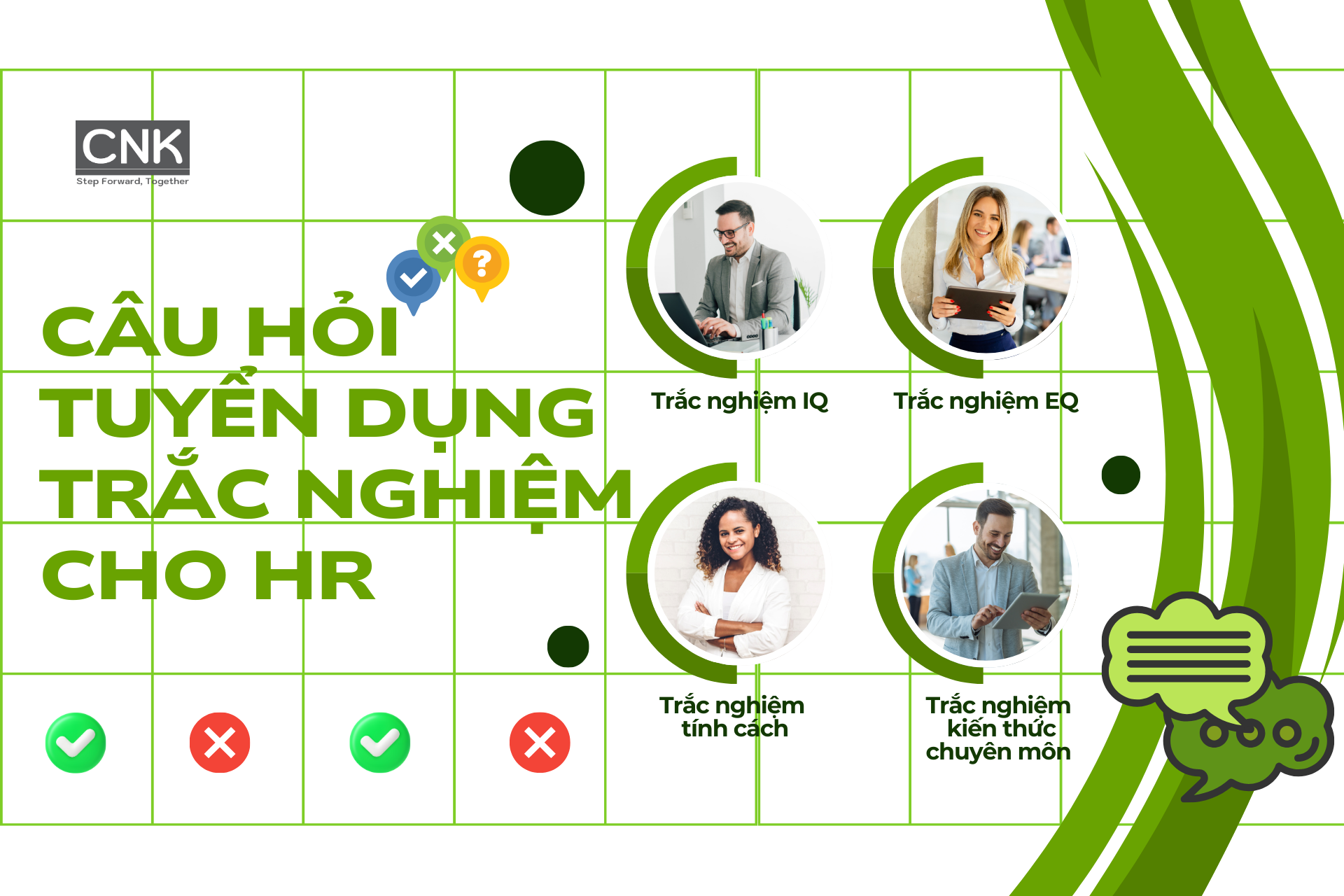
IQ tests (Intelligence Quotient)
IQ tests assess a candidate’s ability to think logically, process information and solve problems quickly. IQ is an important indicator, particularly for roles requiring mental agility and a strong capacity to learn.
Sample questions:
- Shape patterns: “Which shape should replace the question mark to complete the pattern?” For example, a sequence of shapes with features that change according to a specific rule.
- Number sequences: “What is the next number in the sequence 2,6,12,20?”
- Quick reasoning: “If today is Monday, what day of the week will it be in 100 days?”
EQ tests (Emotional Quotient)
EQ tests measure a candidate’s ability to manage emotions, understand others and communicate socially. High EQ is a key factor in roles involving teamwork, leadership or customer service.
Sample questions:
- Hypothetical conflict: “What would you do if a colleague appeared irritated and uncooperative?” A. Ignore them, B. Report them to your manager, C. Speak with them privately to understand the issue, D. Challenge them directly.
- Responding to negative feedback: “You receive a poor performance review. How would you respond?”
Personality tests
Personality tests help assess a candidate’s fit with the company’s culture and the specific requirements of the role. Different roles may suit particular personality traits: sales professionals need to be outgoing, while accountants need to be meticulous. You can use multiple-choice questions that ask candidates to select the description that best represents them, such as “Do you prefer working independently or as part of a team?” or “Do you prefer detailed planning or adapting as situations arise?”
Technical knowledge tests
These questions test foundational and specialist knowledge to establish whether candidates have the skills to start work immediately. Examples for different fields include:
Marketing roles
- What does SEO stand for?
- How do you calculate ROI for an advertising campaign?
- What is the difference between Google Ads and Facebook Ads?
IT and software development roles
- Explain the difference between front-end and back-end programming languages.
- What is the role of an API?
- What are the basic steps for resolving a bug in code?
Finance & accounting roles
- How would you record a cash withdrawal in account 112 (Bank deposits)?
- Define current assets and non-current assets.
- Are you familiar with the latest personal income tax regulations?
Engineering and production management roles
- What does JIT mean in production, and what are its benefits?
- What does the 5S methodology involve in production management?
- What is the purpose of following occupational safety rules in a factory?
>> Read more: How to screen & assess candidate applications (with templates)
Conclusion
Carefully prepared interview questions help HR teams build a comprehensive picture of each candidate’s capabilities and experience, while assessing interpersonal skills, attitude and cultural fit. This preparation is central to successful hiring and building a strong team.
CNK Consulting Vietnam
Hotline: +84 369 882 579
Email: info@cnk-consulting.com.vn
Address: 12BT6, Thanh Bình Urban Area, No. 3 Nguyễn Cảnh Dị Street, Định Công Ward, Hanoi
Receive new job updates from CNK
Selected job opportunities and practical updates on applications, interviews and career development.