


What is a headhunter agency? It refers to firms that provide recruitment solutions, specializing in finding and connecting businesses with high-quality candidates. Unlike in-house recruiters, headhunter agencies operate independently and proactively hunt for talent in the market.
What is a headhunter agency? Concept, role, and how it works
The concept of a headhunter is often confused with traditional recruitment. So let’s start with the fundamentals: understanding exactly what a headhunting agency is, its role, and how it helps businesses find talent.
Who is a headhunter?
A headhunter is an independent recruitment expert, or one working at a headhunting firm, whose job is to find, approach, and attract high-quality candidates for businesses.
Unlike traditional recruitment, headhunters actively “hunt” candidates who have no intention of looking for a job but who possess outstanding capabilities, deep expertise, or currently hold important positions at other companies.
Headhunters typically work at firms that provide headhunting services or operate independently in the HR industry. Their competitive advantages include:
- A broad, high-quality network of senior-level professionals.
- The ability to discreetly source candidates through industry relationship networks.
- Skills in assessing candidates’ professional expertise and leadership ability.
- Behavioral interviewing skills and the ability to evaluate cultural fit.
- Negotiation skills around salary, contract terms, and candidate retention.
- In-depth knowledge of the labor market, specific to each industry.
>> Discover CNK Consulting Vietnam’s headhunting service for more effective recruitment.
What is the role of a headhunter agency in recruitment?
A headhunter agency is a firm that provides specialized recruitment services, particularly for mid-to-senior level positions or hard-to-find talent in an industry. The role of a headhunter agency includes:
- Connecting talent with businesses quickly and accurately.
- Reducing the risk of a bad hire through a professional candidate evaluation process.
- Saving companies time on positions that require confidentiality or are difficult to fill.
- Advising on HR strategy, compensation structure, and market competitiveness.
- Guaranteeing candidate quality through a post-placement warranty policy.
The scope of headhunting services today
Headhunting services today no longer stop at recruiting senior-level staff – they have developed into a diverse ecosystem of HR solutions for businesses. Specifically, the common service groups include:
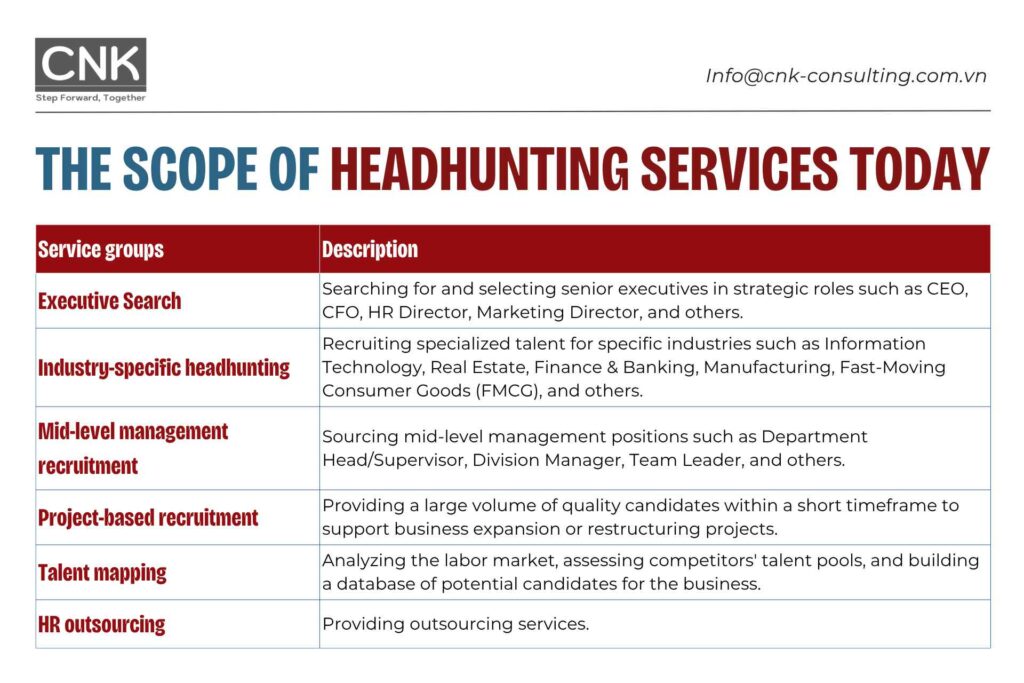
Thanks to this diverse range of services, headhunting firms can flexibly meet a business’s recruitment needs across various levels and industries.
Distinguishing between a headhunter agency and an in-house recruiter
To distinguish between a headhunting agency and an in-house recruiter, businesses need to consider factors such as role, methods, and objectives.
Position and work environment
An in-house recruiter is a full-time employee on the company’s official payroll. They work within the HR department and carry out recruitment duties solely for that one organization.
A headhunter agency consists of specialists from independent HR service firms. They are external partners who can simultaneously support multiple clients in their search for talent.
Target candidates and search methods
In-house recruiters typically focus on mass-hiring positions or mid-level staff. They prioritize public posting channels, such as LinkedIn, the company website, and job boards, to attract candidates.
Headhunter agencies, on the other hand, specialize in leadership roles or hard-to-find experts. Rather than waiting for candidates to submit applications, they proactively reach out directly through extensive relationship networks and in-depth data sources.
Objectives and cost structure
In-house recruiters focus on building company culture and long-term workforce stability. The business pays them a fixed monthly salary, just like any other employee.
A headhunter agency, on the other hand, focuses on the effectiveness of each specific position. The business only pays a service fee once that position has been successfully filled – typically a fee calculated as a percentage of the candidate’s annual salary.
How a headhunter agency works
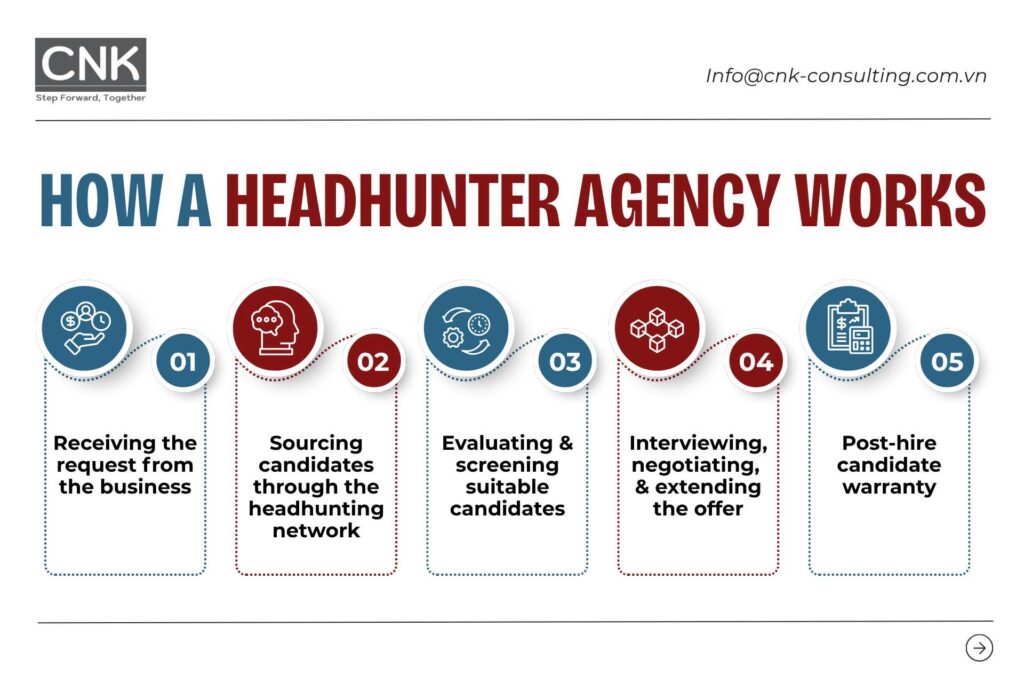
To understand exactly what the process of a headhunting agency looks like and how it operates, we need to examine each step of service delivery – from receiving the recruitment request to handing over qualified candidates to the business.
Receiving the request from the business
In the first stage, the headhunter works with the business to analyze the recruitment requirements, including:
- Gathering detailed information: The headhunter works directly with the business to understand the position to be filled, along with the required competencies, experience, and soft skills of candidates.
- Understanding the target culture: Grasping the company culture, vision, and strategic goals of that position within the organization. This helps the headhunter find candidates who are not only professionally skilled but also a good fit for the work environment.
- Aligning on terms: Discussing and signing the headhunting contract, and agreeing on terms such as service fees, timeline, and warranty policy.
Correctly understanding the HR challenge from the outset is the foundation for carrying out the entire process that follows.
Sourcing candidates through the headhunting network
After fully understanding the recruitment requirements, the headhunter begins the most important step of the process: sourcing and reaching out to potential candidates through an in-depth headhunting network.
- Leveraging the relationship network: Headhunters maintain a high-quality candidate database built up over years of work. This is a rare pool of candidates – most of whom are stably employed at other companies and don’t appear on public job boards.
- Using specialized channels: Beyond personal relationships and industry referrals, headhunters also tap into LinkedIn, professional forums, specialist communities, and premium recruitment platforms to broaden their search for suitable candidates.
- Passive outreach: Headhunters research the labor market, identify target companies, and build a list of potential candidates for each position – then approach them in a strategic, tactful, and confidential manner.
Thanks to this proactive, targeted, and multi-channel search approach, headhunters can reach exactly the right candidates – ones that businesses would find hard to access through traditional recruitment.
Evaluating and screening suitable candidates
The goal of this step is to select the most promising candidates to introduce to the business.
Resume screening
Headhunters evaluate resumes based on relevance to the job description, hands-on experience, notable achievements, core professional competencies, and career stability. Candidates showing signs of frequent job-hopping or lacking evidence of competence are ruled out from the start.
Preliminary interview
Candidates who pass the resume screening move on to a preliminary interview by phone or online. At this stage, the headhunter carries out the following tasks:
- Verifying the accuracy of the information in the CV.
- Assessing soft skills, mindset, and working style.
- Analyzing the degree of cultural fit with the business.
- Understanding career motivations and reasons for changing jobs.
- Recording expected salary and negotiation flexibility.
Candidate reporting
Candidates who meet the requirements are compiled into a shortlist to send to the business. Each candidate will have an in-depth evaluation profile that includes:
- Summary of notable experience
- Strengths and areas for improvement
- Assessment of fit for the position
- Insights from the headhunting expert
- Current salary and expected salary information
Interviewing, negotiating, and extending the offer
The headhunter acts as the bridge between the business and the candidate during interviews, helping manage two-way feedback and ensuring the process runs smoothly. Once the business decides to hire, the headhunter steps in to negotiate, helping both parties reach the best possible agreement.
Post-hire candidate warranty
Reputable headhunting firms always offer a candidate warranty policy lasting from 30 to 90 days. If a candidate turns out to be a poor fit or leaves the job during this period, the headhunter will provide a replacement candidate completely free of charge – reflecting their commitment to service quality.
Advantages and Limitations of Headhunting Services
Headhunting services bring significant strategic value to both businesses and candidates; however, they also come with limitations that need to be carefully considered.
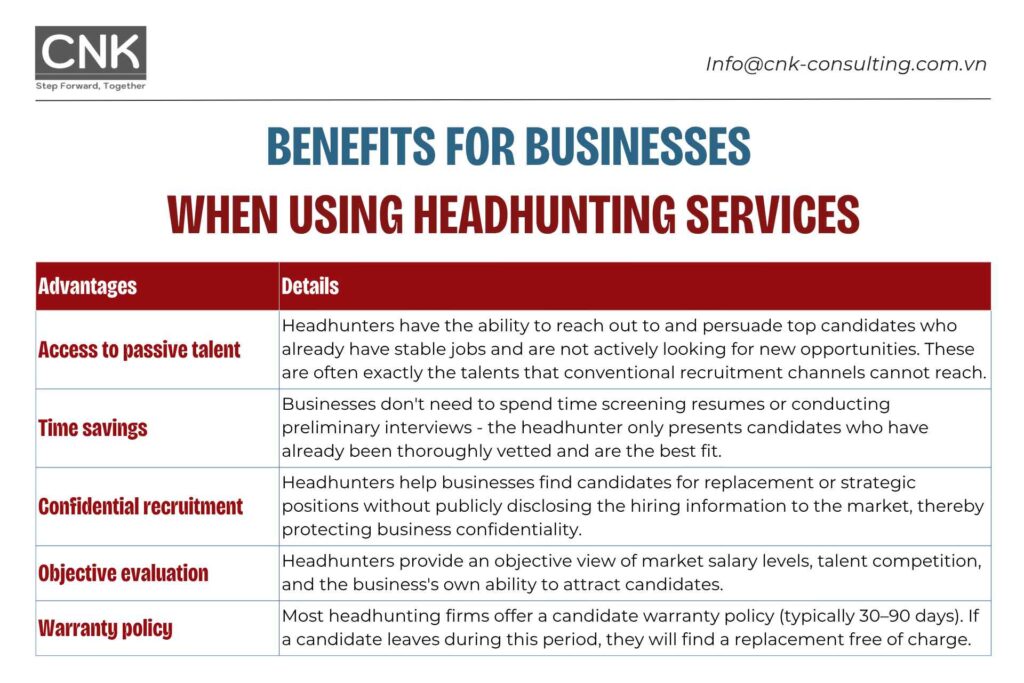
Benefits for businesses
Using headhunting services helps businesses effectively solve difficult recruitment challenges, especially for senior-level and highly specialized positions.
Benefits for candidates
For candidates – especially those with extensive experience and high-level expertise – working with a headhunter offers significant benefits for career development:
- In-depth career advice: The headhunter acts as a career advisor, offering objective insight into the candidate’s market value, growth potential, and fit with the company culture.
- Negotiation representation: The headhunter professionally supports the candidate throughout salary and benefits negotiations, helping them secure better compensation.
- Efficient interview process: Candidates are thoroughly prepared with information about the company and the position, helping them feel confident and perform at their best in interview rounds.
- Confidentiality: The headhunter keeps the candidate’s profile and job search process completely confidential until the candidate agrees to submit their application for a specific position.
Limitations to consider when using headhunting services
Although headhunting services offer many advantages, they also come with certain drawbacks that businesses need to consider:
- High cost: Headhunting service fees are usually quite high, ranging from 15% to 30% of the position’s total annual gross salary.
- Dependence on individual quality: The quality of the service depends heavily on the experience, relationship network, and professional ethics of the specific headhunter handling the assignment.
- Risk of limited internal understanding: If the headhunter doesn’t spend enough time gaining a deep understanding of the business’s culture and internal workflows, the candidates they introduce may be professionally skilled but not a good cultural fit.
- Extended search time: For very senior management positions or extremely rare areas of expertise, the candidate “hunting” process can take longer than expected due to the scarcity of available talent.
When should a business partner with a headhunter agency in Vietnam?
Using a headhunter agency service in Vietnam isn’t a solution for every recruitment need – rather, it’s a strategic decision applied when traditional recruitment channels are no longer effective.
Below are the typical situations in which businesses should consider partnering with headhunter agencies in Vietnam:
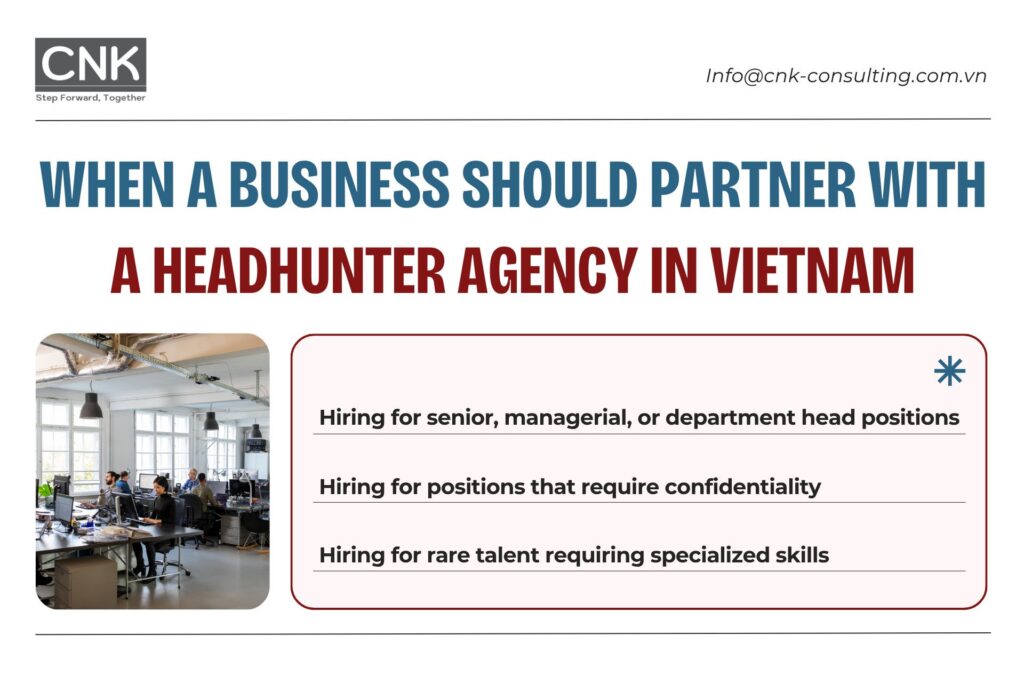
Hiring for senior, managerial, or department head positions
Senior-level positions such as managers, department heads, and directors play a decisive role in a company’s strategy and operational effectiveness. However, this group of candidates typically isn’t actively looking for a job in the market, making them very difficult to reach through conventional recruitment channels.
That’s why a headhunter agency helps businesses connect with them through a high-quality talent network and a professional evaluation process.
Hiring for positions that require confidentiality
When a business wants to replace a sensitive position, build a new team, or launch a strategic project without making it public yet, headhunting services help find candidates discreetly, keeping the recruitment information completely confidential.
Hiring for rare talent requiring specialized skills
For hard-to-fill positions such as AI engineers, cybersecurity specialists, R&D engineers, or senior finance experts, headhunters have the ability to reach specialized talent pools within the industry and accurately assess how well candidates match the job requirements.
Conclude
Understanding exactly what a headhunter agency is helps businesses choose the right recruitment strategy for each stage of their development.
Compared to in-house recruiters, headhunter agencies offer advantages in speed, a high-quality candidate network, and the ability to reach senior-level talent. Depending on their needs and resources, businesses can combine both approaches to optimize recruitment effectiveness.
If you’re looking for a professional headhunting service, feel free to check out our service packages below.
CNK Consulting Vietnam
Providing senior/executive-level recruitment solutions
Hotline: +84 369 882 579
Email: info@cnk-consulting.com.vn
Địa chỉ: 12BT.6 Thanh Binh Garden, 3 Nguyen Canh Di, Dinh Cong, Ha Noi, VietNam.
Nguồn tham khảo:
- Wikipedia: Executive Search (Overview of history and business models).
- Forbes Council: The Headhunter Mindset: Turn Recruiting Into A Strategic Advantage (An analysis of the “Headhunter Mindset” and how to turn recruitment into a strategic advantage).
- International Executive Search Federation: The history and rise of the profession Executive Search (History and development of the executive search profession).