

A Research Dossier for Target Company is a structured, evidence-based analysis designed to support a specific business decision. Rather than simply compiling company facts, it connects information about the business model, ownership, leadership, financial signals, market position, competitors, workforce trends, and recent developments to clarify what is happening, why it matters, and what action should be taken next.
For sales teams, executive search firms, recruiters, investors and business leaders, the real value of a dossier is not the volume of information it contains. Its value comes from turning scattered evidence into decision intelligence that helps determine whether a company should be pursued, monitored, approached, researched further or removed from consideration.
This guide provides a practical framework for building a target company research dossier, evaluating evidence quality, identifying workforce and leadership signals, researching private companies and converting research into clear recommendations.
What Is a Research Dossier for a Target Company?
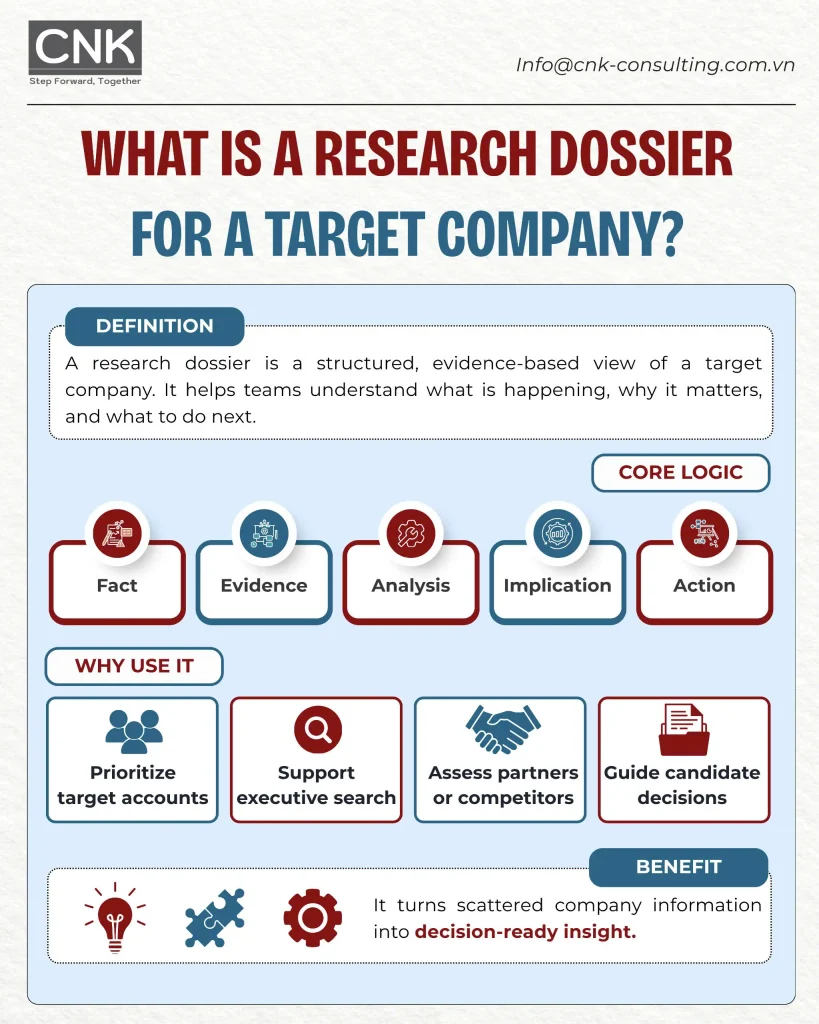
A research dossier for a target company is a structured document that combines verified company information with interpretation and recommendations. It typically covers the company’s business model, ownership, leadership, strategy, financial signals, competitive environment, workforce, recent developments, risks and implications for the decision being made.
A company profile primarily explains what a company is, while a research dossier explains what is happening inside and around the company, why those developments matter and what you should do next. This distinction is important because collecting facts without interpreting them rarely helps a decision maker act.
A practical research dossier should therefore follow a simple logic:
Fact → Evidence → Analysis → Implication → Action
For example, discovering that a manufacturer has announced a new factory is only a fact. A useful dossier would investigate whether investment has started, whether hiring is increasing, what functions are being built, whether leadership is changing and what those signals imply for suppliers, recruiters, executives or business development teams.
What decisions can a target company dossier support?
The purpose of target company research is not simply to understand an organization. It should answer a defined business question such as whether the organization represents an attractive client, hiring target, partnership opportunity, talent source or potential employer.
A dossier can support questions such as:
- Should we pursue this company as a strategic client?
- Is there enough evidence to approach the company now?
- What business problem is the organization likely to face next?
- What leadership capabilities could the company require?
- Which companies contain comparable leadership or specialist talent?
- Should a candidate consider joining this organization?
- Does the company require deeper commercial, legal or financial due diligence?
- Is the company expanding, restructuring or transforming?
- Which people are likely to influence a purchasing or hiring decision?
- What should the next research or business-development action be?
The purpose of a target company research dossier is therefore not to create the longest possible company report. Its purpose is to reduce uncertainty around a decision by organizing the most relevant evidence and clearly separating facts, interpretations, unknowns and recommended actions.
Research Dossier vs Company Profile vs Due Diligence
A research dossier sits between a basic company profile and formal due diligence. Understanding the distinction helps prevent researchers from either producing an overly superficial report or presenting public-source research as if it were legal, financial or investment due diligence.
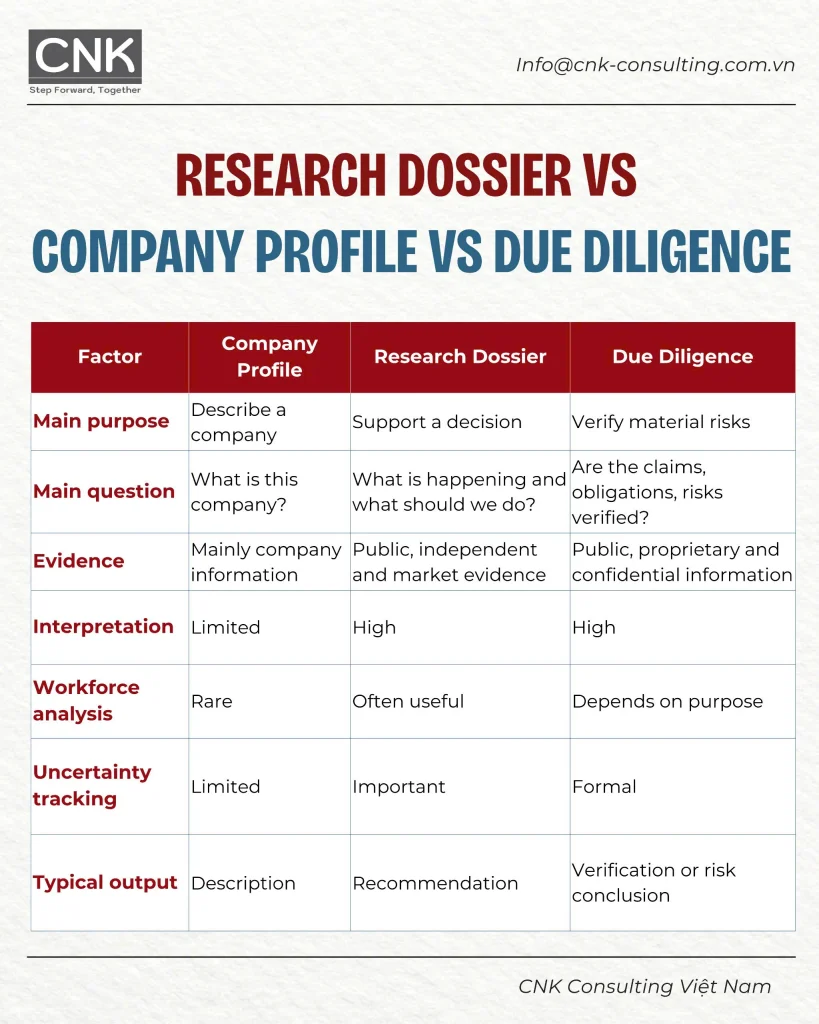
| Factor | Company Profile | Research Dossier | Due Diligence |
| Main purpose | Describe the company | Support a decision | Formally verify risks and facts |
| Typical content | Basic company facts | Facts, signals, analysis and implications | Detailed verified evidence |
| Main sources | Company-provided information | Company, public and independent sources | Public, proprietary and confidential sources |
| Interpretation | Limited | High | High |
| Risk assessment | Limited | Included | Extensive |
| Workforce analysis | Rare | Often useful | Depends on transaction |
| Typical users | Marketing, general research | Sales, recruitment, strategy, executive search | Investors, M&A, legal, finance |
| Final output | Description | Recommendation | Verification and risk conclusion |
A company profile may tell you that a business employs 2,000 people, operates three factories and serves customers across Asia. A research dossier asks whether headcount is growing or falling, where hiring is concentrated, whether recent investment supports expansion, whether leadership has changed and what those developments imply.
When does company research become due diligence?
Company research becomes due diligence when the objective moves from understanding public signals to formally verifying claims, obligations, liabilities or risks before a significant transaction. That process may require confidential financial records, contracts, litigation documents, tax information, legal reviews, customer concentration data or other information that cannot be reliably assessed using public research alone.
A target company dossier should therefore be clear about its limits. Publicly available evidence can support a business decision or determine whether further investigation is warranted, but it should not be presented as a substitute for professional legal, tax, financial or transaction due diligence.
Start With the Decision, Not the Data
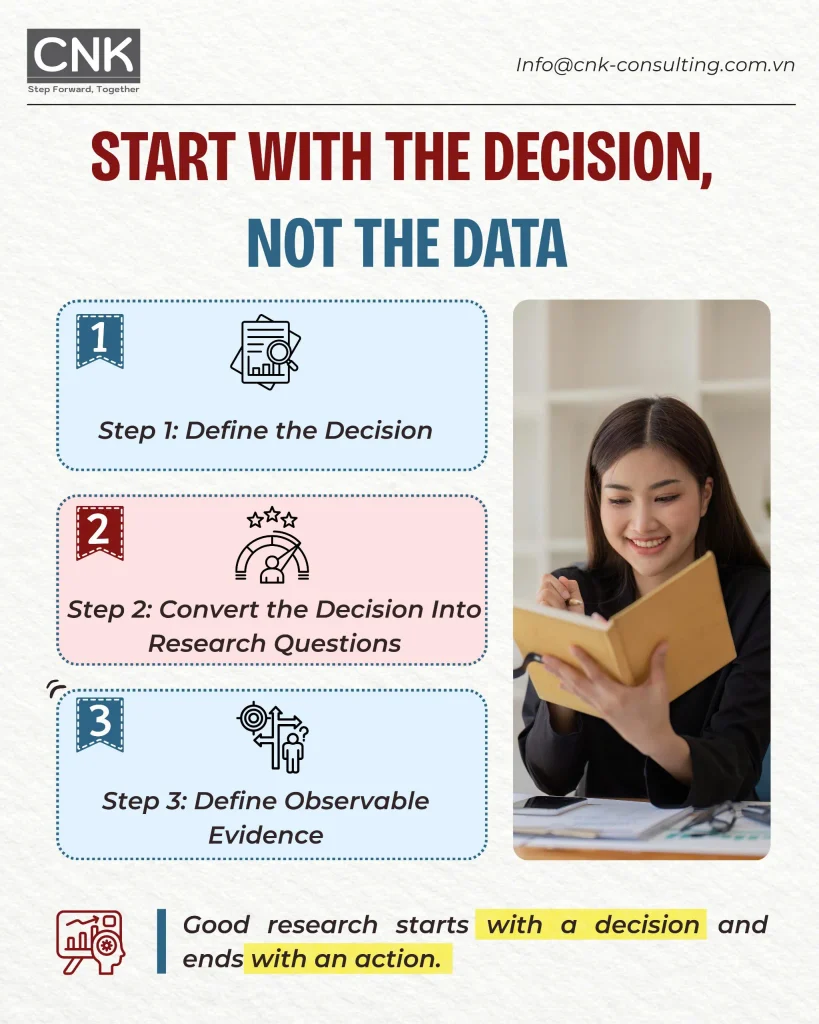
The most effective company research starts by defining the decision the research needs to support. Without a clear decision, researchers often collect large amounts of information that appear useful but have little influence on the final recommendation.
A practical research workflow is:
Decision → Questions → Evidence → Analysis → Action
The decision defines the questions, the questions determine what evidence is required and the evidence provides the foundation for analysis. Only after those stages should the researcher recommend an action.
Step 1: Define the decision
A B2B sales team might ask: Is this company worth pursuing as a strategic account? The research should therefore concentrate on business size, growth, investment, strategic priorities, decision makers, trigger events and problems that the company’s offering can realistically address.
An executive search consultant might ask: What kind of executive would be successful in this organization during the next stage of its development? That question requires analysis of business strategy, organizational structure, leadership, capability gaps, culture, growth priorities and comparable talent markets.
A talent-mapping project could begin with: Which companies are most likely to contain the leadership or specialist capability required by our client? In this case, the research should focus less on general company history and more on organization design, functions, scale, technology, geography and talent concentration.
A senior candidate may instead ask: Should I pursue this leadership opportunity? Relevant evidence could include ownership, leadership stability, business performance, investment, recent senior departures, strategy, reputation, organizational risk and whether the role has sufficient authority to deliver the expected outcome.
Step 2: Turn the decision into research questions
Once the decision is clear, convert it into a small number of research questions. This prevents the team from collecting information simply because it is available.
For an executive-search assignment, useful questions might include:
- What is changing inside the business?
- What capabilities is the company trying to build?
- What growth or transformation agenda is visible?
- Is the organization expanding, restructuring or replacing leadership?
- Where could a leadership capability gap exist?
- Which competitors already possess that capability?
- Where is relevant talent most likely to sit?
- Which developments create urgency now?
These questions create a research boundary. Information that does not materially help answer one of them should receive a lower priority.
Step 3: Define the evidence required
Each research question should be linked to observable evidence rather than assumptions. This encourages researchers to look for multiple signals before drawing conclusions.
| Research question | Evidence to investigate |
| Is the company expanding? | Investment, new facilities, revenue growth, hiring, new markets |
| Is leadership changing? | Appointments, departures, organization changes, board changes |
| Is talent demand increasing? | Job postings, headcount growth, skill concentration, leadership hiring |
| Is the company entering Vietnam? | Legal entity, investment certificate, facilities, local hiring |
| Is a transformation underway? | Technology investment, consulting partners, digital roles, new leadership |
| Is cost pressure increasing? | Layoffs, hiring freezes, restructuring, margin pressure |
| Is a new capability being built? | New departments, new job families, acquisitions, specialist hiring |
This approach produces more useful research than beginning with a generic checklist. A checklist tells you what information might exist, while decision-driven research explains which information matters and why.
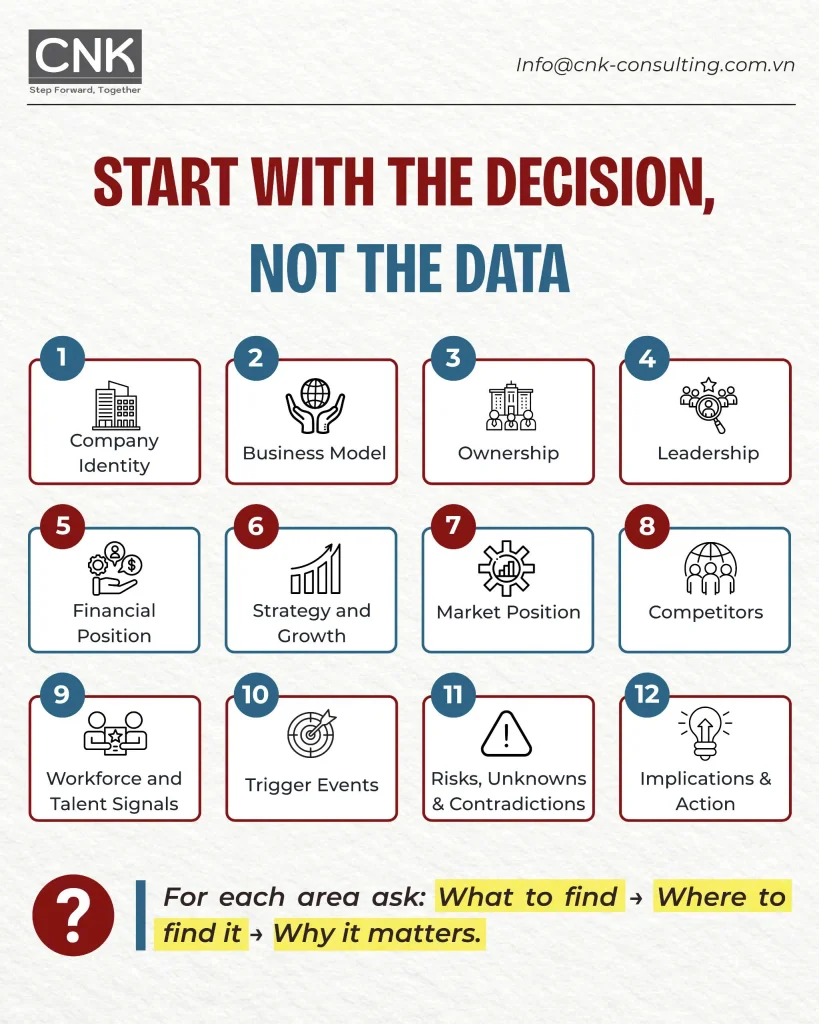
The 12-Part Target Company Research Framework
A comprehensive research dossier does not need to give equal space to every topic. The depth of each section should depend on the decision, but the following 12 areas provide a strong framework for most target-company research projects.
For every section, use the same three questions: What should we find, where can we find it and why does it matter?
1. Company Snapshot
The company snapshot establishes exactly which organization is being researched. This is particularly important for multinational groups, companies with similar names, subsidiaries operating under different brands or businesses that have changed legal entities.
Useful information includes the legal company name, trading name, headquarters, year established, industry, operating locations, estimated employee size, ownership and key subsidiaries. The research question is simple: Who exactly are we researching?
Entity ambiguity can create serious downstream errors. If a researcher confuses a Vietnam subsidiary with its global parent, financial information, leadership details, employee numbers and decision-making authority can all be attributed incorrectly.
For multinational companies, it is often useful to map the structure as:
Global Parent → Regional Entity → Vietnam Entity → Business Unit
This structure helps identify where strategy is set, where budgets may sit and whether a hiring, purchasing or investment decision is likely to be controlled locally or regionally.
2. Business Model
Understanding the business model means answering the question: How does this company actually make money? A dossier should identify products or services, customer segments, revenue streams, geographic markets, sales channels and the company’s positioning within its industry.
Two companies categorized under the same industry can have completely different economics and organizational needs. A high-volume manufacturer serving global OEM customers operates differently from a specialist engineering business selling high-margin customized projects, even if both appear under the same industrial classification.
Researchers should therefore understand who pays the company, what customers are buying, what determines revenue growth and which parts of the value chain the business controls. This context becomes important when interpreting hiring, investment, expansion and leadership requirements.
3. Ownership and Corporate Structure
Ownership determines who influences strategic decisions, capital allocation, senior appointments and long-term priorities. Research should examine the parent company, subsidiaries, major shareholders, joint ventures, regional entities and significant ownership changes.
This is particularly important when researching foreign-invested enterprises. A Vietnam company may appear locally independent while key decisions actually follow a chain such as Global Headquarters → APAC Leadership → Vietnam Management.
A senior hiring decision, for example, could involve the Vietnam Managing Director, regional HR leadership and functional leaders outside Vietnam. Understanding that structure helps sales and recruitment teams avoid assuming that the visible local contact is the only decision maker.
Ownership changes can also create important trigger events. A new investor, acquisition, joint venture or privatization process can lead to changes in strategy, leadership, technology, reporting structures and talent demand.
4. Leadership and Decision Makers
Leadership research should go beyond listing the CEO, CFO and HR Director. A useful dossier maps key executives, functional leaders, regional leaders, reporting relationships, tenure, recent appointments and significant departures.
Depending on the decision, relevant leaders may include the CEO, Managing Director, CHRO, HR Director, CFO, COO, Plant Director, Commercial Director, technology leader, supply-chain leader or regional functional head. Board members and major shareholders can also matter when strategic decisions are centralized.
Leadership stability should be treated as a signal rather than a static list of names.
| Leadership signal | Possible implication |
| New CEO | Strategic priorities may change |
| New CHRO | Talent and organization agenda may change |
| New CFO | Cost, investment or governance priorities may shift |
| Multiple senior departures | Possible restructuring or instability |
| New regional leader | Local leadership may be reviewed |
| Long leadership tenure | Stability, succession need or entrenched organization |
| Newly created leadership role | New capability may be emerging |
These are hypotheses, not automatic conclusions. A leadership change becomes meaningful when it is combined with business context, timing and additional evidence.
5. Financial Position
A target company dossier usually does not need to become a full financial analysis. The objective is to identify financial signals that materially affect the business decision.
Relevant information can include revenue, growth, profitability, funding, investment, capital expenditure, major contracts, debt pressure, cost-reduction initiatives and changes in financial performance. For private companies, precise financial data may not be available, so the researcher should distinguish reported numbers from proxy signals.
Financial evidence should always be translated into a business implication. Writing that revenue increased by 20% is less useful than explaining what the increase could indicate when combined with other evidence.
For example, strong revenue growth combined with facility expansion, management hiring and new engineering roles may indicate that additional operational capacity is being built. Revenue growth combined with hiring freezes and restructuring could instead suggest a focus on productivity or margin improvement.
6. Strategy and Growth Priorities
Strategy research answers the question: Where is the company trying to go? Useful signals include geographic expansion, new products, digital transformation, automation, AI adoption, sustainability initiatives, localization, M&A, restructuring and changes in customer segments.
Corporate strategy is not always communicated through a single document. Researchers may need to combine annual reports, management interviews, company announcements, leadership posts, job descriptions, investment news and customer or partner announcements.
Job postings can be especially useful because they sometimes reveal capabilities a company is trying to build before a formal strategy announcement becomes visible. A cluster of roles involving data, automation, cybersecurity or regional sales may offer an early indication of organizational priorities.
The key is to separate an isolated activity from a strategic pattern. One job opening rarely proves a transformation, but multiple related roles combined with investment, leadership changes or technology partnerships can create a much stronger signal.
7. Market Position
Market-position research should establish where the company competes, who it serves and what differentiates it. Useful areas include target customers, geographic reach, market segment, product positioning, major customers, competitive strengths and growth markets.
Researchers should avoid inventing precise market-share estimates when reliable evidence is unavailable. A qualitative assessment based on customer base, operating scale, known contracts, geographic presence and competitor comparison is often more credible than an unsupported percentage.
The objective is to understand whether the company is a market leader, a challenger, a specialist player, a low-cost competitor or a business moving into a new segment. That position influences both business strategy and the type of talent the company needs.
8. Competitor Landscape
A strong dossier distinguishes between business competitors and talent competitors. The two groups can overlap, but they are not necessarily the same.
Business competitors compete for customers, contracts, market share or distribution. Talent competitors compete for the people, skills and leadership capabilities the target company needs.
For example, a manufacturer could compete commercially against one set of companies while competing for engineers, plant leaders, supply-chain executives or technology specialists against a different group of employers. For executive search and talent intelligence, the second category can be more important than the first.
Researchers should therefore ask two separate questions:
- Who competes with this company for customers?
- Who competes with this company for talent?
This distinction is particularly valuable when building a target-company universe for executive search. Searching only direct commercial competitors can unnecessarily shrink the available talent pool and overlook organizations that contain highly transferable capabilities.
9. Workforce and Talent Signals
Workforce analysis is one of the most useful but frequently underdeveloped sections of target-company research. Hiring patterns can reveal what capabilities an organization is building, where growth is occurring and whether business strategy is translating into organizational action.
Useful signals include estimated workforce size, employee growth, hiring volume, locations, open roles, management hiring, emerging skills, hard-to-fill roles, functional concentration, competitor talent pools and recent leadership changes.
The researcher should look for patterns rather than individual job postings. A single engineering vacancy may simply reflect replacement hiring, while 15 engineering vacancies across automation, quality and operations may indicate capacity expansion or a new capability program.
Hiring Signal Index
A simple Hiring Signal Index can help researchers describe the strength of observed workforce activity.
| Signal | Indicative strength |
| One or two isolated vacancies | Weak |
| Multiple roles in one function | Moderate |
| Multiple specialist or leadership roles | Strong |
| New site combined with hiring surge | Very strong |
| Hiring + investment + new leadership | Strategic trigger |
The index should not be treated as a mathematical score. Its purpose is to force researchers to distinguish isolated recruitment activity from broader organizational change.
Workforce research is especially powerful when connected to business context. The sequence should be Business change → Organizational requirement → Capability requirement → Talent demand, rather than assuming every job advertisement represents a strategic priority.
10. Recent Trigger Events
Trigger events explain why now. They identify developments that could create a new business need, change leadership requirements, increase hiring demand or alter the attractiveness of the target company.
Relevant events from the previous six to twelve months can include new leadership, investment, factory openings, acquisitions, fundraising, restructuring, layoffs, hiring surges, market entry, new product launches, digital transformation initiatives and major regulatory changes.
Researchers should not simply record the event. They should explain the chain of implications created by it.
For example:
New Vietnam factory → headcount growth → new operational structure → plant leadership → supply-chain capability → HR infrastructure → increased competition for talent.
That chain is more valuable than the headline announcing the factory. It converts news into business intelligence.
11. Risks, Unknowns and Contradictions
Good research makes uncertainty visible instead of hiding it. Every dossier should distinguish between known risks, unknown information and contradictory evidence.
A known risk is supported by evidence. An unknown is something important that cannot currently be verified, while a contradiction occurs when reliable sources appear to support different interpretations.
| Company claim or signal | Conflicting evidence | Possible interpretation |
| Rapid expansion | Hiring remains flat | Expansion may not yet affect workforce |
| Strong growth | Cost reductions reported | Growth may coexist with margin pressure |
| Stable leadership | Several recent departures | Organizational changes may be underway |
| Large investment | Limited local hiring | Project may still be in early stage |
| Transformation program | Few related job roles | Capability may be outsourced or centralized |
Contradictions should not automatically be resolved by selecting the source that best fits the preferred narrative. They should be documented, assigned a confidence level and, where important, added to the next-verification list.
12. Implications and Recommended Action
The final section of a dossier is the most important because it converts research into a decision. A dossier should never finish with the equivalent of “here is everything we found.”
It should finish by answering: Based on the evidence, what should we do?
A simple decision framework is:
- Proceed — Evidence is sufficiently strong and the opportunity or research direction is attractive.
- Proceed with conditions — The opportunity appears attractive, but one or more important assumptions must be verified.
- Pause — Available evidence is not strong enough to justify additional resources yet.
- Do not pursue — Risks, strategic mismatch or limited value outweigh the potential opportunity.
The recommendation should also include one concrete next action. Examples include contacting a decision maker, expanding the talent map, verifying an investment timeline, checking a leadership appointment or monitoring the company for another 90 days.
How to Evaluate the Quality of Evidence
Not every source deserves the same level of trust. A reliable research dossier evaluates evidence based on source quality, corroboration, freshness and relevance to the specific claim.
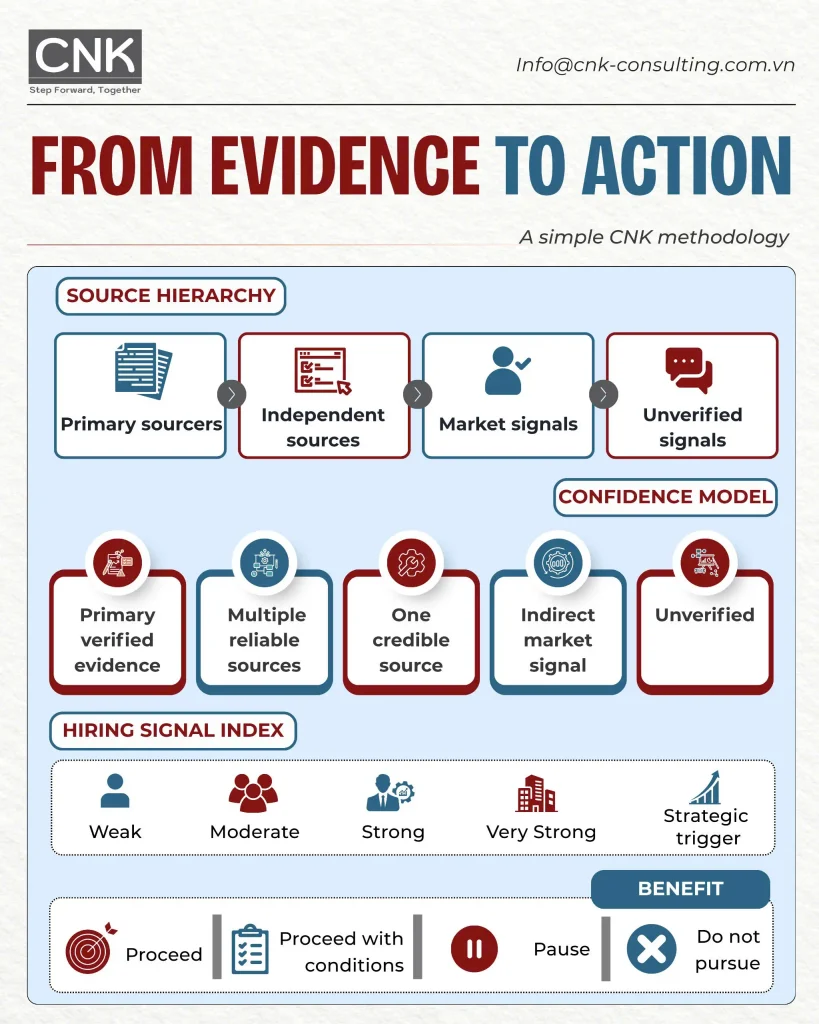
A practical source hierarchy can help researchers avoid treating company marketing content, job advertisements, media reports and anonymous comments as if they were equally reliable.
Tier 1: Primary sources
Primary sources include regulators, corporate filings, investor-relations documents, annual reports, official financial reports and company announcements. These sources are generally the strongest starting point for legal identity, ownership, investment, reported financials and official corporate actions.
However, primary does not always mean neutral. A company’s own press release may accurately confirm an investment while presenting the expected benefits in the most positive possible way.
Tier 2: Independent authoritative sources
These can include major media organizations, established industry associations, research organizations and reputable trade publications. They are particularly useful for industry context, independent confirmation and developments that may not be fully explained by the company.
Researchers should still examine whether the article is based on original reporting or simply repeats a company announcement. Multiple websites reproducing the same press release do not represent independent confirmation.
Tier 3: Market signals
Market signals include LinkedIn data, job advertisements, leadership profiles, employee reviews, customer announcements and supplier information. These sources can be extremely useful for workforce and organization analysis, even when they are less authoritative for legal or financial claims.
For example, a set of current job postings can provide strong evidence that a company is recruiting specific capabilities. It does not necessarily prove that the company is profitable, expanding overall or implementing a particular global strategy.
Tier 4: Unverified signals
Forums, anonymous comments, social discussions and unattributed claims can provide hypotheses that deserve further research. They should rarely be used as the sole evidence for an important conclusion.
A weak signal can still be useful if it leads to a stronger source. The researcher should treat it as a discovery mechanism rather than verified evidence.
The CNK Evidence Confidence Model
A simple confidence model allows the reader to distinguish between verified facts and directional signals. This is especially useful when a dossier combines corporate information, leadership research and workforce intelligence.
| Grade | Meaning |
| A | Verified primary evidence |
| B | Confirmed by multiple reliable sources |
| C | Supported by one credible source |
| D | Indirect market signal |
| E | Unverified or speculative |
Confidence should not depend on source type alone. A useful way to think about it is:
Confidence = Source Reliability × Cross-Verification × Freshness
This does not need to become a mathematical formula. It is a research discipline that forces the analyst to ask whether the source is trustworthy, whether another source supports the claim and whether the information is still current enough to matter.
A three-year-old annual report may remain useful for understanding company history, while it may be too old to support a conclusion about current hiring demand. Conversely, a job posting from the previous week can be highly relevant to current recruitment activity even though it is not a formal corporate filing.
Evidence Freshness: How Old Is Too Old?
Different types of company information become stale at different speeds. Researchers should therefore judge freshness according to the information being analyzed rather than applying one universal date threshold.
| Information | Suggested freshness |
| Legal identity | 12–24 months |
| Ownership | 6–12 months |
| Leadership | 3–6 months |
| Hiring activity | 30–90 days |
| Current job openings | Current |
| Strategy | 6–12 months |
| Trigger events | 6–12 months |
| Financial information | Latest reporting period |
These ranges are practical guidelines rather than strict rules. A CEO appointed in 2023 may remain completely relevant in 2026 if the executive is still in the role, while a job advertisement from 2023 provides very little evidence about current hiring demand.
Researchers should therefore record both the publication date and the period to which the information refers. This prevents an old article describing an even older event from being mistaken for current evidence.
How to Research a Private Company
Researching a private company requires more triangulation because detailed financial, ownership and strategy information may not be publicly available. The goal should not be to fill every gap with an estimate, but to combine multiple credible signals while clearly identifying what remains unknown.
A practical sequence is:
- Verify the business or legal entity.
- Review the corporate website.
- Identify the parent company or group structure.
- Map leadership.
- Review LinkedIn company and employee signals.
- Analyze current and recent job openings.
- Research major customers.
- Research suppliers and partners.
- Review investment or fundraising announcements.
- Search reputable local and industry media.
- Check relevant industry associations.
- Examine employee and workforce signals.
This sequence moves from identity and structure toward softer market evidence. It reduces the risk of building an analysis around a company with an incorrectly identified entity, parent group or geographic operation.
What if financial data is unavailable?
Do not convert an estimate into a fact simply because the financial number would make the dossier feel more complete. State clearly that the information is unavailable and use proxy signals where they genuinely help.
Useful proxy signals can include facility expansion, hiring, customer wins, major contracts, fundraising, new locations, export activity and geographic expansion. None of these signals alone proves revenue or profitability, but together they may indicate direction and momentum.
For example, a private manufacturer opening a new factory, recruiting operational leaders and adding engineering roles is clearly building capacity. It would still be inappropriate to claim a specific revenue growth rate without supporting evidence.
How CNK Uses Target Company Research in Executive Search
In executive search, target company research is not only about understanding a potential client. It is also used to translate business strategy into leadership capability and identify where that capability is likely to exist in the talent market.
A practical executive-search research chain is:
Business Context → Organization → Leadership → Capability Gap → Target Industries → Target Companies → Candidate Universe → Candidate Outreach
The process begins with the business problem rather than the candidate database. This increases the likelihood that the final search universe reflects the client’s real strategic requirement.
Understand the business situation
The first question is what the organization is trying to achieve. The company may be scaling, restructuring, transforming, entering Vietnam, opening a factory, building a new function or replacing an existing leader.
Different business situations require different leadership profiles. A company establishing operations from zero may need a builder, while a mature organization under margin pressure may require an executive with restructuring and operational-excellence experience.
Translate strategy into capability
A business event should not automatically be translated into a job title. A factory expansion, for example, does not automatically mean the company needs a Plant Manager.
The researcher should examine capacity, organization, technology, supply chain, customer requirements and current leadership before determining the likely capability gap. The logic should be business requirement → organizational requirement → capability requirement → leadership profile.
This reduces the risk of searching for candidates based only on title similarity. Two executives with the same title can have very different experience depending on facility scale, technology, product complexity, organization maturity and customer requirements.
Build the target company universe
Once the required capability is clear, the next question becomes: Where is this capability likely to exist? This is where business research connects directly with talent mapping.
Target companies may include direct competitors, adjacent industries, suppliers, customers, regional leaders or organizations that have already completed a similar transformation. The best talent source is therefore not always the most obvious commercial competitor.
A search for automation leadership could include manufacturers known for advanced factories even if they compete in different product categories. A commercial leadership search could include companies with similar customer models rather than only companies selling similar products.
Map leadership and talent
After the target-company universe is established, researchers can move from organization to function, leadership and individual candidates. The sequence becomes:
Company → Function → Leadership → Candidate
This approach produces a more defensible candidate universe than starting with individual profile searches. It also gives consultants more context when assessing whether a candidate’s experience is genuinely transferable.
Example: Research Dossier for an FDI Manufacturing Company in Vietnam
Consider a hypothetical company called ABC Industrial Group, a multinational manufacturer preparing to expand operations in Vietnam. The company has approximately 3,000 employees globally, has announced a new manufacturing facility and appears to be increasing recruitment for engineering and operational positions.
The objective of the research is not to write a general company profile. The question is: What leadership capabilities is ABC Industrial likely to require during its Vietnam expansion?
Step 1: Define the research question
The team begins by identifying the decisions the research needs to support. In this case, the goal is to determine whether the expansion creates a meaningful executive-search or talent-mapping opportunity.
The team therefore needs evidence about the project stage, future organization, hiring activity, operational complexity and leadership structure. General information about company history receives a lower priority unless it helps interpret those questions.
Step 2: Collect evidence
Researchers identify several relevant signals: a factory investment announcement, increasing engineering vacancies, supply-chain recruitment, new regional leadership and a number of local management positions. None of these signals alone proves the future organization structure, but together they suggest that the company is progressing beyond the initial investment stage.
Researchers also investigate whether the roles are replacements or newly created positions. Where possible, they compare hiring activity with the previous three to six months.
Step 3: Interpret the signals
The combination of facility investment and multi-function hiring suggests that the expansion is moving toward operational scaling. The company may therefore need capabilities beyond basic project management.
Potential areas include plant leadership, operations, quality, engineering, supply chain and HR. The exact requirement should still be verified against organization structure and current leadership.
Step 4: Translate business change into talent implications
The team avoids assuming that every function requires an external senior hire. Instead, it identifies which functions are being created, expanded or likely to become more complex as production ramps up.
This produces a capability map rather than a list of job titles. That map can then be compared with the experience available inside the target company and across the external market.
Step 5: Build the target-company map
Researchers identify companies in Vietnam and the region that already operate facilities of comparable scale, technology and customer complexity. Direct competitors are included, but suppliers, adjacent manufacturers and companies with advanced production systems may also contain relevant talent.
This creates a broader and more realistic talent universe. The final search strategy is based on capability similarity rather than only industry labels.
Step 6: Make the decision
If the evidence consistently indicates expansion, multi-function hiring and a growing leadership requirement, the recommendation could be: Proceed with talent mapping.
The next action might be to map Plant, Operations, Engineering, Supply Chain, Quality and HR leadership across 20 to 30 relevant organizations. The dossier has therefore moved the team from news discovery to an actionable search strategy.
Target Company Research Dossier Template
A useful research template should record not only the finding, but also the evidence, date, confidence and implication. This makes the dossier easier to review, update and challenge.
| Area | Key question | Finding | Evidence | Source | Date | Confidence | Implication |
| Company | Who are they? | ||||||
| Business | How do they make money? | ||||||
| Ownership | Who controls the business? | ||||||
| Strategy | Where are they going? | ||||||
| Leadership | Who leads the organization? | ||||||
| Financial | What are the financial signals? | ||||||
| Market | Where do they compete? | ||||||
| Competitors | Who competes for business and talent? | ||||||
| Talent | What capabilities are being built? | ||||||
| Trigger | What changed recently? | ||||||
| Risk | What conflicts or gaps exist? | ||||||
| Decision | What should we do? |
The Implication column is one of the most important parts of the template. Without it, the document can easily become a collection of facts rather than a decision-support tool.
Add an Unknowns Log
Good research should make important knowledge gaps visible. An Unknowns Log prevents assumptions from gradually being treated as established facts as the dossier passes between researchers, consultants and decision makers.
| Question | Status | What is missing? | How to verify? |
| Vietnam plant opening date | Unconfirmed | Official timeline | Company or regulator |
| Current CHRO | Conflicting | Latest appointment | Company or verified profile |
| Local revenue | Unavailable | Financial filing | Parent company or filing |
| Hiring target | Unknown | Planned headcount | Company or leadership source |
| Reporting line | Unconfirmed | Organization structure | Leadership verification |
An unknown does not necessarily weaken the entire dossier. It tells the decision maker exactly where uncertainty remains and whether that uncertainty is important enough to change the recommendation.
Build a Contradiction Log
Contradictions deserve their own tracking mechanism because important company developments are rarely perfectly consistent across sources. A Contradiction Log prevents researchers from silently selecting whichever source supports the preferred conclusion.
A practical format is:
Claim → Conflicting Evidence → Confidence → Interpretation → Next Verification
For example, a company may publicly communicate rapid expansion while current hiring remains limited. The correct conclusion is not automatically that either source is wrong; the project may still be in a capital-investment phase, hiring may be managed through agencies or most new roles may begin later.
Documenting the contradiction improves research quality because it separates what is known from what is inferred. It also creates a clear task list for future verification.
How AI Can Accelerate Target Company Research
AI can significantly reduce the time required to discover, organize and compare company information. It is particularly useful for processing large volumes of text, identifying recurring themes and converting unstructured information into a consistent research format.
AI is useful for:
- Discovering relevant research directions.
- Summarizing long reports.
- Extracting named entities and dates.
- Classifying information into dossier sections.
- Comparing multiple companies.
- Identifying repeated themes.
- Structuring job-posting information.
- Producing first-pass synthesis.
- Generating research questions.
- Highlighting potential contradictions for review.
The greatest risk appears when AI-generated synthesis is treated as verified evidence. A confident sentence can still contain outdated, misattributed or completely unsupported information.
AI should therefore receive stronger verification for claims involving:
- Ownership.
- Executive status.
- Financial information.
- Legal entities.
- Investment figures.
- Regulatory information.
- Confidential claims.
- Major strategic changes.
- Causal conclusions.
A practical human-in-the-loop model is:
AI discovers → Researcher verifies → Analyst interprets → Decision maker decides
AI accelerates the research process, but it should not be responsible for deciding whether the evidence is sufficiently reliable to support an important business conclusion.
Common Mistakes When Building a Target Company Dossier
The first common mistake is researching without a decision. When researchers do not know what the final decision is, they tend to collect company history, executive biographies, financial numbers and news without a clear method for determining what is relevant.
The second mistake is treating company claims as independently verified facts. Corporate websites are excellent sources for official announcements, but claims about market leadership, innovation, growth or customer value should be interpreted as company-provided statements unless independently supported.
The third mistake is using stale information. Leadership, hiring and organization information can change quickly, so researchers should always check dates and verify whether the information remains current.
The fourth mistake is confusing business competitors with talent competitors. A direct commercial competitor is not always the best source of the capability required for an executive-search assignment.
The fifth mistake is ignoring contradictory evidence. Research quality improves when contradictions are recorded and investigated rather than removed from the narrative.
The sixth mistake is allowing AI to generate unverified conclusions. AI can summarize and connect information efficiently, but important claims should still be checked against their original sources.
The seventh mistake is ending with information instead of a recommendation. A dossier should help the reader decide whether to proceed, pause, verify something, change direction or stop.
One-Page Executive Research Memo
A full research dossier can contain dozens of pages, links and supporting notes. Senior decision makers, however, often need a one-page summary that explains the situation quickly without removing the evidence behind the conclusion.
A practical executive memo can use the following format.
Company
ABC Industrial Group
Decision
Should this company be prioritized for executive-search business development?
Key Signals
Summarize three to five signals that directly influence the decision. These could include investment, workforce growth, leadership changes, hiring activity, new facilities or strategic transformation.
Key Risks
List the two or three issues most likely to change the recommendation. These may include uncertain project timing, financial pressure, centralized decision making or contradictory hiring signals.
Talent Signals
Highlight the functions, skills or leadership capabilities that appear to be increasing in importance. Avoid listing every vacancy unless the individual role materially affects the conclusion.
Confidence
State whether the recommendation has High, Medium or Low confidence. The rating should reflect evidence quality, freshness and corroboration rather than the researcher’s subjective confidence alone.
Recommendation
Choose one clear recommendation:
Proceed / Proceed with conditions / Pause / Do not pursue
Next Action
Specify one concrete action and an owner where appropriate. A useful next action might be “Map Plant, Operations and Supply Chain leadership across 25 comparable manufacturers in Vietnam and Thailand.”
The one-page memo turns the dossier from a company-research document into a decision-intelligence tool. Executives can review the conclusion quickly while researchers retain the underlying evidence for deeper examination.
Frequently Asked Questions
What is a research dossier for a target company?
A research dossier for a target company is a structured analysis that combines company facts, independent evidence, market signals and interpretation to support a specific decision. Unlike a basic company profile, it should explain what is happening, why it matters and what action should follow.
What should a company research dossier include?
A strong dossier normally includes company identity, business model, ownership, leadership, financial signals, strategy, market position, business competitors, talent competitors, workforce signals, trigger events, risks, unknowns, contradictions and a recommendation. The exact depth of each section should depend on the decision being supported.
How do you research a target company?
Begin by defining the decision, turn that decision into research questions and identify the evidence required to answer them. Then collect evidence from primary sources, independent sources and market signals before analyzing implications and recommending an action.
What is the difference between a company profile and a research dossier?
A company profile mainly describes what the company is. A research dossier combines facts with analysis to explain what is changing, why it matters and what the reader should do next.
Is a company dossier the same as due diligence?
No. A company dossier can support early-stage commercial, recruitment or strategic decisions using public and independently available evidence, while formal due diligence normally involves deeper verification of legal, financial, operational or transaction risks.
How do you research a private company?
Private-company research usually requires triangulating business-registration information, corporate websites, parent-company information, leadership profiles, job postings, customers, suppliers, investment announcements, local media and workforce signals. Where reliable data is unavailable, the dossier should state the gap rather than convert an estimate into a fact.
How long should a company research dossier be?
There is no ideal page count because the correct length depends on the decision and complexity of the company. A useful dossier should contain enough evidence to support the recommendation while allowing a decision maker to understand the main conclusion quickly through an executive summary.
How often should a company research dossier be updated?
Update frequency depends on the information being tracked. Hiring and job-opening data may need updates every 30 to 90 days, while ownership, strategy and financial information can usually be reviewed according to major events or reporting cycles.
Can AI create a target company research dossier?
AI can accelerate discovery, extraction, classification, comparison and first-pass synthesis. Important claims involving leadership, ownership, financials, legal information, strategy and causal conclusions should still be verified by a researcher before they are treated as evidence.
What sources should be used for company research?
Prioritize primary sources such as filings, regulators, investor relations and official company announcements, then use reputable independent sources to confirm and contextualize findings. LinkedIn, job postings, supplier information and employee signals can add valuable market intelligence when their limitations are understood.
How is target company research used in executive search?
Executive-search teams use target company research to understand business context, identify organizational and leadership capability gaps, determine which companies contain comparable experience and build a more relevant candidate universe. This connects company intelligence directly to talent mapping rather than beginning with an isolated search for job titles.
From Company Research to Decision Intelligence
A high-quality research dossier for target company should do more than describe a business. It should help the reader understand which changes matter, which evidence is reliable, what remains uncertain and how those findings affect the decision at hand.
The strongest dossiers begin with the decision, prioritize evidence over assumptions and distinguish between facts, signals and interpretation. They also make contradictions and unknowns visible instead of forcing every piece of information into a single narrative.
For executive search and talent intelligence, company research becomes especially valuable when business developments are translated into organizational and capability implications. Understanding where a company is going can help determine what leadership it may need, which organizations already possess that capability and where relevant talent is likely to be found.
A company dossier identifies what is changing inside an organization. Executive search takes the next step by identifying where the leadership and specialist capabilities required for that change exist in the market.
Need to understand a target company, map its leadership environment or identify specialist talent in Vietnam? CNK Consulting Vietnam helps organizations connect business context, market intelligence and talent mapping to support more informed hiring and workforce decisions.