


Recruiting senior IT talent on your own often reaches a dead end because the best candidates rarely apply for jobs proactively. As a result, businesses can waste valuable time interviewing the wrong people. This is where IT headhunters become the solution. Let’s uncover the secrets behind how they identify, approach, and connect with some of the world’s brightest technology minds.
What is a technology headhunter? Their strategic role in the tech race
A technology headhunter is an executive search specialist focused on the information technology and digital transformation sector. Unlike mass recruitment, they specialize in identifying, approaching, and persuading senior-level IT candidates – a talent pool that typically does not actively look for jobs on the open market.
Many corporations today view technology headhunting as a “strategic weapon” to gain a competitive edge in the market. Rather than waiting for candidates to submit their CVs, they proactively hunt for the best talent from competitors or from leading technology companies.
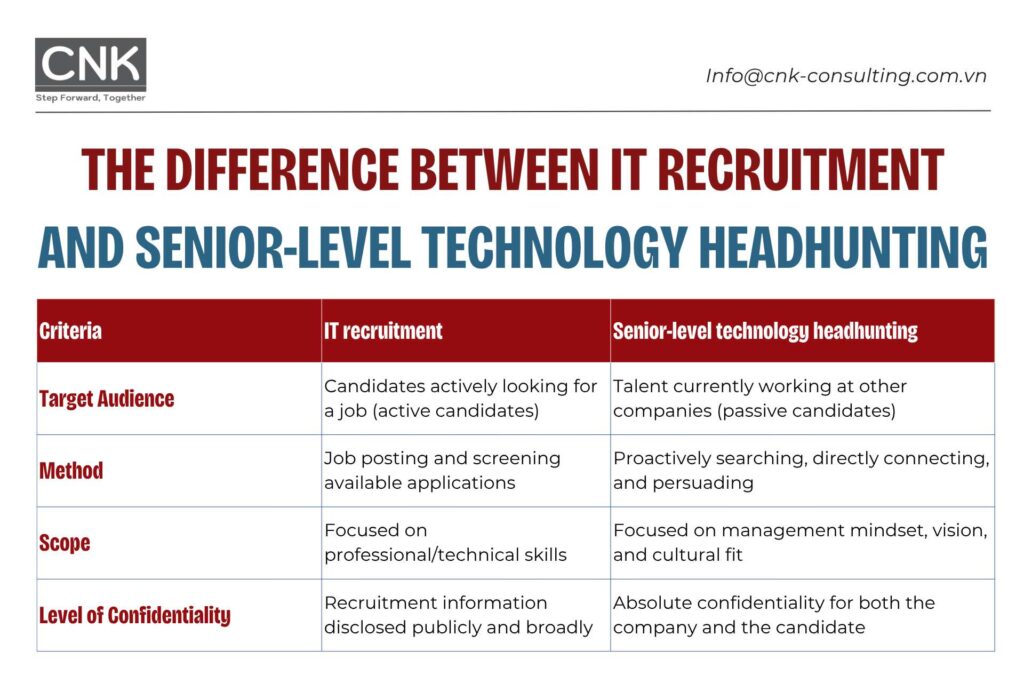
The difference between IT recruitment and senior-level technology headhunting
Although both relate to IT recruitment, IT recruitment and technology headhunting are built on completely different mindsets and methodologies:
>> Partner with CNK Consulting Vietnam to Hire Top Tech Talent
Why do tech giants always need a specialized IT headhunter?
Large corporations like Google, Meta, or Fintech Unicorns in Vietnam never wait for talent to come to them. They need specialized IT headhunters for 3 strategic reasons:
- Access to a “hidden” talent network: Outstanding CTOs, Solution Architects, or AI Engineers typically have no publicly stated need to change jobs. Only headhunters with deep, extensive industry networking can reach out to and open a conversation with them.
- Understanding technical language: A professional IT headhunter is capable of assessing a candidate’s competence through in-depth technical keywords such as Microservices, Scalability, Cloud Native, or DevSecOps. They serve as a high-quality filter before candidates are brought into the technical interview round.
- Shortening recruitment time: In the technology race, falling behind by even a single day can mean losing the chance to lead. Headhunters maintain a ready “talent pipeline,” helping companies fill key positions in the shortest possible time with the highest degree of accuracy.
“Decoding” the IT headhunting process
A professional technology headhunter doesn’t just “find people” – they must also have a deep understanding of the technology market, a clear grasp of candidate behavior, and the ability to simultaneously assess both technical competence and leadership qualities.
Behind every successful recruitment deal is typically a methodically executed, multi-layered, and highly confidential IT headhunting process.

How headhunters build a hidden talent map
One of the biggest advantages of a technology headhunter is their ability to build “talent mapping” – a hidden talent map within the IT industry.
This is a data system that covers technology experts, senior managers, and potential candidates, including those who have never applied for a job.
Unlike ordinary recruiters, who only tap into candidates actively looking for a job, IT headhunters proactively build a network of technology talent organized by specific areas of expertise, such as:
- Software Engineering
- AI/Machine Learning
- Cybersecurity
- Blockchain
- Cloud & DevOps
- Product Management
- Data Engineering
The process of building a hidden talent map typically begins with researching the IT recruitment market, analyzing the organizational structure of major technology companies, and identifying where top experts are concentrated.
What makes this notable is that many candidates on the “talent map” have never publicly expressed any interest in changing jobs. They are known as “hidden candidates” – a group of high-quality talent that is nearly invisible on the mass recruitment market.
To maintain this system, IT headhunters typically combine multiple data sources, such as:
- LinkedIn and GitHub
- Tech communities
- Technology conferences
- Internal referral networks
- Personal relationships within the IT industry
- A recruitment database accumulated over many years
It is precisely thanks to talent mapping that headhunters can shorten the recruitment process and reach the right candidates, even for roles where talent is extremely scarce.
Techniques for approaching “passive candidates”
In the technology sector, most top-tier talent belongs to the “passive candidates” group. They are not looking for jobs on recruitment platforms, don’t regularly update their CVs, and rarely respond to mass job invitations.
To reach them, technology headhunters need to use specialized approach techniques:
- Personalizing the outreach: Instead of generic recruitment messages, headhunters carefully research a candidate’s open-source projects (GitHub) or professional posts to open the conversation in the most persuasive way possible.
- Selling the opportunity, not the job: Rather than talking about salary, headhunters focus on the technical challenge, the product vision, and the position’s impact on the tech community to spark genuine interest.
- Building trust: Approaching candidates with a “companion” mindset. A skilled headhunter often maintains a good relationship with a candidate for months before formally raising the topic of a specific position.
In a fiercely competitive technology environment, the ability to reach and persuade passive candidates is precisely what sets a senior IT headhunter apart from an ordinary recruiter.
Assessing technical competence and management mindset
Recruiting senior technology talent cannot rely solely on an impressive CV or a list of skills on LinkedIn. A professional technology headhunter must be able to assess both actual technical competence and team management mindset.
Technical assessment in IT recruitment
Headhunters assess a candidate’s system design capability, problem-solving mindset, and ability to adapt to new technology trends such as AI, Cloud Native, or Cybersecurity.
Assessing the leadership mindset of technology leaders
During periods of rapid growth, companies need not just a skilled engineer, but someone with a leadership mindset – a technology leadership mentality.
Technology headhunters use situational questions to measure a candidate’s ability in team building, risk management, and business acumen.
Especially at startups or scale-up tech companies, leadership mindset matters even more than pure technical skill. A great CTO is not the person who codes best, but the one who can build a strong team, retain talent, and direct technology to serve the company’s growth strategy.
For this reason, the modern IT headhunting process always combines technical assessment and leadership assessment in parallel, to ensure that a candidate is not only “good enough,” but also “the right fit” to lead the organization in the long run.
The “Secrets” only insiders in the technology headhunting industry know
Behind the successful contracts closed by technology headhunters lie unspoken rules and a subtle art of interpersonal handling that few outsiders can truly understand. This is not simply about finding people – it is a delicate contest of wits and coordination.

The art of salary and compensation negotiation
For senior-level IT talent, income isn’t limited to the monthly “net salary” figure alone. A seasoned technology headhunter acts as the architect of the overall total rewards package, designed to satisfy both parties:
- Optimizing ESOP and Bonuses: Headhunters know exactly how to convince candidates of the future value of stock options (ESOP) or performance-based bonuses, helping companies ease the pressure on their initial cash flow.
- Psychological Touchpoints: They know when to push harder on the salary figure and when to focus instead on non-financial benefits such as autonomy, a training budget, or flexible work arrangements (remote/hybrid).
- Neutral Positioning: Rather than letting the company and the candidate confront each other directly over money, the headhunter steps in to mediate, keeping the negotiation professional and preventing damage to the relationship from the very start.
This is precisely why technology headhunting is regarded as a senior-level HR consulting activity, rather than simply recruitment.
How headhunters ensure absolute confidentiality for both companies and candidates
Confidentiality is an extremely important principle in the technology headhunting industry. Even a small mistake can cause a company to lose a key employee or put a candidate’s current job at risk.
- Candidate safety: Individuals currently holding senior positions at major corporations always require absolute discretion. A properly structured confidentiality process allows them to explore new opportunities with peace of mind, without worrying about jeopardizing their current position.
- Use of NDAs (Non-disclosure agreements): Every step of the process, from sending the JD (job description) to the interview stage, is bound by strict legal commitments.
- Protecting the company’s strategy: When a corporation is hunting for a “Head of AI” position, it’s often a sign of a confidential digital transformation project underway. Headhunters know how to approach candidates without revealing the company’s identity until genuine interest has been confirmed.
“Culture matchmaking”: When professional skill is not the final deciding factor
There’s a secret that technology headhunters always keep in mind: skill gets a candidate to the interview, but culture is what keeps them there. For this reason, when screening candidates, headhunters need to evaluate the following criteria:
- Mindset fit: A rising tech star from a fast-paced startup environment may not necessarily suit the highly process-driven machinery of a multinational corporation. Headhunters must assess this “fit” before making a connection.
- Shared vision: Headhunters dig deep to determine whether a candidate’s product development philosophy aligns with the long-term strategy of Founders/CEOs.
- AQ (adversity quotient): For IT management positions, the ability to overcome adversity and handle crises is sometimes more important than writing flawless code.
In modern technology headhunting, success lies not in finding the most skilled person, but in finding the most suitable person to grow with the company over the long term.
Criteria for choosing a reputable technology headhunting company in Vietnam
Among hundreds of recruitment service providers, choosing the right technology headhunting partner can help a company save 50% of its recruitment time and minimize the risk of a poor hiring match. Below are 3 gold-standard criteria for choosing a trustworthy partner.
Specialization by niche (domain expertise): AI, Blockchain, Fintech, or Cloud computing?
One of the most common mistakes many companies make is choosing a “generalist” recruitment agency for highly specialized technology positions. A reputable headhunting firm must have deep expertise in each specific niche segment:
- Technical understanding: Rather than simply keyword-filtering CVs, a skilled headhunting specialist must understand the difference between an AI Engineer specializing in Natural Language Processing (NLP) and one specializing in Computer Vision.
- Industry-specific knowledge: If you’re building a financial platform, you need a partner experienced in Fintech to understand security standards and compliance requirements. The same applies to niches like Blockchain, E-commerce, or SaaS.
- Reverse consulting: A highly specialized firm will be able to advise you on market salary benchmarking and which Tech Stacks are currently facing a talent shortage.
Therefore, when choosing a technology headhunting company, businesses should prioritize a firm with proven experience recruiting for their specific technology sector, rather than opting for a generalist mass-recruitment agency.
Networking and brand reputation in the market
The reputation of a technology headhunter is measured by the breadth and depth of the network they possess. Leading headhunters are often seen alongside speakers at major events such as Vietnam Web Summit or AWS Community Day.
Thanks to their standing in the industry, they can carry out reference checks in an informal yet remarkably accurate way by tapping into the network of a candidate’s former colleagues.
Businesses can assess how reputable an IT headhunting firm is by looking at:
- Actual recruitment case studies
- Previous clients they’ve worked with
- Successful placement rate
- Quality of professional consulting
- Depth of understanding of the technology industry
- Reviews from candidates and businesses
Talent guarantee commitment and professional ethics
This is the dividing line between a professional headhunting firm and amateur operators:
- Guarantee period policy: Typically, senior-level positions come with a guarantee period of 3 to 6 months. If the hired employee resigns or fails to meet requirements within this period, the headhunting firm must commit to a free replacement search.
- Off-limits policy: This is the ultimate ethical rule. A reputable firm will commit to never poaching talent from a client they have worked with or are currently working with, for a set period of time (usually 12 – 24 months).
- Transparency: Every process – from pricing and evaluation criteria to candidate information confidentiality – must be clearly documented in writing and in a legally binding contract.
This is precisely the foundation that helps a technology headhunter build a lasting relationship with clients and become a long-term strategic partner in the journey of technology talent development.
Trends in senior-level IT talent headhunting in the AI Era
The explosive growth of Artificial Intelligence (AI), Big Data, and automation is comprehensively reshaping the technology recruitment market.
For technology headhunters, AI is not a replacement tool, but rather a “powerful assistant” that helps elevate the accuracy of connecting exceptional minds with the right technology platforms.
Applying AI and big data to predict talent movement
One of the biggest shifts in the technology headhunting industry is the application of AI and Big Data to analyze career behavior and predict trends in talent movement.
AI helps technology headhunters find the right candidates faster. Modern AI systems, by tracking digital signals such as the frequency of GitHub updates, changes in skills listed on LinkedIn, or interactions within tech communities, can predict that a senior professional is likely to consider leaving even before they submit their resignation.
Beyond simply detecting potential candidates, AI also helps technology headhunters improve accuracy in the process of matching candidates with companies.
Rather than just comparing keywords in a CV as in traditional recruitment, modern Machine Learning algorithms can analyze more deeply – work style, career direction, project preferences, leadership ability, or professional development trends.
From this, the system generates a “matching score” – a rating of how well-suited a candidate is to a company – helping headhunters make more accurate hiring decisions and increase long-term retention after recruitment.
In addition, Big Data helps headhunting firms build an automated talent pipeline – a talent data system that is always ready and available.
Instead of waiting until a company needs to hire before starting a search, modern technology headhunters proactively maintain a network of potential candidates by field, such as AI, Cloud Computing, Fintech, or Data Engineering.
This significantly shortens a company’s time-to-fill, especially for strategic positions such as CTO, Head of Engineering, Head of Data, or AI Director.
From headhunting to talent advisor: The new role of consulting experts
If headhunters only stop at “finding people,” they will gradually lose their competitive edge. The new trend is shifting strongly toward the role of a talent advisor (strategic talent consultant), encompassing tasks such as:
- Organizational Design Consulting: Experts don’t just place people — they also advise companies on building a lean, optimized technology team that balances actual headcount with automated systems.
- Employer Branding: Headhunters act as ambassadors, helping companies tell the story of their culture and technology vision to attract candidates on the same wavelength.
- A Bridge for Culture and Psychology: AI can filter skills, but only a human can sense the passion, alignment with core values, and ability of an IT leader to inspire others. This is the “irreplaceable” value that technology headhunters bring.
Conclude
The tech race is, in essence, a race for talent. Partnering with professional technology headhunters is not merely about solving an immediate staffing shortage – it is a strategic move to secure the most valuable “creative asset” a company can own.
Is your business looking for a CTO, Tech Lead, or other senior IT talent? Explore the Technology Headhunting service at CNK Consulting Vietnam below to gain faster access to a high-quality network of technology talent.
CNK Consulting Vietnam
Fast & Effective Recruitment Solutions
Hotline: +84 369 882 579
Email: info@cnk-consulting.com.vn
Địa chỉ: 12BT.6 Thanh Binh Garden, 3 Nguyen Canh Di, Dinh Cong, Ha Noi, VietNam.
Nguồn tham khảo:
- Humana International Group: Headhunting in 2026: The Rise of Data-Driven, Human-Centric Talent Search (Focusing on specialized skills such as Cloud, Machine Learning, and Cybersecurity requires headhunters to understand technical terminology.).
- Testlify: Top 10 recruitment technology trends for 2026 (Discover the top recruitment technology trends for 2026 and learn how recruitment teams can effectively leverage artificial intelligence, assessments, and automation).
- Iprospectcheck: How to Hire Tech Talent: 13 Recruitment Strategies for 2026 (How to Recruit Tech Talent: 13 Recruitment Strategies for 2026).