


Many businesses struggle for six months to a year without being able to fill a vacant executive/director position. Imagine your organization having an elite leadership team in place right now, running smoothly and ready to drive the company toward breakthrough revenue growth. Turn that vision into reality today with executive search – the precise leadership-hunting solution from top industry experts.
What is executive search? The need for senior leadership recruitment
Executive Search is a specialized term in the recruitment field, referring to the process of finding and attracting senior leadership talent such as CEOs, CFOs, COOs, CTOs, or other strategic management positions that directly influence a company’s direction and growth.
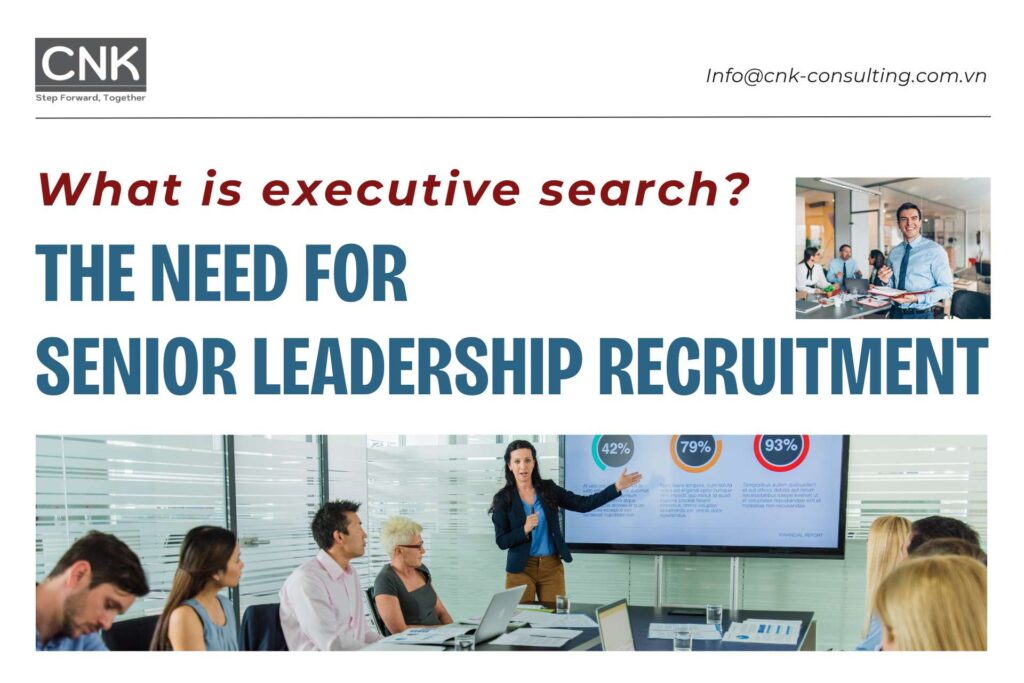
What is executive search?
Executive Search is a specialized process of sourcing, approaching, and recruiting for executive, senior leadership, or other key strategic management positions within a business.
The goal of executive search goes beyond finding the right person – it also involves advising and partnering with businesses to build a leadership team aligned with their long-term vision.
This explains why executive search companies are often referred to as “firms,” similar to those in the legal or auditing fields, reflecting their level of professionalism and their role as strategic advisors.
Key characteristics of executive search:
- Focus on passive candidates: These are individuals currently holding senior positions with strong track records who are not actively job hunting. Approaching them requires refined persuasion skills and the ability to build long-term relationships.
- Absolute confidentiality: Both the business and the candidate are assured of confidentiality throughout the process, especially when a company needs to replace an incumbent leader.
- In-depth executive search process: The executive search process goes beyond traditional recruitment, combining extensive market research, talent mapping, and rigorous competency assessments to identify leaders who are the best fit for both the role and the organization’s culture.
>> Need to hire top executive talent? Explore CNK’s Executive Search service and find the right leaders faster.
The importance of Executive search
At the executive level, every hiring decision can directly impact strategy, business performance, and corporate culture. Therefore, executive search not only helps businesses find people but also plays a role in building a leadership team that creates long-term value.
Below are the reasons why executive search has become a key factor in organizations’ human resources strategy:
- Ensuring leadership quality: Senior positions typically require comprehensive capabilities, from management and decision-making to strategic vision. Executive search helps businesses access personnel whose competencies have been verified and who fit the organizational culture.
- Saving time and reducing the risk of a bad hire: A mis-hire at the C-level can cause significant damage in terms of cost, reputation, and growth direction. The in-depth selection process of executive search helps minimize this risk.
- Supporting HR strategic planning: Executive search firms don’t just introduce candidates – they also provide insights into the talent market, helping businesses adjust their structure, compensation, and leadership succession planning more effectively.
- Increasing competitive advantage: A business with a strong, well-fitted, and committed leadership team has a greater ability to lead the organization further in a volatile market.
How Does the Executive Search Process Work?
Unlike conventional recruitment activities that focus on quickly filling vacant positions, Executive Search is an in-depth, senior-level HR consulting campaign. Thanks to its strategic approach and absolute confidentiality, this process operates through 6 rigorous steps:
Step 1: Assessing the strategic challenge & leadership profile
Beginning with a deep understanding of the business’s nature, Executive Search experts work directly with the Board of Directors or Executive Board to thoroughly analyze the company’s growth objectives and organizational culture.
Building on this foundation, the profile of the ideal leader is drafted – one that goes beyond professional expertise to include a strategic vision and a management style suited to the business’s stage of development.
Step 2: Comprehensive talent mapping across the market
Once the standards are defined, the next step is to scan the entire market proactively rather than wait for candidates to apply. The consulting firm conducts talent mapping to identify C-level executives or incumbent directors at competitor corporations and adjacent industries.
The result of this stage is a confidential target list of individuals who are currently creating real value in the market.
Step 3: Confidential approach and motivating the move
Since most senior leaders belong to the “passive candidate” group (not actively job hunting), the approach requires great subtlety and maximum confidentiality. Executive Search experts act as trusted connectors, reaching out to candidates through private channels to share the business’s career development narrative and vision, rather than simply discussing a job opening.
Step 4: Assessing management competency and cultural fit
Once the candidate shows interest, an in-depth assessment process begins. Rather than conducting basic professional interviews, this step focuses on evaluating strategic thinking, crisis management capability, and leadership style.
More importantly, it ensures alignment of core values between the new manager and the company’s current leadership team.
Step 5: Advising on compensation structure and senior-level negotiation
At the negotiation stage, the compensation package for a C-level position is often complex and decisive. The Executive Search firm serves as a neutral bridge, helping both parties establish and negotiate a comprehensive package – covering not only base salary and bonuses, but also terms related to equity (ESOP/Equity), protection policies, family benefits, and non-compete commitments.
Step 6: Onboarding support and long-term integration assistance
The process doesn’t end once the contract is signed. A new leader taking over always carries cultural and operational risks. Therefore, consultants continue to provide support during the first 6–12 months, helping the new manager navigate change management, integrate into the company culture, and quickly deliver early wins.
What is Headhunting?
Headhunting services, also known as talent hunting, are a popular term in recruitment with a broader scope of application.
The definition and role of headhunting for businesses
Headhunting is an outsourced service in which a headhunter proactively searches for, approaches, and persuades candidates currently working at other companies to join their clients.
Unlike conventional recruitment, headhunting places additional focus on passive candidates – those with strong capabilities who are not actively seeking new job opportunities.
The scope and characteristics of headhunting services
Scope of application
Headhunting is commonly used for middle management positions (managers), senior specialists/experts, or positions that are scarce in the market, such as technology engineers, IT specialists, automation engineers, or experts in emerging fields.
Key characteristics
- Speed and efficiency: The main goal of headhunting is to fill positions as quickly as possible with candidates who have real-world experience and proven capabilities.
- High proactiveness: Headhunters don’t wait for candidates to come to them – they actively reach out and persuade, helping businesses save search time and improve hiring quality.
- Flexible in scale: Headhunting services can be deployed for businesses across various industries and sizes, from small and medium-sized companies to large corporations.
Headhunting is a solution that helps businesses quickly find the right person at the right time, especially in an era of fierce talent competition and an increasingly scarce pool of quality candidates.
Standard headhunting process
A professional headhunting process typically goes through several stages to ensure that businesses not only hire the right person but also minimize the risk of a bad hire. Below is a general overview of the process:
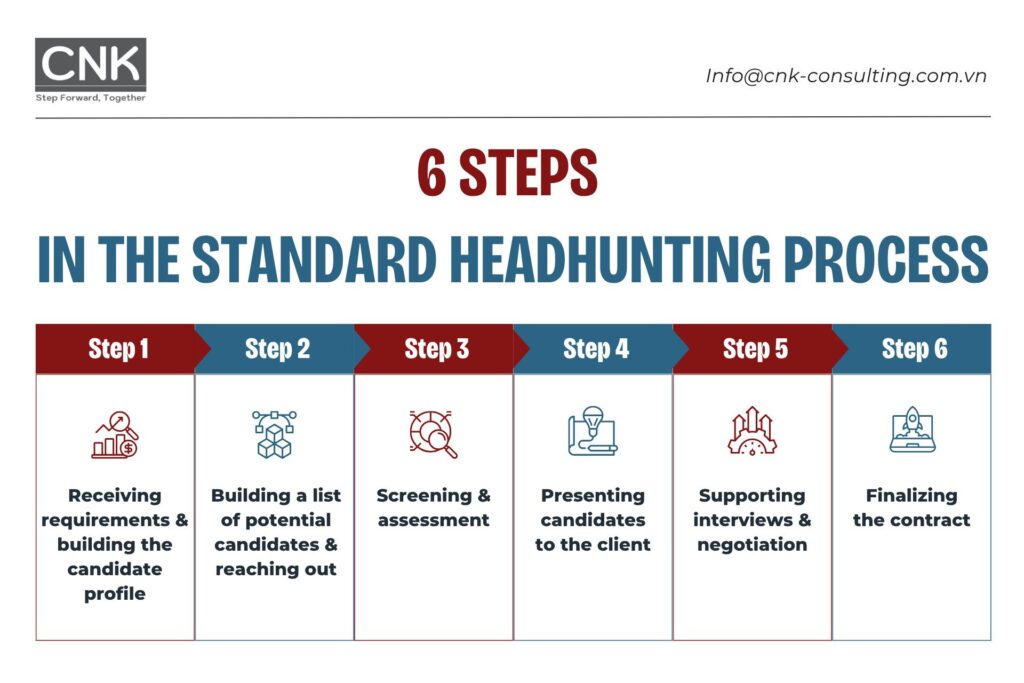
Step 1: Receiving requirements and building the candidate profile
The headhunter engages directly with the business to understand recruitment needs, organizational structure, corporate culture, and key criteria for the position. From there, they build an ideal candidate profile, including experience, skills, personality, and expected salary.
Step 2: Building a list of potential candidates and reaching out
Based on the analyzed requirements, the headhunter searches for candidates from various sources such as LinkedIn, professional networks, internal databases, or specialized industry groups. This stage requires strong market research skills and sharp talent-identification abilities.
Step 3: Screening and assessment
The headhunter conducts preliminary interviews and in-depth assessments to check the fit between the candidate’s capabilities and the job requirements. Beyond professional skills, they also consider cultural fit, career motivation, and potential for long-term commitment.
Step 4: Presenting candidates to the client
After thorough screening, the headhunter sends the CV along with detailed evaluation notes to the business so the client can select the most suitable candidate for the official interview round.
Step 5: Supporting interviews and negotiation
At this stage, the headhunter acts as an intermediary, helping arrange interview schedules, facilitating two-way feedback, and supporting salary and benefits negotiations between the candidate and the business to ensure both sides are satisfied.
Step 6: Finalizing the contract
After the candidate accepts the offer, the headhunter continues to monitor the onboarding process and job performance, ensuring stability over the 3-6-month period. Should a resignation risk arise during the warranty period, the headhunter will provide a replacement candidate according to the contract terms.
Distinguishing between headhunter and recruiter
Many people often confuse headhunters with recruiters, as both are involved in the recruitment process.
However, the nature of the work, scope of operation, and approach to candidates differ significantly between the two roles. Understanding this helps businesses choose the recruitment method that best fits their actual needs.
- Recruiter (In-house Recruiter): A person who directly handles the recruitment function within a business. They typically deal with candidates who actively submit applications through the company’s official recruitment channels. A recruiter’s work includes posting job ads, screening resumes, conducting basic interviews, and coordinating with departments to complete the hiring process.
- Headhunter: A talent hunter who searches for and approaches passive candidates (those who already have stable jobs and are not actively job hunting). They must proactively research, reach out to, and persuade suitable candidates to consider new opportunities. This requires refined communication skills, a deep understanding of the labor market, and the ability to build long-term relationships with senior personnel.
Distinguishing between executive search and regular headhunting
Both headhunting and executive search are outsourced recruitment services. However, executive search is considered a more specialized version of headhunting, focused on finding senior leaders and strategic personnel – positions that directly influence an organization’s development direction.
Differences in level and search strategy
While both aim to connect businesses with suitable talent, headhunting and executive search differ clearly in terms of position scope, level of specialization, and candidate approach:
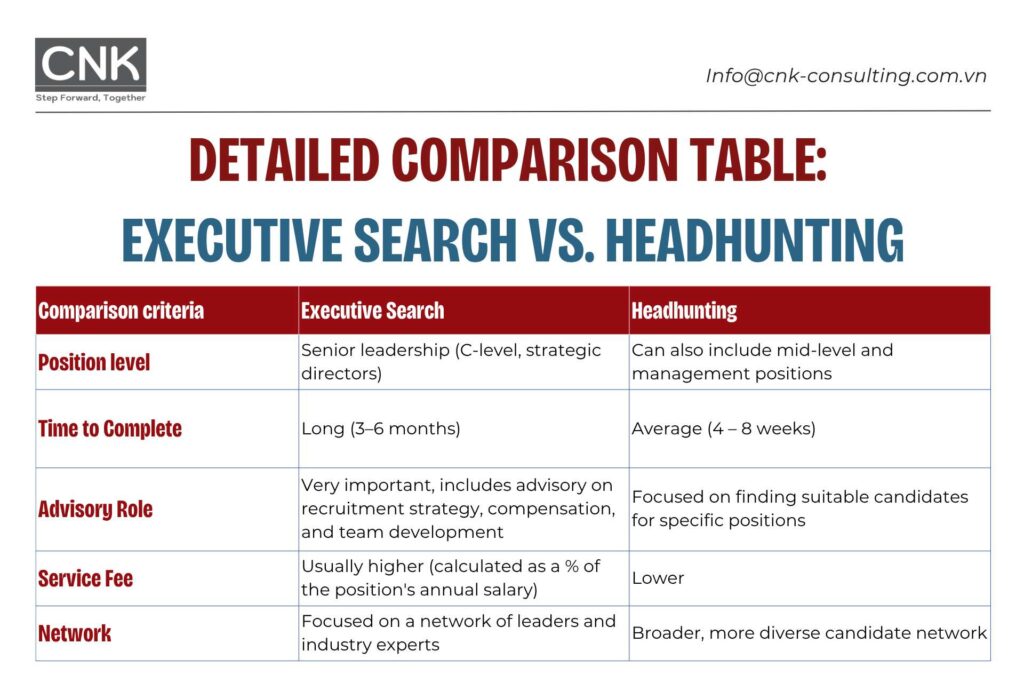
- Position level: Headhunting typically covers a wide range of personnel, from specialists and team leaders to middle managers. Executive search, on the other hand, focuses solely on senior-level positions such as CEO, CFO, COO, Director, or other strategic roles that directly impact a company’s direction and growth.
- Search strategy: Headhunters mainly use open recruitment channels, existing databases, or industry networks to find suitable candidates as quickly as possible. In contrast, the executive search process involves in-depth research, including talent market analysis, candidate mapping, and a comprehensive assessment of capability, leadership style, and cultural fit with the business.
- Advisory role: Executive search firms often act as strategic partners, not only “hunting” for people but also advising on organizational structure, succession planning, and long-term HR strategy for the business. Regular headhunting services, meanwhile, mainly focus on quickly filling positions based on specific requests.
Detailed comparison table: Executive Search vs. Headhunting
The comparison table below will help you clearly see these differences:
When should businesses use executive search vs. headhunting?
The choice between executive search and headhunting depends not only on budget but also on the position level, recruitment goals, and the degree of confidentiality the business requires.
Below is a guide to help businesses determine when to use each service:
Using executive search
Executive search services are ideal when a business needs to recruit senior leaders – those who play a role in shaping strategy and leading the entire organization.
A business should choose an executive search firm when:
- Recruiting senior leadership: The business needs to fill positions such as CEO, CFO, CIO, COO, executive director, or key functional directors. These are individuals who influence the company’s overall operations and strategy.
- Requiring absolute confidentiality: When replacing an incumbent leader or implementing an HR restructuring plan, the search must be conducted discreetly and professionally to avoid internal disruption or impact on shareholders, partners, and the market.
- Business expanding into new markets: When entering a new market, the business needs leaders with local experience who understand the local culture and market to lead the team effectively.
- Needing senior HR strategy consulting: Executive search goes beyond finding people – it also helps assess organizational structure, build succession plans, and shape long-term HR strategy for the business.
Use headhunting services
Regular headhunting services are suitable for mid-level management positions, senior specialists, or specific specialized roles, where the business needs speed, flexibility, and broader access to talent.
A business should choose headhunting when:
- Recruiting mid-level managers or specialists: Positions such as Sales Manager, Marketing Manager, HR Manager, Senior Developer, Data Engineer, etc., often require hands-on experience and high professional expertise that in-house HR may struggle to find.
- Urgent hiring needs: When the HR department is overloaded or needs to fill multiple positions at once, headhunting services help businesses significantly shorten the recruitment timeline.
- Positions with rare market skills: Certain roles, such as emerging technology engineers, financial experts, or data analysts, often lack active candidates, requiring a headhunting team to proactively “hunt” and connect with them.
- When a broad candidate network is needed: Headhunting companies have large databases and deep industry relationships, helping businesses quickly reach the right group of potential talent.
Top reputable headhunter/executive search companies in Vietnam
If your business is considering a partnership, here are some reputable names in the senior-level recruitment industry in Vietnam:
- CNK Consulting Vietnam: Although a newer player in the market, CNK Consulting Vietnam has quickly established its position thanks to a team of experienced experts with deep local market knowledge. The company has demonstrated outstanding capability by successfully searching for and connecting numerous C-level positions for large domestic and international corporations.
- Navigos Search: A firm with a broad network of mid-level and senior-level candidates in the market.
- Robert Walters Vietnam: An international group specializing in recruiting management-level personnel and senior specialists.
- Harvey Nash Vietnam: Strong in technology, engineering, and specialized management positions.
- Talentnet: A reputable local partner combining recruitment services with HR strategy consulting.
- HR2B/ManpowerGroup: International brands with strengths in large-scale headhunting and comprehensive HR services.
Conclude
Whether choosing executive search or headhunting, a business’s overall goal remains the same: finding the most suitable personnel for key positions.
Partnering with reputable executive search providers in Vietnam, such as CNK Consulting, helps businesses optimize their recruitment process, save time, and build a high-quality leadership team with long-term commitment to the organization.
CNK Consulting Vietnam
Trusted Senior-Level Recruitment Partner
Hotline: +84 369 882 579
Email: info@cnk-consulting.com.vn
Địa chỉ: 12BT.6 Thanh Binh Garden, 3 Nguyen Canh Di, Dinh Cong, Ha Noi, VietNam.
Nguồn tham khảo:
- HR News – Executive Search Trends in 2026: What Businesses Need to Know (The article analyzes how businesses are reshaping C-suite recruitment. Companies are now applying data analytics and AI to speed up the process, with digital transformation experts and technology-savvy leaders becoming the new gold standard).
- The Taplow Group – Global Executive Search for Business Growth: Strategies & More (Clarifying the role of global executive search firms, which not only fill vacant positions but also provide talent solutions aligned with corporate culture and governance).
- Hunt Scanlon Media: Why Executive Search is an Ideal First Career Choice for a New Generation (Explaining that the true nature of executive search lies in investment deals rather than simply job placement, typically involving retained contracts and high compensation).